
SHADOW PROTOCOLS | UK INTELLIGENCE | CYBERSECURITY | 31 OCTOBER 2026
Britain’s signals intelligence agency faces scrutiny over its handling of portable storage media, while a separate intelligence identification failure led to innocent people being stopped under counterterrorism powers.
By Open Chronicle
LONDON, United Kingdom | October 31, 2026
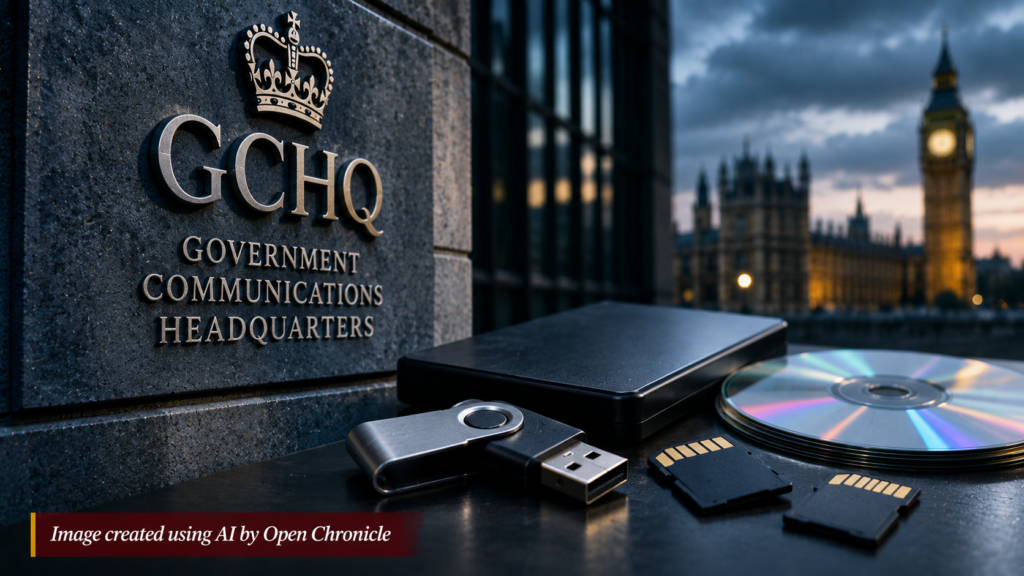
Britain’s Government Communications Headquarters (GCHQ) has come under scrutiny after an official intelligence watchdog disclosed that the agency could not adequately account for thousands of portable data storage devices, raising concerns about record keeping, information security and the protection of sensitive intelligence material.
The findings, published in the Investigatory Powers Commissioner’s Office (IPCO) annual report for 2025, concern USB memory sticks, external hard drives, compact discs, memory cards and other removable storage media used in the agency’s operations.
The watchdog expressed serious concern about the agency’s ability to establish the whereabouts and status of the devices, some of which may have been used to store information obtained through the United Kingdom’s extensive investigatory powers.
In a separate finding, the report revealed that an intelligence identification error had resulted in innocent individuals being wrongly associated with terrorism-related activity, leading to counterterrorism stops and the collection of personal information.
Together, the disclosures raise questions about two fundamental responsibilities of intelligence agencies: maintaining control over sensitive information and ensuring that intelligence assessments do not expose innocent people to unjustified investigative action.
Thousands of storage devices remain unaccounted for
According to IPCO, removable storage media are extensively used within GCHQ and remain an essential component of certain operational processes.
The agency estimated that the number of devices it could not adequately account for was in the thousands.
The report does not establish that every unaccounted device has been physically lost or stolen. Instead, it identifies deficiencies in the systems used to register, track and manage removable media.
That distinction is significant because incomplete inventory records can make it difficult to determine whether an item remains within a secure facility, has been transferred, has been destroyed or is genuinely missing.
Nevertheless, the watchdog said GCHQ had not yet developed a sufficiently reliable understanding of the problem.
Sir Brian Leveson, the Investigatory Powers Commissioner, said the agency had not established a clear picture of the scale, location or potential recovery of the unaccounted devices.
The commissioner also expressed disappointment over the length of time taken to investigate the matter, noting that concerns about the underlying management arrangements had first been raised several years earlier.
The prolonged nature of the issue has become a central element of the watchdog’s criticism.
An intelligence agency may possess strong technical security systems, but those protections can be weakened if the organization cannot accurately establish which physical storage devices exist, where they are located and who is responsible for them.
Potential implications for sensitive intelligence
Some of the storage devices may contain information acquired under the Investigatory Powers Act, the legislation governing a range of surveillance and intelligence collection activities in the United Kingdom.
The Act provides a legal framework for powers including the interception of communications, the acquisition of communications data and certain forms of equipment interference.
Depending on the authorization and operational context, information collected through these powers can include sensitive personal data and intelligence concerning individuals, organizations or communications networks.
The possibility that removable media could contain such material makes accurate inventory control particularly important.
However, the watchdog’s findings do not establish that the unaccounted devices contain classified information, that their contents have been compromised or that unauthorized individuals have obtained access to them.
No evidence of hostile acquisition is presented in the supplied account of the report.
The distinction between an inability to account for equipment and a confirmed security breach is essential to understanding the findings.
An incomplete inventory represents a control failure that requires investigation, but it does not by itself demonstrate that sensitive information has been disclosed.
GCHQ acknowledges weaknesses in tracking system
Responding to the findings, GCHQ acknowledged that its previous removable media management arrangements had not been sufficiently robust.
A spokesperson said the system had failed to provide effective tracking of items registered for operational use.
The agency characterized the issue primarily as a deficiency in inventory records and the reliability of information generated by the tracking system.
GCHQ said it had acted on the watchdog’s recommendations and introduced measures intended to address the identified weaknesses.
The spokesperson also emphasized that the agency maintained safeguards designed to reduce the risks associated with removable storage media.
According to the information accompanying the report, GCHQ subsequently conducted a comprehensive audit of the items it held and updated its management procedures and tools.
The agency also reportedly kept IPCO informed of its progress.
However, the publicly described findings do not establish whether the audit determined precisely how many devices were physically missing.
Nor do they provide a definitive breakdown of how many devices were recovered, destroyed, incorrectly registered or otherwise reconciled.
That leaves an important distinction between improvements to the management system and a complete accounting of the original discrepancies.
Watchdog questions pace of corrective action
One of the most significant aspects of the report is the commissioner’s concern that the problems had persisted despite having been identified years earlier.
IPCO’s criticism was directed not only at the underlying tracking deficiencies but also at the time taken to investigate their extent.
For organizations handling sensitive intelligence, inventory management is part of a wider security framework that includes access controls, audit records, retention rules and the secure disposal of equipment.
Removable storage devices can present particular challenges because they are portable, may be used across different systems and can contain substantial quantities of data.
Maintaining accurate records is therefore necessary to establish accountability throughout a device’s operational life.
The GCHQ case illustrates how administrative weaknesses can create security uncertainty even when there is no confirmed evidence of an external compromise.
The watchdog’s intervention also demonstrates the importance of independent oversight in identifying persistent problems that may not be visible outside intelligence organizations.
Separate intelligence error wrongly linked innocent people to terrorism
The annual report also disclosed a distinct incident involving inaccurate intelligence assessments.
According to IPCO, GCHQ incorrectly identified certain selectors, such as telephone numbers or online account identifiers, in a small number of cases.
These errors resulted in innocent members of the public being wrongly suspected of involvement in terrorism-related criminality.
The consequences extended beyond inaccurate intelligence records.
The watchdog reported that five counterterrorism stops at ports were connected to the misidentifications.
During these encounters, individuals were detained, data were downloaded from their electronic devices and biometric information was collected.
Such powers may be exercised at designated ports and border locations, including airports and international rail terminals, subject to the relevant legal framework.
The report did not provide the identities of those affected or a detailed account of each encounter.
It nevertheless confirmed that inaccurate intelligence had resulted in direct intervention against individuals who were not properly identified as terrorism suspects.
How an unusual software application disrupted intelligence analysis
The misidentifications were linked to the behaviour of a particular software application used by a relatively small section of the public.
IPCO did not name the application.
According to the report, the software operated in an unusual manner that undermined the reliability of GCHQ’s target discovery methodology.
Target discovery refers to intelligence processes used to identify previously unknown individuals or accounts that may be relevant to an investigation.
Such processes can involve examining communications data and relationships between digital identifiers.
In this case, the application reportedly produced conditions that GCHQ had not anticipated, causing the agency to associate certain identifiers with suspected terrorism-related activity incorrectly.
The report did not disclose the precise technical mechanism.
One possible explanation, discussed in the supplied reporting rather than confirmed by IPCO, involves software that routes communications through other users’ devices or network connections.
Under some circumstances, such arrangements could make activity originating from one person appear to be associated with another person’s device or connection.
However, the application and technical cause have not been publicly identified in the material provided, and no specific technology should be treated as responsible without additional evidence.
IPCO says error was not reasonably foreseeable
The watchdog adopted a different assessment of the intelligence identification incident from its criticism of the removable media tracking failures.
In the case of the incorrect selectors, IPCO concluded that GCHQ could not reasonably have anticipated the unusual behaviour of the software application.
The commissioner acknowledged the serious consequences for the individuals affected but recognized that intelligence assessments can sometimes be inaccurate despite reasonable precautions.
The report also stated that GCHQ acted to reduce the effects of the misidentifications once the problem became known.
That finding does not eliminate the consequences experienced by those stopped under counterterrorism powers.
It does, however, distinguish an unforeseen technical problem from a control deficiency that had remained unresolved over an extended period.
The distinction is important for assessing institutional responsibility.
An unexpected intelligence error may require technical improvements, revised analytical procedures and remedial action for affected individuals.
A longstanding inventory control problem raises additional questions about management, implementation of recommendations and the effectiveness of internal accountability.
GCHQ declined to provide further comment on the target discovery incident, according to the supplied reporting.
The challenge of intelligence oversight in a digital environment
The two findings highlight different vulnerabilities within modern intelligence operations.
The removable media issue concerns the physical and administrative control of devices that may hold sensitive information.
The misidentification incident concerns the reliability of digital intelligence analysis and the potential consequences of inaccurate conclusions.
Both demonstrate that advanced technical capabilities must be accompanied by effective procedures for accountability, verification and correction.
GCHQ is one of the United Kingdom’s principal intelligence organizations, specializing in signals intelligence and cybersecurity.
Its work includes supporting national security operations, identifying hostile cyber activity and providing intelligence to the British government.
Much of that work necessarily takes place outside public view, making independent oversight particularly important.
IPCO is responsible for overseeing the use of investigatory powers by intelligence agencies, law enforcement bodies and other authorized public authorities.
Its annual reports provide one of the principal mechanisms through which Parliament and the public can examine how surveillance powers are exercised and whether the organizations using them comply with applicable safeguards.
The latest disclosures illustrate the role of that oversight in identifying operational weaknesses while distinguishing between preventable management deficiencies and unforeseen technical errors.
Questions remain over accountability and remediation
Despite GCHQ’s assurances that it has improved its removable media management arrangements, several questions remain unanswered in the publicly described findings.
The most important is whether the agency has now established a reliable inventory of the devices previously recorded as unaccounted for.
A related question concerns the classification and sensitivity of any information stored on devices that cannot be located.
The report does not establish whether all potentially affected media were encrypted or otherwise protected against unauthorized access.
Nor does the available information clarify whether further investigation identified evidence of actual data exposure.
In the separate intelligence identification case, questions remain about the safeguards introduced to prevent similar technical misunderstandings and the measures taken to address the consequences for those wrongly stopped.
The report indicates that GCHQ acted after discovering the problem, but the supplied account does not specify whether affected individuals received formal notification, correction of their records or other remedies.
These issues are relevant to assessing the effectiveness of the agency’s response, although their absence from the available account should not be interpreted as evidence that no remedial action occurred.
A test of institutional accountability
The findings present GCHQ with two distinct challenges.
The first is demonstrating that its systems can accurately track and safeguard removable storage media throughout their operational use.
The second is ensuring that intelligence derived from digital identifiers is sufficiently reliable before it contributes to decisions affecting individuals.
Both are central to maintaining public confidence in the lawful exercise of intelligence powers.
The watchdog’s report does not suggest that thousands of devices have been stolen, nor does it establish that sensitive information has reached hostile actors.
It does, however, identify a significant weakness in GCHQ’s ability to account for equipment used in sensitive operations.
The separate target discovery incident shows how an unforeseen technical characteristic of software can produce consequences for innocent individuals when intelligence assessments are translated into enforcement action.
For Britain’s intelligence oversight system, the central issue is whether identified problems lead to measurable improvements and whether those improvements can be independently assessed.
For GCHQ, the challenge is to demonstrate that its operational capabilities are matched by equally robust standards of information management, analytical accuracy and accountability.
Sources and Further Reading
The following official sources provide the documentary and institutional background for this article, including intelligence oversight, information security and the legal framework governing investigatory powers in the United Kingdom.
01. Investigatory Powers Commissioner’s Office (IPCO), Annual Report 2025
Official Annual Report | Primary Documentary Source
The primary official source for the findings concerning removable storage media, intelligence identification errors and oversight of investigatory powers.
Read the IPCO Annual Report 2025 (PDF) →
ipco.org.uk | Official PDF
02. Investigatory Powers Commissioner’s Office
Official Oversight Authority | Institutional Reference
Institutional information about the commissioner’s oversight responsibilities and the framework governing investigatory powers.
Visit the Investigatory Powers Commissioner’s Office →
ipco.org.uk
03. Government Communications Headquarters (GCHQ)
UK Intelligence Agency | Institutional Reference
Official institutional information concerning Britain’s signals intelligence and cybersecurity agency.
gchq.gov.uk
04. UK Legislation, Investigatory Powers Act 2016
United Kingdom Legislation | Legal Framework
The statutory framework governing interception, communications data, equipment interference and related investigatory powers.
Read the Investigatory Powers Act 2016 →
legislation.gov.uk
Editorial Note
This article was prepared on October 31, 2026, using the supplied reporting concerning the Investigatory Powers Commissioner’s Office Annual Report 2025.
The article distinguishes between removable media that cannot be accounted for in inventory records and devices confirmed to have been physically lost or stolen. The available information does not establish that sensitive intelligence has been compromised or accessed by unauthorized parties.
The separate incident involving incorrect intelligence identifiers is presented according to the watchdog’s reported findings, including its assessment that the technical problem could not reasonably have been anticipated.
The primary report was linked but could not be retrieved for independent examination during preparation. Its specific findings and quotations should therefore be checked against the original document before publication.