
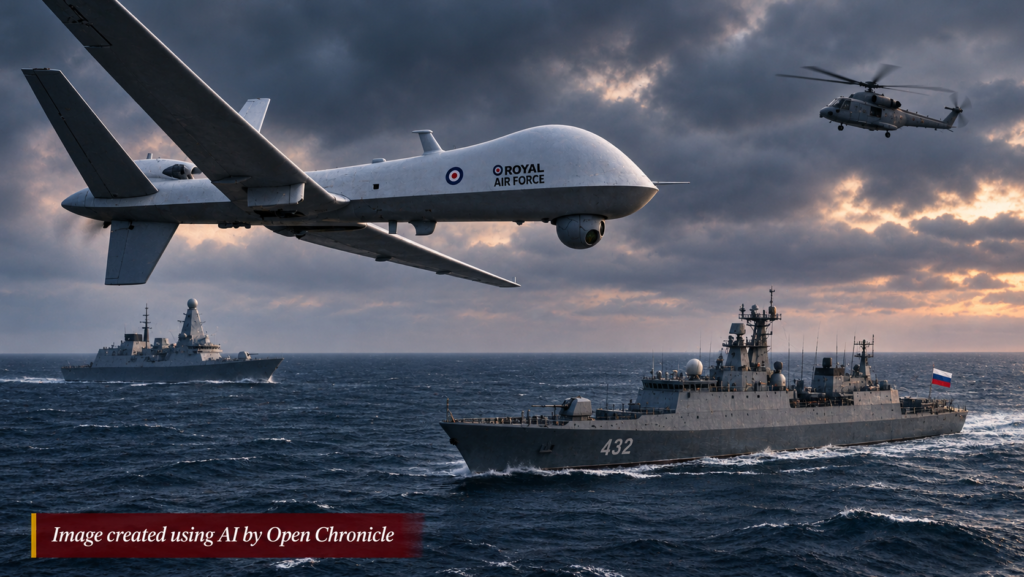
The Royal Air Force’s new surveillance capability has joined Royal Navy operations in the English Channel as Britain strengthens maritime monitoring amid growing concerns over Russian naval activity, underwater infrastructure and potential drone threats.
By Open Chronicle with Agencies
LONDON, United Kingdom | October 31, 2026
The Royal Air Force has deployed its Protector RG1 remotely piloted aircraft to monitor Russian naval activity near British waters for the first time, marking a significant development in the United Kingdom’s efforts to strengthen maritime surveillance and respond to security threats around its coastline.
According to information released by the British Ministry of Defence, an unarmed Protector RG1 conducted a surveillance mission over the English Channel during October, working alongside Royal Navy warships and helicopters as they monitored the movements of a Russian warship.
The aircraft provided more than ten hours of intelligence, surveillance and reconnaissance coverage, extending the military’s ability to observe naval movements over a prolonged period.
The deployment comes as British defence officials and military analysts warn that Russian maritime operations pose increasingly complex challenges, ranging from the surveillance of critical underwater infrastructure to the potential use of unmanned aircraft launched from vessels operating near the United Kingdom.
The operation also highlights the growing importance of remotely piloted aircraft in Britain’s maritime security strategy, particularly as the armed forces seek to maintain persistent surveillance across extensive areas of sea and coastline.
A new surveillance capability enters British maritime operations
The Protector RG1 represents a new generation of remotely piloted aircraft for the Royal Air Force.
Designed for long endurance missions, the aircraft can remain airborne for extended periods while carrying advanced sensors capable of supporting intelligence gathering, surveillance and reconnaissance operations.
Its deployment over the English Channel demonstrates how remotely piloted systems can complement traditional maritime patrol aircraft, surface warships and helicopters.
During the reported mission, the Protector operated without weapons, performing an intelligence collection and observation role rather than a combat function.
The Ministry of Defence said the aircraft provided more than ten hours of surveillance support while Royal Navy assets tracked a Russian warship.
This type of cooperation allows different military platforms to contribute to a shared understanding of maritime activity.
Warships can maintain a physical presence near vessels of interest, helicopters can conduct more localized investigations, and long endurance aircraft can provide wider surveillance coverage.
The addition of the Protector potentially reduces some of the pressure on crewed aircraft while expanding the amount of time that British forces can monitor maritime movements.
The mission is particularly significant because it represents the aircraft’s first reported participation in this type of operation alongside Royal Navy units monitoring Russian activity around British shores.
Royal Navy increases monitoring of Russian vessels
British officials also reported an increase in Royal Navy activity directed at monitoring Russian vessels.
According to the figures provided by the Ministry of Defence, the Navy’s monitoring operations increased by 25 percent during the first seven months of 2026 compared with the equivalent period in 2025.
The figure reflects a higher level of operational attention to Russian maritime movements, although the information provided does not establish whether the increase represents additional Russian deployments, changes in British monitoring priorities or a combination of factors.
Russian naval vessels regularly operate in waters around the British Isles and along maritime routes connecting the Atlantic Ocean, North Sea and English Channel.
The presence of Russian military vessels in international waters is not inherently unlawful. However, their movements can attract heightened scrutiny when they occur near sensitive infrastructure or coincide with broader military tensions.
Britain has maintained extensive military support for Ukraine since Russia’s full scale invasion in February 2022, placing the United Kingdom among Moscow’s most prominent European opponents.
The relationship has become increasingly confrontational as both countries assess each other’s military capabilities, intelligence activities and strategic intentions.
Against that background, British authorities regard the ability to identify, track and assess Russian naval movements as an important element of national defence.
Underwater cables become a growing security concern
One of the principal concerns identified in the supplied reporting involves the security of critical underwater infrastructure.
Submarine communications cables carry large volumes of international digital traffic, while underwater energy infrastructure supports electricity transmission and offshore operations.
Damage to these systems can have consequences extending beyond the immediate maritime area.
British officials have expressed concern about Russian vessels operating near strategically important seabed infrastructure, including cables connecting the United Kingdom with other countries.
The Ministry of Defence has reportedly allocated an additional £330 million over four years to improve seabed monitoring and surveillance and develop advanced capabilities for detecting and responding to underwater threats.
The investment reflects a broader recognition that maritime security now extends beyond the protection of shipping routes and territorial waters.
Underwater cables, pipelines and other installations are increasingly regarded as essential components of national resilience.
Monitoring vessels that operate near such infrastructure can help authorities identify unusual activity and investigate potential threats.
However, the presence of a vessel near an underwater cable does not by itself establish hostile intent.
Determining whether a particular ship is engaged in legitimate navigation, scientific activity, intelligence collection or preparations for sabotage requires additional evidence.
The reported surveillance measures are intended to improve Britain’s ability to make those assessments.
Military experts warn of drones launched from ships
The Protector deployment has also prompted discussion of another potential threat: the use of ships as launch platforms for unmanned aircraft.
A senior military source quoted in the supplied reporting warned that a vessel operating near the British coastline could potentially launch drones capable of reaching targets on land within a short period.
Such a scenario could involve attacks against infrastructure, military installations or other strategically important locations.
The warning reflects concerns about the growing accessibility and operational flexibility of unmanned aerial systems.
Relatively small drones can be transported aboard vessels, launched without the infrastructure required by conventional aircraft and directed toward targets over comparatively short distances.
A coordinated launch involving multiple aircraft could complicate defensive responses, particularly if the drones approached from unexpected directions or operated at low altitude.
However, the source’s comments describe a potential attack scenario rather than a confirmed Russian operational plan against the United Kingdom.
The supplied information does not establish that Russian naval vessels near British waters have been preparing to launch such an attack.
Nevertheless, the possibility has become part of a wider debate over how Britain should protect its coastline and critical infrastructure against emerging forms of warfare.
Early warning systems seen as essential
Military analysts argue that the effectiveness of counterdrone defences depends heavily on detecting threats before they reach their intended targets.
Tim Ripley, a senior analyst at Defence Eye, emphasized the importance of maritime and aerial monitoring in identifying vessels that might pose a threat.
According to Ripley, Britain’s armed forces possess several capabilities for countering small drones, but these systems require sufficient warning to be deployed in the appropriate locations.
That warning could come from a combination of maritime patrols, aircraft surveillance, radar systems and intelligence assessments.
One particular concern involves vessels that deactivate their Automatic Identification System, commonly known as AIS.
AIS transmits information such as a vessel’s identity, position, course and speed, helping maritime authorities and other ships maintain awareness of traffic.
Switching off AIS can reduce a vessel’s visibility to systems that rely on those transmissions, although it does not make a ship invisible to radar or other military sensors.
There are legitimate circumstances in which AIS transmissions may be unavailable or disabled, so the absence of a signal is not conclusive evidence of hostile activity.
Nevertheless, military analysts consider such behaviour one of several factors that may warrant closer investigation.
Ripley argued that identifying potentially threatening vessels early would allow aviation assets and ground based countermeasures to prepare a coordinated response.
The Protector’s ability to remain airborne for extended periods could contribute to that early warning network.
Britain’s counterdrone capabilities under scrutiny
The reported developments also highlight the challenge of defending against increasingly diverse unmanned aerial threats.
Britain’s armed forces employ a range of systems intended to detect, track and defeat drones, including radar, electronic warfare equipment and weapons mounted on aircraft or naval platforms.
The Royal Navy’s Wildcat helicopter is among the platforms capable of contributing to maritime security operations.
Depending on its configuration and available weapons, the helicopter can support the identification and engagement of aerial or surface threats.
The supplied reporting identifies armed Wildcat helicopters as one possible response to hostile drone activity.
However, the effectiveness of any particular counterdrone system depends on the circumstances of an attack, including the number of drones, their speed, altitude, electronic characteristics and the available warning time.
Defending against a large group of drones may require several complementary systems rather than reliance on a single aircraft or weapon.
The broader challenge is therefore not simply developing methods to destroy hostile drones.
It also involves creating a surveillance and command network capable of identifying threats, determining their nature and coordinating a timely response.
The introduction of additional remotely piloted surveillance aircraft may contribute to that objective by improving situational awareness before an incident develops.
Defence spending debate intensifies
The operation comes amid continued debate over the adequacy of British defence spending and the resources available to respond to threats from Russia.
Military figures quoted in the supplied reporting argued that Britain needs more aircraft in the air and additional naval assets at sea to maintain an effective surveillance presence.
Their concerns focus on readiness, the availability of operational platforms and the time required to respond to unexpected incidents.
The debate is particularly relevant because the United Kingdom faces competing defence priorities.
These include supporting Ukraine, maintaining NATO commitments, protecting the North Atlantic, modernizing military equipment and strengthening domestic security.
Increasing surveillance activity can place additional demands on personnel, maintenance budgets and equipment availability.
Long endurance remotely piloted aircraft may help address some of these pressures, but they also require trained operators, communications infrastructure, technical support and integration with other military systems.
The decision to deploy Protector in maritime surveillance therefore represents both a technological development and a practical test of how the RAF and Royal Navy can share operational responsibilities.
Some critics of the Labour government have argued that defence investment is not keeping pace with emerging threats.
Those criticisms form part of the political debate over military readiness and should be distinguished from the Ministry of Defence’s confirmed description of the Protector operation.
Defence Secretary highlights innovation and deterrence
Defence Secretary Wes Streeting welcomed the deployment as evidence of Britain’s efforts to adapt its military capabilities to changing security requirements.
In the statement supplied for this article, Streeting said the Protector had joined Royal Navy warships and helicopters monitoring activity around British shores for the first time.
He presented the operation as an example of innovation intended to strengthen monitoring and deter threatening or provocative behaviour.
Streeting’s position as Defence Secretary is independently confirmed by the British government’s official ministerial record.
GOV.UK
The deployment follows other Royal Navy operations involving Russian military vessels and ships associated with Moscow’s shadow fleet.
In August, the Royal Navy reported that HMS Duncan, HMS St Albans and HMS Severn had monitored Russian naval and cargo vessels during a 72 hour operation in the North Sea and English Channel.
The Navy also reported that monitoring activations had increased by 25 percent during the first eight months of 2026 compared with the equivalent period in 2025.
royalnavy.mod.uk
A changing maritime security environment
The use of Protector for maritime surveillance reflects a wider shift in military operations, with unmanned aircraft increasingly supporting traditional naval and air forces.
For Britain, the immediate advantage is the ability to maintain observation of vessels over extended periods while combining information from multiple military platforms.
The longer term implications extend to protecting underwater infrastructure, monitoring unusual maritime activity and developing early warning capabilities against potential airborne threats.
The emergence of ship launched drones as a possible security concern adds another dimension to maritime defence planning.
Although the supplied reporting does not identify evidence of an imminent Russian drone attack against Britain, military specialists argue that the possibility warrants preparation.
The challenge for British defence planners is to balance those emerging risks against existing operational commitments and limited military resources.
The Protector deployment represents one step in that process.
As Russian naval movements continue to attract scrutiny around the British Isles, the integration of remotely piloted aircraft with Royal Navy operations is likely to become an increasingly important component of Britain’s maritime surveillance capability.
Sources and Further Reading
The following official and journalistic sources provide the documentary background for this article, including British maritime surveillance operations, Russian naval activity and the deployment of the RAF Protector aircraft.
01. UK Ministry of Defence, UK Armed Forces Step Up Monitoring of Increased Russian Activity in UK Waters
August 8, 2026 | Official Government Announcement
Official announcement confirming a 25 percent increase in Royal Navy monitoring activations during the first seven months of the year.
Read the Ministry of Defence announcement →
gov.uk
02. Royal Navy, Royal Navy Monitors Russian Warships and Shadow Fleet Activity in UK Waters
August 29, 2026 | Official Naval Operations Report
Official operational account documenting Royal Navy surveillance missions and updated activity figures concerning Russian warships and vessels associated with the shadow fleet.
Read the Royal Navy operational report →
royalnavy.mod.uk
03. The Telegraph, Drone and Warship Sent to Monitor Russian Navy Vessel Near Wind Farms
October 23, 2026 | Independent News Reporting
Reporting describing a Protector deployment to monitor Russian naval movements near offshore infrastructure, including wind farms.
Read the report reproduced by AOL →
aol.co.uk
04. UK Government, Secretary of State for Defence
Official Government Record | Ministerial Responsibilities
Official government information concerning the appointment and responsibilities of Wes Streeting as Secretary of State for Defence.
Consult the official government record →
gov.uk
Editorial Note
This article was prepared on October 31, 2026, using the supplied reporting and additional publicly available information from the British Ministry of Defence, Royal Navy and UK government.
Official sources independently confirm increased Royal Navy monitoring of Russian maritime activity and establish the wider operational context. Reporting published on October 23 also documents the use of a Protector aircraft to monitor Russian vessels near offshore infrastructure.
The precise claim that the latest operation provided more than ten hours of surveillance, along with the quoted ministerial statement, is based on the material supplied for this article and has not been independently confirmed against the original Ministry of Defence announcement.
Statements concerning possible drone attacks launched from Russian vessels are presented as military assessments and hypothetical scenarios, not as evidence of a confirmed attack plan.