
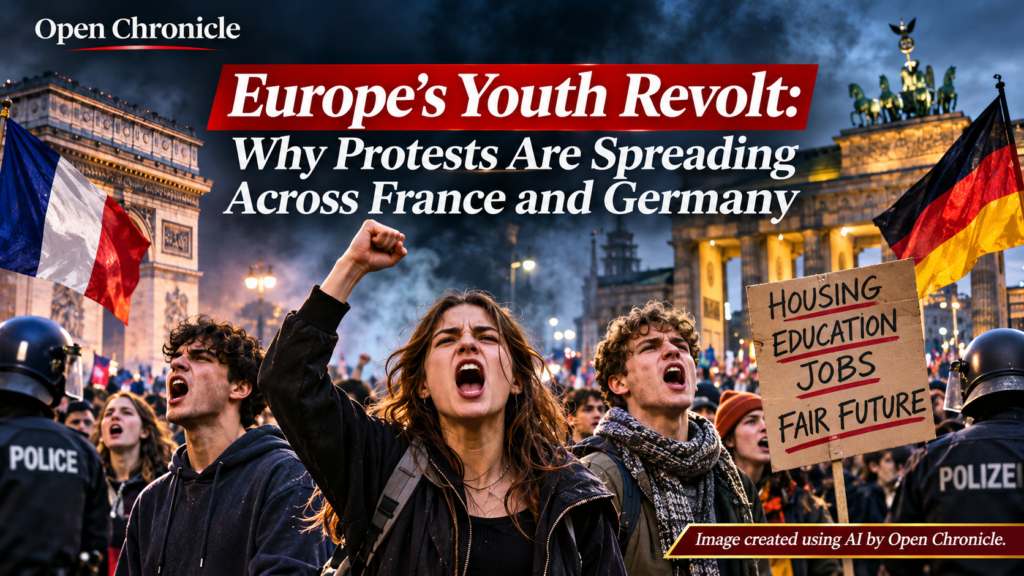
Economic insecurity, housing costs and disputes over government policy are fuelling youth discontent across Europe. Reports of unrest in France and Germany have renewed questions about whether established political institutions are responding to the pressures facing younger generations.
By Open Chronicle
EUROPE | November 1, 2026
A new wave of youth demonstrations has placed European governments under pressure, with France and Germany emerging as focal points of growing frustration over living costs, economic insecurity and political priorities.
Reports of confrontations between police and demonstrators, including allegations of looting in Frankfurt and renewed unrest in several French cities, have brought attention to the increasingly visible role of younger generations in European protest movements.
But the demonstrations cannot be understood simply as a series of public order incidents.
Behind the images of crowds, police lines and damaged property lies a broader debate about whether Europe’s economic and political systems are providing younger citizens with realistic opportunities for financial independence, affordable housing and long term stability.
The immediate causes of demonstrations differ between countries. In Germany, reported grievances include living costs, education spending and military service. In France, dissatisfaction with economic policy and government priorities has contributed to recurring mobilization.
Although some commentators have described the developments as a continent wide revolt led by Generation Z, there is not yet sufficient evidence to establish that the various demonstrations constitute a single coordinated movement.
What they do reveal is the political importance of a generation increasingly willing to challenge established institutions in public.
Germany: A Nationwide Protest Movement
Demonstrations across 34 cities
The latest German demonstrations were organized by a campaign known as Gen Z regelt, a phrase meaning roughly “Gen Z takes charge.”
Protests took place on October 31 in 34 cities, including Berlin, Frankfurt and Munich.
The campaign called for greater investment in schools, universities, healthcare and social services, alongside measures to reduce living costs.
It also opposed proposals to revive compulsory military service.
Germany is confronting several competing pressures, including sluggish economic growth, an ageing population, demands for greater defence spending and growing financial strains on public services.
For many young demonstrators, those pressures have raised concerns that decisions taken today will leave future generations facing greater obligations without corresponding improvements in their living standards.
The size of the demonstrations remains disputed.
Organizers initially anticipated as many as 182,000 participants, but police estimates in several major cities were substantially lower.
Reuters reported that turnout figures in Frankfurt, Munich and Berlin collectively reached approximately 18,000, compared with roughly 36,000 claimed by organizers for those cities. The campaign subsequently claimed more than 100,000 participants nationally, although a consolidated police figure was not immediately available.
Frankfurt: Peaceful demonstrations followed by rioting
The most serious disturbances occurred in Frankfurt, Germany’s financial centre.
After largely peaceful demonstrations during the day, groups of rioters damaged shopfronts and looted businesses in the city centre.
Police closed sections of the Zeil shopping district and surrounding areas as officers attempted to contain the disorder.
According to German regional broadcaster Hessenschau, approximately 30 people were detained, while officers checked the identities of a larger group during the night.
Reports also described attacks on emergency services involving bottles, stones and incendiary devices.
The disturbances continued into the early hours of November 1 before the situation became calmer.
German Interior Minister Alexander Dobrindt called for severe penalties against those responsible and praised police efforts to prevent more extensive violence.
He also alleged that extremist groups had exploited otherwise peaceful demonstrations. Those accusations require evidence linking specific individuals or organizations to the incidents.
The distinction matters because participation in a lawful demonstration does not establish involvement in subsequent violence.
Military service becomes a political flashpoint
One of the defining characteristics of the German demonstrations is opposition to compulsory military service.
Germany’s debate over military recruitment has intensified as European governments reassess their defence requirements in response to the war in Ukraine and concerns about regional security.
For some young people, the possibility of mandatory service raises questions about personal freedom, educational plans and the distribution of national responsibilities.
Supporters of stronger military recruitment argue that European security requires credible armed forces and sufficient personnel.
Opponents contend that young people should not bear a disproportionate share of the burden, particularly while education and social services face financial pressure.
The demonstrations reveal how national security policy can become closely connected to broader debates about economic fairness.
France: A Third Weekend of Mobilization
Economic grievances bring protesters back to the streets
France experienced its third consecutive weekend of major demonstrations on October 31.
The protests were driven by dissatisfaction with living costs, strained public services and education, attracting young participants alongside trade unions and other groups critical of President Emmanuel Macron’s leadership.
Large crowds marched through Paris, while demonstrations also took place in other French cities.
Reuters reported that the principal marches were largely peaceful before confrontations developed between smaller groups and police toward the end of some events.
In Paris, riot police dispersed groups involved in disturbances. Police also used tear gas in Lyon and Toulouse, while tensions were reported in Marseille.
The protests followed more serious violence on October 17, when rioting and looting caused substantial damage to businesses and public property.
French authorities have therefore faced the challenge of allowing peaceful political expression while preventing further attacks on people and property.
More than 560 arrests reported
Reporting published on November 1 indicated that French authorities had arrested more than 560 people during the latest period of unrest.
The figure relates to the reported nationwide disturbances and should not be interpreted as the number of people involved in violence or as evidence that the demonstrations were predominantly violent.
Police imposed restrictions in parts of Paris ahead of Halloween night, including limitations on access to certain areas and additional measures concerning unaccompanied minors.
Despite these precautions, most demonstrators participated peacefully.
The contrast between large peaceful gatherings and smaller outbreaks of violence has become a central feature of the political debate surrounding the protests.
Why Are Young Europeans Protesting?
The cost of becoming independent
Although the French and German movements have different political contexts, their economic concerns overlap.
Young adults face difficulties securing affordable accommodation, entering stable employment and planning financially independent lives.
Even where employment opportunities exist, the relationship between earnings and essential expenses can leave younger households with limited disposable income.
Housing is particularly important because it affects decisions about education, employment, family formation and geographical mobility.
A generation that believes it must work longer or accept greater financial insecurity to achieve the living standards of its predecessors may become increasingly sceptical of established economic arrangements.
These concerns help explain why protests about education or government spending can expand into wider debates about social fairness.
Education and public services
Investment in education has emerged as another central demand.
German demonstrators have criticized the condition of schools and universities, arguing that insufficient resources threaten educational quality.
Similar concerns have featured in France, where students and other participants have linked education to broader dissatisfaction with public services.
For governments, the challenge involves balancing immediate budget constraints against the longer term benefits of investing in skills, infrastructure and social mobility.
For younger citizens, cuts affecting education can appear especially consequential because their effects may extend throughout an individual’s working life.
Defence spending and competing priorities
The German protests also demonstrate how defence policy has become part of the wider economic argument.
European governments face pressure to strengthen military capabilities, but increased defence expenditure competes with other public spending priorities.
That competition does not necessarily mean defence investment and social investment are mutually exclusive.
It does, however, create difficult choices for governments operating under fiscal constraints.
When young people perceive those choices as unfair, defence policy can become a focus of political mobilization.
Is Generation Z Becoming a New Political Force?
The phrase Generation Z generally refers to people born from the late 1990s through the early 2010s, although definitions vary.
Its growing visibility in political reporting reflects the influence of younger activists who use digital platforms to organize demonstrations, distribute information and challenge political narratives.
Social media can accelerate mobilization by allowing campaign messages to circulate beyond established political organizations.
However, online visibility does not automatically translate into unified political objectives.
The German campaign has attracted a broad mixture of political and civil society groups, and questions have been raised about its organizational leadership.
Germany’s national school student umbrella organization, BSK, has distanced itself from Gen Z regelt and announced plans for a separate protest on November 20.
This suggests that the emerging youth protest landscape is diverse rather than politically uniform.
Some participants are primarily concerned with education. Others focus on housing, environmental policy, public spending or military service.
Their shared characteristic is not necessarily a common ideology, but a belief that existing political arrangements are failing to address important concerns about the future.
Beyond France and Germany
Portugal’s housing protests
The wider European context includes demonstrations over housing affordability in Portugal.
Thousands of people gathered in Lisbon on October 31 to protest the housing crisis, carrying signs demanding affordable accommodation and government action.
The demonstration was reported as peaceful in international coverage of the weekend’s European protests.
Portugal’s housing debate reflects concerns familiar in other European countries, particularly the difficulties younger residents face when attempting to rent or purchase homes in major urban centres.
Although the Portuguese demonstrations were not necessarily organized by the same groups as those in France or Germany, they illustrate the geographical reach of concerns about economic opportunity.
The Netherlands and other European countries
Authorities in the Netherlands also increased their security presence following online calls for demonstrations and concerns about possible disorder.
In The Hague, police monitored central shopping areas, although major disturbances had not been reported during the period covered by the initial accounts.
Elsewhere, student activism in Serbia has demonstrated how younger generations can influence political developments through sustained mobilization.
These examples should not be treated as evidence of a centrally coordinated European protest campaign.
Instead, they suggest that comparable grievances are emerging within different national political environments.
The Political Challenge for European Governments
European leaders now face a difficult balancing act.
They must respond to public concerns about living standards and government priorities while maintaining public safety and protecting democratic freedoms.
Heavy police intervention can become politically controversial if peaceful demonstrators believe they are being treated unfairly.
At the same time, authorities have a responsibility to investigate looting, attacks on emergency personnel and other criminal acts.
The credibility of government responses will depend partly on whether officials distinguish between lawful protest, isolated violence and organized criminal activity.
Political dialogue may also prove important.
Demonstrations can draw attention to problems, but lasting solutions require decisions concerning housing supply, education funding, employment conditions, public finances and social protection.
These issues are complex and cannot be resolved through policing alone.
What Happens Next?
Further demonstrations are expected as organizers assess the response to the latest mobilization.
In Germany, November 20 has emerged as a date for additional student activism, although different organizations are planning separate initiatives.
French authorities will be watching whether demonstrations continue into another weekend and whether measures to prevent violence prove effective.
The longer term political significance will depend on whether youth mobilization produces sustained organizations, influences government policy or changes electoral behaviour.
For now, the events in France and Germany have demonstrated that younger citizens can mobilize substantial attention around economic and social concerns.
They have also revealed the risks of escalation when peaceful political gatherings become associated with violent disturbances.
Europe’s youth protest movements are not a single political force, and their demands cannot be reduced to one slogan.
Nevertheless, their emergence presents European governments with a question that extends well beyond the latest demonstrations:
Can political institutions offer younger generations a credible prospect of greater economic security, opportunity and influence over the decisions shaping their future?
Sources and Further Reading
The following reports provide the factual foundation for this article. The analysis of generational concerns and political implications is Open Chronicle’s editorial interpretation.
1. Reuters | Rioters Loot Stores in Frankfurt as Gen Z Protests in Germany Turn Violent
October 31, 2026
Reporting on demonstrations in 34 German cities, campaign demands, turnout estimates and the disturbances in Frankfurt.
2. Reuters | Isolated Clashes in France After Peaceful Marches
October 31, 2026
Reporting on the third weekend of French demonstrations, economic grievances, police operations and incidents in Paris, Lyon, Toulouse and Marseille.
3. Hessenschau | Thirty Arrests and Shops Looted During Frankfurt Disturbances
November 1, 2026
German regional reporting on police operations, arrests, property damage and the restoration of order in Frankfurt.
4. ABC News Australia | Third Weekend of Protests in France as Youth Rallies Sweep Europe
November 1, 2026
International reporting covering France, Germany, Portugal and the Netherlands, including demonstrations, arrests and public order developments.
5. Anadolu Agency | German Students Hold Nationwide Rallies Against Welfare Cuts and Conscription
November 1, 2026
Coverage of student demands, opposition to military service and demonstrations in Berlin and other German cities.
6. Reuters | Germany’s Dobrindt Calls for Tough Penalties After Frankfurt Unrest
November 1, 2026
Reporting on the German interior minister’s response, police action and allegations concerning extremist involvement.
Editorial Note
This article was prepared by Open Chronicle on November 1, 2026, using reporting from Reuters, German regional media, Anadolu Agency and ABC News Australia.
The demonstrations in France and Germany, the disturbances in Frankfurt and the reported police operations have been corroborated through multiple published accounts.
Attendance estimates differ between organizers and police. Arrest figures reflect the reporting available at the time and may change as authorities release updated information.
The article distinguishes between peaceful participants, individuals involved in violence and allegations concerning extremist organizations. Responsibility for criminal acts should not be attributed to an entire protest movement.
The description of a wider European youth revolt is an editorial framing of related but distinct national developments. It does not imply the existence of a single organization directing protests across Europe.