
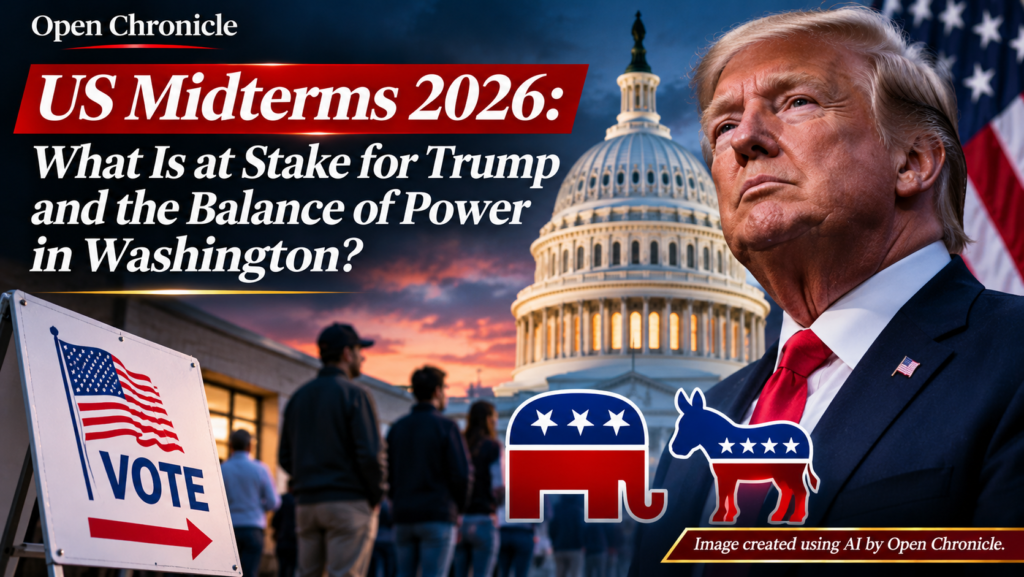
With Americans preparing to vote on November 3, the midterm elections will determine control of Congress and shape the final two years of President Donald Trump’s second term. The consequences could extend from taxation and immigration to foreign policy, congressional investigations and the next presidential election.
By Open Chronicle
WASHINGTON, November 1, 2026
The United States is approaching one of the most consequential political tests of Donald Trump’s second presidency.
On Tuesday, November 3, American voters will elect a new House of Representatives, decide a series of Senate contests and choose governors and other state officials across the country.
The elections will not determine who occupies the White House. Trump remains president regardless of the congressional results.
They will, however, decide how much political freedom his administration enjoys during the remaining two years of its term.
For Republicans, retaining control of Congress would preserve important opportunities to advance the president’s legislative agenda, approve appointments and defend administration priorities.
For Democrats, gaining control of either chamber would create new possibilities to challenge the White House, conduct oversight investigations and influence negotiations over federal spending.
A divided Congress could produce legislative gridlock, but it could also force both parties to negotiate over issues that neither can resolve alone.
Beyond the immediate contest for power, the results will offer a nationwide assessment of Trump’s leadership and provide an early indication of the political environment heading into the 2028 presidential election.
The Numbers Behind the Election
House seats contested
Entire voting membership
Senate seats contested
33 regular, 2 special elections
Republican Senate seats
Before Election Day
Early votes reported
As of November 1
Figures from US election authorities, the European Parliamentary Research Service and Reuters.
The House of Representatives: The Most Immediate Threat to Republican Control
The House is where Democrats appear to have their clearest opportunity to change the balance of power.
All 435 voting seats are being contested. Republicans enter Election Day with a narrow majority, making relatively small shifts in competitive districts potentially decisive.
The House majority matters because it determines which party controls the chamber’s leadership, committee chairmanships and legislative agenda.
If Republicans retain control, Speaker Mike Johnson and his party would be positioned to continue advancing administration priorities, although internal divisions could complicate the passage of major legislation.
If Democrats win, they could use committee powers to investigate executive decisions, request documents, summon witnesses and examine the implementation of federal policies.
They could also block legislation originating from the White House or Senate that requires House approval.
A Democratic House would not automatically overturn existing laws or remove Trump from office. It would, however, substantially change the administration’s relationship with Congress.
Why a small number of districts could decide everything
The battle for the House is concentrated in a limited number of competitive districts.
An October briefing from the European Parliamentary Research Service identified only around one tenth of House districts as potentially competitive, reflecting the extent to which many constituencies favour one party.
The Cook Political Report had identified 22 genuine tossups and another 21 districts leaning toward one party as of September.
Mid decade redistricting has further complicated the electoral landscape, with changes to congressional boundaries potentially affecting which voters are represented in competitive seats.
The national popular vote will therefore be politically significant but will not directly determine control of the House.
What matters is which party wins enough individual districts to secure at least 218 seats when the chamber is fully occupied.
The Senate: A More Difficult Path for Democrats
The Senate presents a different challenge.
Republicans currently hold 53 of its 100 seats. Democrats hold 45, while two independents caucus with them, producing a 53 to 47 balance.
Democrats would need a net gain of four seats to reach 51 and take an outright majority.
Only 35 Senate seats are on the ballot, including two special elections in Florida and Ohio.
Of those contests, Republicans are defending 22 seats, while Democrats are defending 13.
This creates opportunities for Democratic gains but does not guarantee them.
The races that could determine control
Several states deserve particular attention.
Maine is important because Republicans are defending a seat in a state that supported the Democratic presidential candidate in 2024. The contest could offer Democrats one of their most plausible opportunities to gain a Republican seat.
North Carolina is another significant battleground, with both parties competing for a closely watched Senate seat.
Georgia and Michigan present challenges for Democrats because they must defend seats in states Trump carried in the previous presidential election.
Ohio and Florida are holding special Senate elections to fill the remaining terms of seats vacated when JD Vance became vice president and Marco Rubio became secretary of state.
Iowa and Kansas have attracted renewed attention in the final days of the campaign.
Trump is campaigning in both states on November 1, a sign of Republican concern about contests that might otherwise have been expected to favour the party.
Reuters reported that polling showed unexpectedly competitive races in both states, alongside weaker support for Trump among some rural voters.
A Democratic Senate majority would give the party control over the confirmation process for many presidential nominees and the chamber’s committee agenda.
If Republicans retain the Senate but lose the House, Trump would still have an important institutional advantage when seeking confirmation of executive and judicial appointments.
Trump Is on the Ballot Politically, Even Without Being a Candidate
Midterm elections are frequently interpreted as a referendum on the sitting president.
That does not mean every vote is determined by presidential approval. Local candidates, state issues and campaign organization also matter.
Nevertheless, the national political environment can shape turnout and influence voters who are dissatisfied with the direction of the country.
Trump has made himself a central figure in the closing stages of the campaign.
His rallies, public statements and endorsements are intended to mobilize Republican voters and reinforce the connection between congressional candidates and the administration’s policy agenda.
The strategy also carries risks.
Republican candidates in competitive districts must appeal both to Trump’s supporters and to voters who may disagree with aspects of his presidency.
Democrats, meanwhile, are attempting to turn dissatisfaction with the administration into support for their congressional candidates.
Reuters identified Trump’s declining approval, frustration over living costs and disputes about immigration as three defining features of the campaign.
The election will test whether Republican enthusiasm is sufficient to overcome dissatisfaction among independent and less politically committed voters.
The Economy: The Issue That Reaches Almost Every Household
Economic concerns are central to the midterm campaign.
For many Americans, the most immediate political questions concern household budgets rather than institutional control of Congress.
Housing costs, food prices, healthcare expenses and the broader affordability of everyday life have become important measures of economic performance.
Republicans argue that the administration’s approach to taxation, regulation, energy and domestic production offers a stronger foundation for economic growth.
Democrats contend that the government has failed to deliver sufficient relief from living costs and that its policies have increased financial uncertainty for households.
These are competing political arguments, and their electoral impact will vary across regions and demographic groups.
A strong economy as measured by national indicators does not necessarily mean that all households feel financially secure.
Likewise, voter dissatisfaction with prices does not by itself establish that any single administration policy caused those costs.
The political challenge for both parties is to persuade voters that their proposed solutions are credible.
Why affordability may matter more than national political slogans
Household costs can influence voters who are otherwise reluctant to engage with partisan politics.
A family struggling to meet mortgage payments may evaluate the government’s performance differently from a business owner focused on regulation or taxation.
Younger voters may place particular emphasis on housing and employment opportunities.
Older voters may prioritize healthcare, retirement security and the protection of established benefits.
The party that connects its economic message most effectively to these everyday concerns may gain an advantage in closely contested districts.
Immigration: A Defining Political Divide
Immigration remains another major issue.
Trump’s administration has emphasized border enforcement, deportations and restrictions intended to reduce unauthorized immigration.
Republicans generally present tougher enforcement as necessary for national security, public order and the credibility of immigration law.
Democrats have criticized aspects of the administration’s enforcement strategy, raising concerns about due process, humanitarian consequences and the effects on families and communities.
The debate also includes economic questions about labour supply, public services and the role of immigrants in different industries.
Voters do not necessarily divide neatly along party lines.
Some support stronger border controls while opposing particular enforcement practices. Others prioritize humanitarian protections while also demanding an effective immigration system.
These distinctions could matter in suburban districts and states where election outcomes depend on relatively small numbers of persuadable voters.
What Would a Democratic Victory Mean for Trump’s Presidency?
The consequences would depend on which chamber changes hands.
Scenario One: Republicans retain the House and Senate
Unified Republican control
Trump would retain an important advantage in pursuing legislation, approving nominations and shaping congressional priorities.
Internal Republican disagreements and Senate procedural rules could still limit what the administration can accomplish.
Scenario Two: Democrats win the House, Republicans retain the Senate
Divided Congress
Democrats could expand investigations and block Republican legislation in the House.
Republicans would retain Senate control over nominations and could continue to protect many administration priorities.
Major new legislation would generally require negotiation across party lines.
Scenario Three: Democrats win both chambers
Democratic congressional control
Democrats would gain control of legislative scheduling and congressional committees in both chambers.
They could conduct more extensive oversight and block many administration proposals.
However, Trump would retain the presidency, including veto powers, executive authority and responsibilities over foreign policy.
Could Trump be impeached?
A Democratic House could initiate impeachment proceedings if members concluded that the constitutional grounds were met.
But impeachment by the House is not the same as removal from office.
Removal requires conviction by a two thirds majority of senators present.
Even if Democrats gained Senate control, achieving that threshold would be a separate and substantially more demanding political challenge.
It would therefore be misleading to describe a Democratic congressional victory as automatically placing Trump’s presidency at risk of removal.
The Courts, Federal Agencies and Congressional Oversight
The Senate’s role in confirming federal judges and senior executive officials makes its composition particularly important.
A Republican Senate could continue confirming many presidential nominees, subject to the applicable voting requirements and political circumstances.
A Democratic Senate could delay or reject nominees and conduct more aggressive scrutiny of administration appointments.
Congressional committees also possess substantial investigative powers.
A change in House control could result in new inquiries into government contracts, executive conduct, federal spending, immigration enforcement and the operation of government agencies.
Such investigations can influence public debate, but their findings must be evaluated on the evidence produced rather than on partisan accusations alone.
An Election With International Consequences
Although Americans are voting primarily on domestic representation, the results will also matter abroad.
Ukraine and European security
Congress plays an important role in approving federal spending, including assistance to foreign governments and defence programmes.
A change in congressional control could affect negotiations over security assistance to Ukraine, the financing of military programmes and the broader relationship between Washington and European allies.
The president retains significant authority over diplomacy, but sustained foreign policy initiatives often require legislative support.
NATO and transatlantic relations
European governments will be watching whether the election strengthens or weakens Trump’s political position.
The administration’s approach to trade, defence contributions and relations with NATO partners has generated debate across Europe.
A Congress controlled by Democrats could challenge some administration priorities through legislation, funding decisions and oversight.
It would not, however, automatically reverse the president’s diplomatic positions.
China, trade and industrial policy
The balance of power in Washington could also influence trade policy, technology restrictions and industrial competition with China.
Both major parties have expressed concerns about American competitiveness and national security, but they differ over particular economic instruments and diplomatic approaches.
Changes in congressional leadership could alter the political environment for future legislation without necessarily producing a complete reversal of existing policy.
Record Early Voting and Election Administration
More than 52 million Americans had already cast ballots by November 1, according to Reuters, a record level of early participation for a midterm election.
That figure indicates substantial engagement but should not be interpreted as evidence that either party is winning.
Early voting patterns depend on state rules, campaign strategies and the characteristics of voters who choose to participate before Election Day.
Election administration has also become an important political issue.
Reuters reported legal disputes involving mail ballots in California and election procedures in Alaska.
Such disputes can affect how particular votes are processed or how results are certified, but allegations of irregularities should not be treated as established facts without supporting evidence.
American elections are administered through state and local systems operating under applicable federal and state law.
Procedures for counting ballots, conducting recounts and certifying results differ between jurisdictions.
The fact that a closely contested race remains unresolved on election night does not itself indicate wrongdoing.
Why November 3 May Not Produce Every Answer Immediately
Some election outcomes may be clear within hours of polls closing.
Others could take considerably longer.
Close races may require the counting of additional mail ballots, provisional ballots or votes from jurisdictions that report later.
Certain states also require runoff elections when no candidate receives the legally required share of the vote.
The European Parliamentary Research Service notes that several states use majority requirements that can trigger subsequent contests.
Consequently, control of one or both chambers might remain uncertain after Election Day.
The new Congress is scheduled to convene in January 2027.
Until then, the existing Congress remains in office.
What the Results Could Mean for 2028
The midterms will also shape the early political environment for the next presidential election.
Trump is serving his second elected presidential term and is barred by the Twenty Second Amendment from being elected president again.
The 2028 election will therefore involve a contest to succeed him.
A strong Republican midterm performance could reinforce the influence of Trump and his political allies within the party.
A significant defeat could encourage internal debate about electoral strategy, leadership and the direction of the Republican movement.
For Democrats, winning control of Congress could demonstrate that the party has recovered political momentum after the 2024 presidential election.
Failure to make substantial gains could raise questions about its message, coalition and ability to attract voters outside its traditional base.
Neither outcome would determine the 2028 presidential election, but both parties would use the results to evaluate their future prospects.
The Final Question: Who Will Control Washington?
The November 3 elections will determine more than the composition of Congress.
They will influence the ability of the federal government to pass legislation, approve appointments, investigate executive decisions and respond to domestic and international challenges.
For Trump, the election represents an opportunity to preserve Republican control and demonstrate continued support for his presidency.
For Democrats, it offers a chance to regain institutional power and impose greater limits on the administration.
For voters, the decision involves competing assessments of economic performance, immigration policy, public services, national security and the direction of American democracy.
The results may produce unified Republican government, divided congressional control or a broader shift toward the Democrats.
Whatever the outcome, the next Congress will play a decisive role in determining the political direction of the United States during the final two years of Trump’s presidency.
On November 3, Americans will not choose a new president. They will decide how much power the current president can exercise through Congress.
Sources and Further Reading
The following institutional and journalistic references support the election figures, political context and campaign developments discussed in this article.
1. European Parliamentary Research Service | Understanding the 2026 United States Midterm Elections
October 9, 2026
Detailed briefing covering contested seats, the congressional balance of power, redistricting, competitive districts and potential outcomes.
2. Reuters | Trump Heads to Iowa, Kansas for Rallies Before Midterms
November 1, 2026
Reporting on Trump’s final campaign appearances, competitive Senate contests, early voting and election administration disputes.
3. Reuters | Three Issues Defining the 2026 US Midterm Elections
October 20, 2026
Analysis of the president’s political standing, household affordability and immigration as major campaign issues.
4. USAGov | Congressional Elections and Midterm Elections
Official United States Government Reference
Official United States government explanation of House and Senate elections, congressional terms and voting procedures.
5. Ballotpedia | United States Congress Elections, 2026
Election Reference Database
Election reference covering congressional party control, competitive districts, Senate contests and special elections.
6. Bipartisan Policy Center | The 2026 Midterms: Key Dates and Events
February 27, 2026, subsequently updated
Explanation of the election calendar, the 35 Senate contests and the transition to the 120th Congress.
Editorial Note
This article was prepared by Open Chronicle on November 1, 2026, using official United States election information, research from the European Parliamentary Research Service, data compiled by Ballotpedia and reporting from Reuters.
The congressional figures and election schedules reflect information available before voting on November 3. The composition of the House may change because of vacancies or other developments before the new Congress convenes.
Assessments of possible Democratic and Republican victories are scenarios, not predictions of certified election results. Polling and forecasts remain subject to uncertainty.
The discussion of presidential authority, congressional investigations and international implications is an institutional and political analysis. It does not imply that any election outcome would automatically produce particular legislation, impeachment proceedings or changes in foreign policy.
Open Chronicle will distinguish projected winners from officially certified results in its subsequent election coverage.