
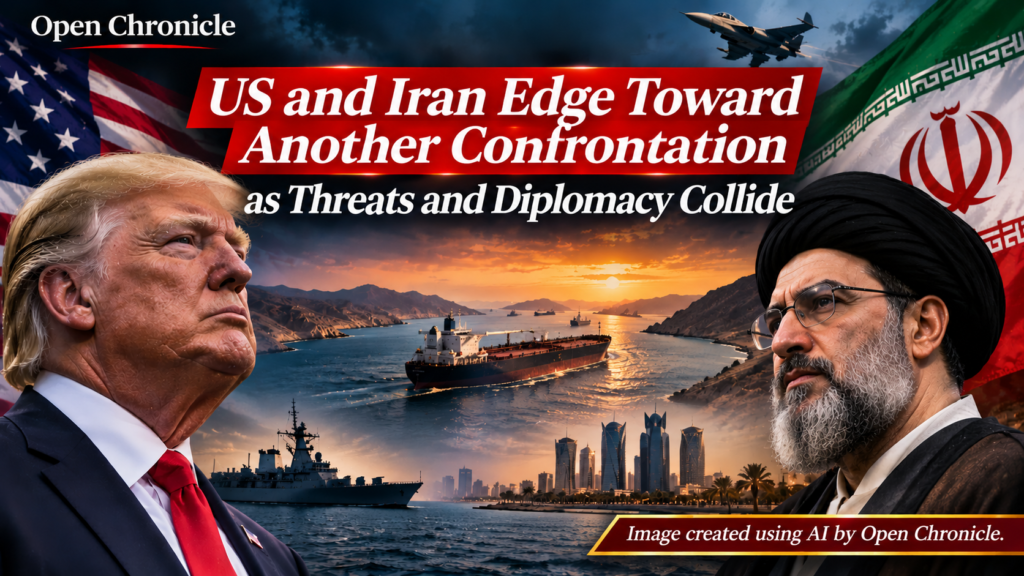
Washington and Tehran remain locked in a dangerous strategic rivalry, with military deterrence, regional alliances, nuclear concerns and economic sanctions complicating the prospects for a diplomatic breakthrough. The central question is whether either side can reduce tensions without appearing to surrender its security interests.
By Open Chronicle
WASHINGTON / TEHRAN | November 1, 2026
The confrontation between the United States and Iran remains one of the most consequential sources of instability in the Middle East, with the possibility of renewed military escalation overshadowing efforts to establish a more predictable relationship between the two governments.
The dispute extends far beyond the immediate exchange of political warnings. It encompasses Iran’s nuclear programme, American military deployments, regional armed groups, economic sanctions, maritime security and the competing security interests of Israel and Gulf countries.
For Washington, the challenge is to deter actions it considers threatening while preventing a wider conflict that could place American forces and regional partners at risk.
For Tehran, the priority is to preserve its security and political autonomy while resisting pressure it regards as an attempt to weaken the Iranian state.
Neither government can easily abandon its central demands without facing significant domestic and international consequences.
The result is a confrontation in which military signalling and diplomatic possibilities coexist, but where miscalculation could carry serious consequences.
This analysis examines the underlying pressures driving the rivalry and the possible routes toward either renewed confrontation or de-escalation.
A War That Has Not Reached a Lasting Settlement
The current crisis is not merely a return to the diplomatic tensions that preceded the 2026 conflict.
The United States and Israel launched strikes against Iran on February 28, initiating a war that has continued, with varying levels of intensity, for approximately eight months.
The initial attacks killed Iran’s Supreme Leader, Ali Khamenei, and targeted military and nuclear infrastructure. His son, Mojtaba Khamenei, subsequently became supreme leader.
A ceasefire and a memorandum of understanding reached in June reduced the intensity of the fighting, but failed to produce a durable settlement.
Subsequent disputes and military exchanges have left the region in a fragile condition in which the threat of further large scale attacks remains real.
The most difficult outstanding questions concern the future of Iran’s nuclear programme, access to the Strait of Hormuz, the American blockade of Iranian ports and the terms under which sanctions might be eased.
Each issue has become a source of leverage for one side and a source of vulnerability for the other.
Doha Emerges as the Centre of a Diplomatic Effort
The most immediate diplomatic developments have taken place in Qatar.
Iranian negotiators were in Doha on November 1 for a third consecutive day of consultations with Qatari mediators, according to Reuters.
The discussions followed more than 12 hours of meetings between Iranian and Qatari representatives in Tehran on October 30.
A source briefed on the negotiations said the contacts were coordinated with Washington, suggesting that indirect communication between the United States and Iran remains active despite the absence of a comprehensive agreement.
Qatar has become an important intermediary because it maintains diplomatic channels with both sides and has experience facilitating negotiations involving regional adversaries.
Pakistan has also played a significant mediation role, including in earlier efforts to establish a ceasefire.
The proposals on the negotiating table
The central disagreement is over the sequence of concessions.
According to Reuters, Qatari mediators proposed a seven day confidence building arrangement under which Washington and Tehran would take successive steps toward broader negotiations.
Iranian officials considered that proposal inadequate.
Tehran has advanced a separate framework involving the lifting of the American blockade of Iranian ports, the release of frozen assets and arrangements governing maritime passage through the Strait of Hormuz.
Washington has not accepted that proposal.
Iranian Foreign Minister Abbas Araghchi has also described discussions concerning a possible reopening of the strait within two days, provided that Iranian conditions are met.
Those conditions reportedly include sanctions relief, changes to American military deployments and broader regional security commitments.
The competing proposals reveal the central obstacle.
Washington wants assurances that Iran will restore maritime access and address American security concerns.
Tehran wants meaningful economic and security concessions before surrendering its most important bargaining tools.
Neither side wants to make the first major concession without guarantees that the other will follow.
Trump Keeps the Military Option Open
President Donald Trump has repeatedly indicated that the United States retains the option of conducting further strikes.
The timing has become politically sensitive because Americans will vote in congressional midterm elections on November 3.
Trump has said the United States will not resume attacks before the vote, while leaving open the possibility of subsequent action.
At the same time, he has characterized the latest negotiations as productive.
Secretary of State Marco Rubio said on October 31 that the president had not decided whether to authorize new strikes and would prefer a diplomatic solution.
Rubio nevertheless emphasized that American forces remained capable of conducting military operations if necessary.
The administration’s position therefore combines two messages.
The first is that diplomacy remains possible.
The second is that failure to reach an acceptable agreement could result in additional military action.
This approach may be intended to strengthen Washington’s negotiating position, but it also increases the importance of how Tehran interprets American statements and military preparations.
The November 3 calculation
The American election introduces uncertainty into the diplomatic process.
Reuters reported in September that some senior administration officials favoured avoiding a major escalation before the midterms, partly because of the potential domestic political consequences.
That does not establish that new strikes will occur after the election.
It does indicate that the electoral calendar has become part of the strategic calculations surrounding the war.
For regional governments, the concern is that the political constraints discouraging escalation before November 3 may become less significant afterward.
For Iran, the challenge is deciding whether to negotiate under the threat of renewed attacks or maintain its existing demands.
Iran Warns That Another Attack Would Bring Retaliation
Iranian leaders have responded to American warnings with threats of their own.
Supreme Leader Mojtaba Khamenei has instructed the armed forces to prepare for possible renewed attacks and warned that retaliation would not necessarily be geographically limited.
Iranian officials have indicated that American and Israeli interests in neighbouring countries could become targets if the war intensifies.
The warnings are intended to communicate that Tehran retains military capabilities despite the damage inflicted during the conflict.
They also seek to discourage neighbouring states from facilitating new operations against Iran.
A dangerous nuclear warning
Iranian security chief Mohsen Rezaei has suggested that renewed fighting could prompt debate over the country’s prohibition on nuclear weapons.
That statement should not be interpreted as confirmation that Iran has decided to build a nuclear weapon or that its official nuclear doctrine has changed.
It is nevertheless significant because it introduces the possibility of a more serious confrontation over nuclear policy.
Iran has long maintained that its nuclear programme is intended for peaceful purposes.
The United States, Israel and other governments have raised concerns about its nuclear activities, the availability of international verification and the potential for weapons development.
The absence of a comprehensive settlement makes these concerns more difficult to resolve.
The Strait of Hormuz: A Global Economic Pressure Point
One of the most consequential aspects of the confrontation is the disruption of maritime traffic through the Strait of Hormuz.
The narrow waterway connects the Persian Gulf to the Gulf of Oman and international shipping routes.
It is strategically important because substantial quantities of oil and liquefied natural gas normally pass through it.
Iran has used its influence over the strait as leverage in negotiations, while the United States has imposed restrictions on Iranian maritime commerce.
The resulting disruption has contributed to pressure on global energy markets and uncertainty for shipping companies.
Reuters reported in September that American and Iranian negotiators were exploring a phased arrangement involving the reopening of the strait and the removal of the American economic blockade.
The negotiations encountered the same fundamental difficulty that remains visible today: neither side was prepared to surrender its leverage first.
Why the disruption matters beyond the Middle East
The consequences extend far beyond Iran and its immediate neighbours.
Energy importers in Asia and Europe are exposed to changes in supply and shipping costs.
Higher transport and insurance expenses can affect the prices of imported goods.
Prolonged disruption can also complicate industrial production and increase inflationary pressure in economies already facing financial constraints.
The degree of impact depends on how long the disruption lasts, how much alternative supply becomes available and how energy markets respond.
A credible agreement on maritime access would therefore provide economic benefits beyond the countries directly involved in the conflict.
Israel and the Risk of a Wider War
Israel remains a central participant in the confrontation.
Israeli leaders regard Iran’s nuclear and military capabilities as major national security concerns.
The Israeli government has supported military measures intended to limit threats originating from Iran and has maintained pressure on Tehran during the conflict.
A renewed American military campaign could involve coordination with Israel or create conditions for further Israeli operations.
Iran, meanwhile, has warned that Israeli targets could be included in its response.
The danger is that military actions intended to achieve limited objectives could trigger retaliation across multiple locations.
The result could be a broader conflict involving military installations, energy infrastructure, transport networks and civilian areas.
Analysts interviewed by the Financial Times warned that even extensive air strikes might not eliminate Iran’s remaining missile and drone capabilities.
They also cautioned that attacks on military and civilian infrastructure could generate wider retaliation and worsen humanitarian conditions.
Gulf Countries Try to Prevent Escalation
The Gulf states face a particularly difficult security environment.
Many maintain close defence relationships with the United States while also having strong economic interests in regional stability.
Their infrastructure, energy exports and commercial transport networks are vulnerable to the consequences of renewed fighting.
Qatar’s mediation reflects the importance of preventing a conflict that could destabilize the entire Gulf.
Other regional governments have also become involved.
The Associated Press reported that representatives from Saudi Arabia, Pakistan and Turkey met Iranian officials in Tehran on October 26 to discuss regional cooperation and the prevention of renewed hostilities.
Turkey warned that additional attacks could destabilize the region, while the participating governments agreed to continue diplomatic engagement.
These initiatives demonstrate that the conflict is not simply a bilateral dispute between Washington and Tehran.
Its consequences affect the security calculations of governments throughout the Middle East.
Yemen and the Danger of Regional Spillover
The war has also intensified tensions involving Yemen.
Iranian backed Houthi forces have carried out attacks against Saudi backed forces and infrastructure, contributing to a wider regional security crisis.
Saudi and allied military operations have responded to perceived threats from Houthi positions.
The Associated Press reported renewed violence and diplomatic concern over attacks affecting civilian infrastructure and humanitarian operations.
Some battlefield claims remain difficult to verify independently.
The significance of the Yemeni front is that escalation there could complicate attempts to reach a settlement with Iran.
Even if Washington and Tehran agreed on immediate steps to reduce their confrontation, regional armed groups and neighbouring governments might continue pursuing their own military objectives.
A durable agreement would therefore need to account for the wider security environment.
The Humanitarian Dimension
The conflict has imposed costs that extend beyond military infrastructure and government budgets.
Civilian populations face the consequences of insecurity, disrupted economic activity, damaged infrastructure and uncertainty about future attacks.
Restrictions affecting ports and transport can also complicate the movement of essential goods.
The American administration has indicated willingness to discuss the delivery of additional medical supplies into Iran.
Trump said he had approved contact concerning humanitarian shipments, although he played down suggestions that the initiative represented a broader diplomatic breakthrough.
Humanitarian arrangements could provide one of the more practical starting points for confidence building.
They would not resolve the nuclear dispute or the underlying military confrontation, but they could reduce immediate suffering and demonstrate that limited cooperation remains possible.
Three Possible Paths From the Current Crisis
Three Possible Paths From the Current Crisis
PATH 1
A phased diplomatic agreement
Qatar and other mediators help establish reciprocal commitments involving maritime access, economic restrictions and security guarantees.
This could reduce the risk of immediate escalation while leaving more difficult nuclear and regional issues for subsequent negotiations.
PATH 2
Continued military pressure without a settlement
Both governments maintain threats and limited operations while avoiding a return to the most intense phase of the war.
This would preserve some negotiating leverage but leave the region vulnerable to renewed confrontation.
PATH 3
Renewed large scale escalation
The United States or Israel conducts additional major strikes, followed by Iranian retaliation against military or economic targets.
The consequences could include greater regional instability, disruption of energy supplies and increased humanitarian suffering.
These scenarios describe possible developments rather than predictions.
Their likelihood depends on decisions that have not yet been made, the progress of mediation and the ability of military and political leaders to manage further incidents.
What to Watch After the US Midterms
The period immediately following November 3 could prove important.
The first indicator will be whether Washington continues to prioritize negotiations or adopts a more confrontational military posture.
The second will be whether Qatar can secure agreement on initial steps involving the Strait of Hormuz and the American blockade.
The third will be Iran’s response to any new military movements or diplomatic proposals.
A fourth factor will be the positions adopted by Israel and Gulf governments, whose security concerns may influence the direction of the crisis.
Finally, developments in Yemen and other regional conflict zones could complicate efforts to contain the confrontation.
A Conflict That Neither Side Can Easily End
The United States and Iran have entered a dangerous phase in which diplomacy remains active but the threat of renewed warfare is explicit.
Washington possesses considerable military capabilities and economic leverage.
Tehran retains the ability to impose costs through regional retaliation, missile and drone operations and disruption of strategically important maritime routes.
Both governments have reasons to avoid an uncontrolled escalation.
Both also face political and strategic pressures that make compromise difficult.
The diplomatic activity in Doha demonstrates that channels of communication remain open.
It does not establish that a settlement is imminent.
For the Middle East and the wider international economy, the stakes extend beyond the immediate relationship between Washington and Tehran.
The coming days will test whether military pressure can be converted into a negotiated arrangement or whether the region will face another escalation in a war that has already lasted eight months.
The decisive question is no longer simply whether the United States and Iran can avoid a new war. It is whether they can find a durable way to end the conflict already underway.
Sources and Further Reading
The following sources support the latest diplomatic developments, military warnings and regional context. The assessment of escalation risks and possible outcomes is Open Chronicle’s editorial analysis.
1. Reuters | Iranian Negotiators in Doha to Continue Talks to End the US–Iran War
November 1, 2026
Reporting on the latest Qatari mediation, Iranian negotiators, contacts with Washington and the possibility of further American strikes.
2. Reuters | Iranian Envoys Meet Qatari Mediators as Threat Looms of US Strikes After Midterms
October 31, 2026
Detailed reporting on negotiations in Doha and Tehran, competing proposals, American military warnings and Iran’s response.
3. Associated Press | Delegations Meet in Iran as Region Braces for Renewed Fighting
October 26, 2026
Coverage of diplomatic meetings involving Iran, Saudi Arabia, Pakistan and Turkey, together with developments in Yemen.
4. Council on Foreign Relations | Conflict With Iran
Updated October 23, 2026
Background on the war, the February attacks, subsequent ceasefire arrangements and unresolved diplomatic disputes.
5. Reuters | US and Iran Discuss Phased Deal to Reopen Hormuz and End US Blockade
September 24, 2026
Reporting on proposals linking maritime access, economic restrictions and reciprocal concessions.
6. Financial Times | Military Briefing: What Would Another US–Iran Conflict Look Like?
November 1, 2026
Assessment of possible military operations, Iranian retaliation capabilities, risks to regional infrastructure and limitations of air power.
7. Al Jazeera | Mediators Continue US–Iran Negotiations Amid War Rhetoric
November 1, 2026
Explanation of the latest diplomatic proposals, Iranian conditions for reopening the Strait of Hormuz and statements from both governments.
Editorial Note
This article was prepared by Open Chronicle on November 1, 2026, using reporting from Reuters, the Associated Press, the Financial Times and Al Jazeera, supplemented by the Council on Foreign Relations’ conflict documentation.
Statements attributed to American and Iranian officials reflect their publicly reported positions and should not automatically be interpreted as independently established facts.
Diplomatic proposals remain under negotiation. No comprehensive peace agreement had been confirmed at the time of preparation.
The discussion of possible military escalation, regional consequences and diplomatic outcomes represents editorial analysis rather than a prediction of future events.
Open Chronicle distinguishes between confirmed military developments, official threats, diplomatic claims and assessments by independent analysts.