
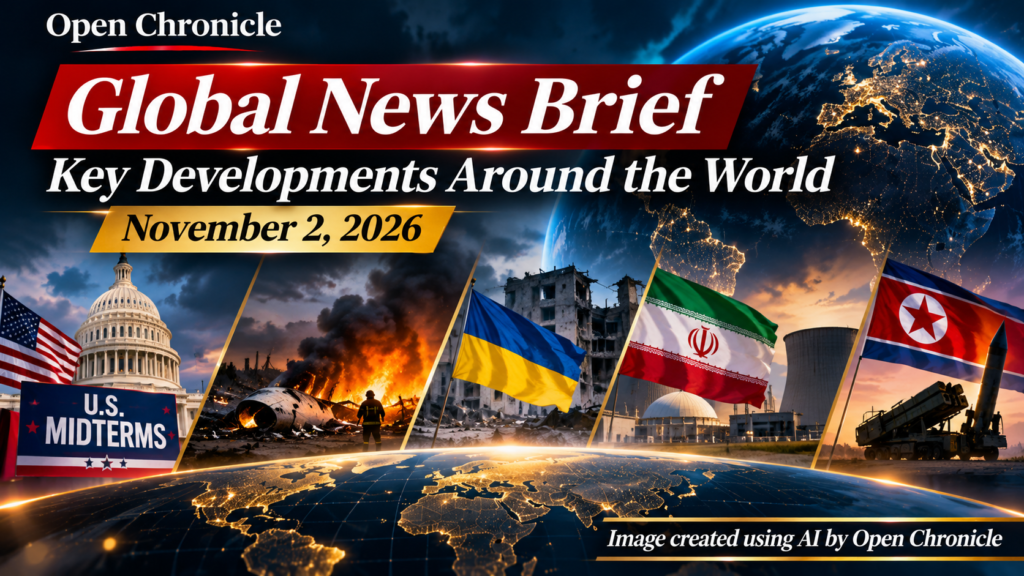
From the final campaign push before the United States midterm elections to renewed tensions involving Iran, cyberattack warnings in Ukraine and Russia, and a deadly aviation disaster in Florida, Monday’s international news agenda reflects a world facing political uncertainty, security threats and humanitarian challenges.
By Open Chronicle
November 2, 2026 | Global News Desk
The international news agenda on Monday, November 2, is dominated by developments in the United States, the Middle East and Eastern Europe, as governments confront electoral pressure, military tensions and growing concerns over digital security.
Americans are preparing for congressional elections that could reshape President Donald Trump’s political position in Washington. Meanwhile, diplomatic efforts involving Iran are unfolding alongside warnings of further military confrontation.
In Ukraine, a temporary humanitarian ceasefire around Oleshky has reportedly ended after hundreds of civilians were evacuated. Separately, reports of cyberattacks affecting emergency warning systems in Ukraine and Russia have raised concerns about the reliability of public safety information during wartime.
Elsewhere, a deadly private aircraft crash in Florida, renewed tensions on the Korean Peninsula, allegations of cross border drone operations in Sudan and political developments in Bulgaria are drawing international attention.
The following briefing brings together the principal developments identified in the November 2 news cycle. Some breaking reports remain subject to independent confirmation, particularly where initial accounts rely on official statements, preliminary investigations or unnamed sources.
United States: Midterm Elections Enter Their Final Hours
Trump and Republicans face a decisive congressional test
The United States is entering the final phase of campaigning before the November 3 midterm elections, with control of the House of Representatives and Senate at stake.
President Donald Trump has been campaigning for Republican candidates, attempting to mobilize supporters and defend his party’s congressional position.
For Republicans, the elections represent a test of whether the president’s political influence can overcome voter concerns about economic conditions, public services and the direction of the country.
Democrats, meanwhile, are seeking to capitalize on dissatisfaction with the administration and strengthen their position in Congress.
The outcome could affect the government’s legislative agenda, congressional investigations, federal spending priorities and the balance of political power during the remainder of Trump’s presidency.
Several closely contested states are expected to play an important role, with Michigan, Georgia and other battlegrounds attracting particular attention.
Michigan Senate race shaken by an unexpected endorsement
One of the most unusual late campaign developments has emerged in Michigan, where reports indicate that Democratic politician Haley Stevens has endorsed Republican Senate candidate Mike Rogers.
The reported endorsement has attracted attention because of its potential implications for party unity and voter behaviour in a competitive Senate contest.
An endorsement crossing party lines can have symbolic significance, especially during the final stages of a closely fought election.
However, its electoral impact cannot be established from the announcement alone. Voter preferences, early ballots and broader campaign conditions will ultimately determine the result.
The reported development also illustrates the extent to which individual political decisions can disrupt national campaign strategies.
Election disinformation remains a concern
Alongside conventional campaigning, concerns are growing about online manipulation, misleading political content and coordinated attempts to influence voters.
Reports have highlighted the use of automated social media accounts and networks that impersonate American voters.
Such activity raises questions about the ability of electoral institutions, technology companies and news organizations to distinguish genuine public debate from organized influence operations.
Claims involving artificial intelligence, manipulated media and foreign interference require careful examination before responsibility can be attributed to particular governments or organizations.
Florida: Nine Reported Dead After Business Jet Crashes
A private business jet crashed in southern Florida, with early reports indicating that all nine people aboard were killed.
The aircraft reportedly entered a steep descent before striking the ground and catching fire, creating a dangerous situation in a nearby residential area.
Reports concerning the final moments of the flight refer to an emergency radio transmission in which a pilot said, “We’re out of time.”
Other accounts describe an extremely rapid descent, with a reported vertical speed of approximately 32,000 feet per minute.
These details remain preliminary and should not be interpreted as an established explanation of the accident.
Aviation investigators will need to examine flight data, communications, maintenance records, weather conditions and any available wreckage evidence before determining what caused the crash.
The tragedy has also raised questions about the consequences of aircraft accidents in populated areas, where the impact can endanger residents as well as passengers and crew.
Ukraine: Humanitarian Ceasefire Around Oleshky Ends
Evacuation operation reportedly helps hundreds escape
A temporary ceasefire in the Oleshky area of Ukraine’s Kherson region has reportedly expired after allowing hundreds of civilians to leave dangerous locations.
Reports attribute a diplomatic role to US First Lady Melania Trump and indicate that approximately 800 people were evacuated during the humanitarian arrangement.
The operation, if confirmed in full, would represent a limited but significant humanitarian achievement in an area exposed to prolonged military activity.
The expiry of the arrangement has renewed concerns about civilians who remain in communities affected by shelling, drone attacks and restricted access to essential services.
The reported evacuation figures, the precise terms of the ceasefire and the roles of individual mediators require confirmation through the relevant authorities and humanitarian organizations.
False emergency warnings raise cyberattack concerns
Ukraine has also reported suspected interference with a public air raid alert application after users received false warnings, including alerts relating to radiation or nuclear threats.
Separately, Russian authorities have reported cyberattacks affecting an emergency services application.
The incidents have raised concerns about the vulnerability of digital warning systems that civilians depend upon during emergencies.
False alerts can create panic, undermine confidence in official communications and complicate the response to genuine threats.
At present, the reports do not establish that the incidents in the two countries were coordinated or carried out by the same actors.
Nor should the circulation of a false nuclear warning be interpreted as evidence that a nuclear incident occurred.
For populations living under the threat of military attacks, the integrity of emergency information remains a critical public safety issue.
Middle East: Iran Warns of a Longer War as Diplomatic Contacts Continue
Tehran responds to renewed American threats
Tensions between the United States and Iran remain high, with Iranian officials warning that renewed military confrontation could become prolonged and extend beyond the geographical boundaries of previous fighting.
President Trump has continued to threaten military action while also signalling that a negotiated settlement remains possible.
Iranian officials have offered mixed responses, warning against further strikes while describing changes in Washington’s diplomatic language as potentially encouraging.
Qatar remains involved in efforts to facilitate communication between the two governments.
The central disagreements include security guarantees, economic restrictions, Iran’s nuclear programme and maritime access through the Strait of Hormuz.
Reports also indicate that Israeli Prime Minister Benjamin Netanyahu has pressed for a tougher American approach.
For Gulf countries, the principal concern is that another military escalation could threaten energy infrastructure, shipping routes and civilian populations.
The continued existence of diplomatic contacts does not guarantee an agreement, particularly while both governments maintain military options.
Saudi Arabia issues and lifts emergency alerts
Saudi authorities briefly activated emergency warnings in several southern areas amid tensions involving Yemen’s Houthi movement.
Civil defence authorities subsequently announced that the immediate danger had passed.
The Saudi led coalition also reported military action involving Houthi capabilities.
These developments highlight the possibility that renewed confrontation involving Iran could have consequences beyond Iranian territory, particularly in Yemen and the wider Gulf region.
The immediate circumstances surrounding reported projectile attacks and interceptions require continued verification.
North Korea Condemns Allied Military Exercises
North Korea has criticized military exercises involving the United States and South Korea, describing them as justification for strengthening its nuclear deterrent.
Pyongyang’s statements come amid longstanding disagreements over the Korean Peninsula’s security architecture and the presence of American forces in South Korea.
The United States and South Korea describe their military exercises as defensive preparations.
North Korea regularly characterizes such activities as hostile and uses them to defend its weapons development programme.
The latest rhetoric adds to concerns about the possibility of further missile testing, military demonstrations and diplomatic confrontation.
Cryptocurrency Security: North Korea Linked to Reported Binance Attack
American authorities have reportedly identified the North Korea associated cybercriminal group TraderTraitor in connection with a major attack on cryptocurrency exchange Binance.
The reported losses of approximately $6.3 billion would make the incident exceptionally significant in the history of cryptocurrency theft.
Blockchain intelligence companies have also reportedly linked the attack to North Korean actors.
However, the attribution of a cyberattack involves several distinct questions: who conducted the intrusion, how the assets were transferred, whether the stolen funds can be recovered and who ultimately bears the losses.
An official attribution does not necessarily establish the full chain of responsibility for every stage of the operation.
The incident has renewed scrutiny of cryptocurrency custody arrangements, transaction monitoring and the security of digital asset exchanges.
Given the extraordinary reported value, the exact loss, recovery status and customer exposure require confirmation through primary investigative and company disclosures.
Europe: Bulgaria’s Presidential Election Signals Political Change
Bulgaria’s presidential election has produced a reported victory for Iliana Yotova, whose campaign emphasized a diplomatic approach to the war in Ukraine.
According to Anadolu’s November 2 briefing, parallel counts from major polling agencies placed Yotova ahead of challenger Andrey Gyurov, with her share estimated between 56.6% and 58.2%.
Gyurov acknowledged the outcome.
The result is politically significant because Bulgaria is both a European Union member and a NATO ally situated near the Black Sea.
Yotova’s positions on military assistance to Ukraine may influence the country’s political debate, although Bulgaria’s foreign and security policies also depend on its government, parliament and international commitments.
The election comes amid wider European concerns about Russian military activity, Black Sea security and the future of European defence cooperation.
Sudan: Drone Warfare Raises Regional Tensions
Sudan has accused neighbouring Ethiopia of involvement in drone operations connected to the country’s conflict.
Reports indicate that Sudanese authorities have submitted complaints to international and regional organizations.
The allegations are serious because direct involvement by a neighbouring state could increase the risk of a wider regional confrontation.
However, allegations of responsibility must be distinguished from independently established evidence.
Separately, reports of drone attacks affecting electricity infrastructure in eastern Sudan have raised concerns about disruptions to essential services.
The country’s prolonged conflict continues to impose severe costs on civilians, with insecurity, displacement and damage to infrastructure complicating humanitarian operations.
Israel and the Palestinian Territories: Violence and Political Uncertainty
Israeli security forces have reportedly confronted ultra Orthodox Jewish demonstrators protesting the arrest of a man accused of avoiding military service.
The incident reflects continuing divisions over conscription and the obligations of religious communities within Israeli society.
The issue has become politically sensitive because military service, exemptions and national security are closely connected to debates over government policy.
In Gaza, reports of Israeli strikes and Palestinian casualties have raised further questions about the durability of ceasefire arrangements.
Separate reports of settler attacks and restrictions affecting Palestinian communities in the occupied West Bank have also attracted international concern.
Casualty figures and allegations of ceasefire violations require attribution to the reporting organizations and authorities providing them, particularly when independent access is limited.
Asia: Taiwan, China and Regional Security
Taiwan has emphasized the importance of maintaining independent control over its maritime information systems amid pressure from China.
Maritime awareness is an essential part of Taiwan’s security planning, allowing authorities to monitor commercial shipping, military activity and potential disruptions near the island.
The issue illustrates the increasing importance of information systems in regional security.
China continues to assert sovereignty over Taiwan, while Taiwan’s authorities reject Beijing’s claim to govern the island.
Separately, Japan and South Korea are pursuing major defence and industrial initiatives, including investments in military capabilities, nuclear energy and advanced technology.
These developments reflect a broader regional effort to respond to strategic competition, supply chain vulnerabilities and changing security requirements.
Global Economy: OPEC+ Holds Oil Production Targets Steady
OPEC+ members have decided to maintain their December oil production targets, leaving more difficult decisions about output levels for 2027.
The decision comes as the conflict involving Iran continues to disrupt energy markets and create uncertainty around maritime transport through the Strait of Hormuz.
According to Reuters, seven major members maintained their existing production targets, while the broader group is scheduled to discuss its 2027 framework later in November.
Oil producers must balance concerns about supply shortages against the possibility that increased exports could eventually place downward pressure on prices.
The decision illustrates how military developments in the Gulf continue to influence global economic expectations, including inflation, transport costs and energy security.
South Asia: Bangladesh Garment Workers Protest Over Pay
Garment workers in Bangladesh have continued demonstrations demanding better wages and working conditions.
Reports indicate that some factories have experienced disruptions, reflecting tensions between employees and an industry facing international competition and production pressures.
The garment sector is central to Bangladesh’s export economy and employs large numbers of workers.
Disputes over wages, workplace conditions and purchasing power therefore have consequences beyond individual factories.
For international clothing brands, the unrest also raises questions about supply chain resilience and labour standards.
Climate and Disaster Preparedness: India Braces for Cyclone Murasu
Authorities in southern India are preparing for the effects of Cyclone Murasu, with reports of evacuations in vulnerable coastal areas.
The storm has renewed concerns about flooding, coastal damage and the ability of emergency services to protect communities.
Early warnings and precautionary evacuations are particularly important in densely populated coastal regions, where severe weather can disrupt transport, electricity, agriculture and essential services.
The cyclone’s precise intensity, trajectory and impact remain subject to updated meteorological assessments.
Bhutan: Thousands Participate in Buddhist Construction Project
Bhutan has attracted international attention after reports that tens of thousands of volunteers helped construct 108 Buddhist stupas in Gelephu Mindfulness City.
The initiative combines religious tradition, community participation and the country’s ambitions for a new development project.
Gelephu Mindfulness City is intended to support Bhutan’s economic future while reflecting its cultural and environmental priorities.
The event illustrates how the Himalayan kingdom is seeking to combine spiritual identity with long term development planning.
The Wider Picture
The developments of November 2 reveal several themes shaping international affairs.
The American midterm elections could alter the political balance in Washington at a time when the United States is involved in sensitive diplomatic and military questions.
The conflict involving Iran continues to affect Gulf security and global energy markets.
In Ukraine, the temporary humanitarian pause around Oleshky has demonstrated the potential value of limited agreements, even as wider hostilities continue.
Cyberattacks affecting emergency warning systems show how digital vulnerabilities can have immediate consequences for civilian populations.
Meanwhile, events in Sudan, East Asia and Europe underline the continuing importance of regional security, political stability and international cooperation.
For governments and international institutions, the immediate challenge is to manage these overlapping crises without allowing local confrontations to develop into wider emergencies.
Sources and Further Reading
The following references support the principal developments covered in this briefing.
1. Reuters | Florida Learjet Crash
November 1, 2026
Reporting on the nine fatalities, flight circumstances and federal investigation.
2. Reuters | Oleshky Humanitarian Ceasefire
November 1, 2026
Reporting on the expiry of the six day arrangement and civilian evacuations in Kherson.
3. The Guardian | Ukraine War Briefing
November 2, 2026
Reporting on false emergency alerts and suspected cyberattacks affecting Ukraine’s public warning systems.
4. Anadolu Agency | Morning Briefing
November 2, 2026
Coverage of Bulgaria’s presidential election, the American midterm elections, Iran and developments in Saudi Arabia.
5. Federal Bureau of Investigation | Binance Cyberattack
October 31, 2026
Official attribution of the Binance cryptocurrency theft to North Korean TraderTraitor actors.
6. Reuters | Binance Response
November 1, 2026
Reporting on the exchange’s restoration of stolen assets and the continuing investigation.
7. Reuters | OPEC+ Oil Production Decision
November 1, 2026
Reporting on December oil production targets and preparations for the group’s 2027 production framework.
8. Associated Press | Oleshky Ceasefire
October 2026
Background on the humanitarian arrangements and diplomatic involvement.
Editorial Note
This Global News Brief was prepared by Open Chronicle on November 2, 2026, using the supplied international news roundup and selected independent reporting.
The briefing distinguishes between confirmed developments, official statements, preliminary reports and allegations requiring further verification. The supplied roundup contains headlines from multiple publishers, but not full source articles for every development. Accordingly, some secondary items are presented as reported developments rather than independently established facts.
The article reflects information available at the time of preparation. Breaking news, casualty figures, electoral results and military developments may change as additional information becomes available.