
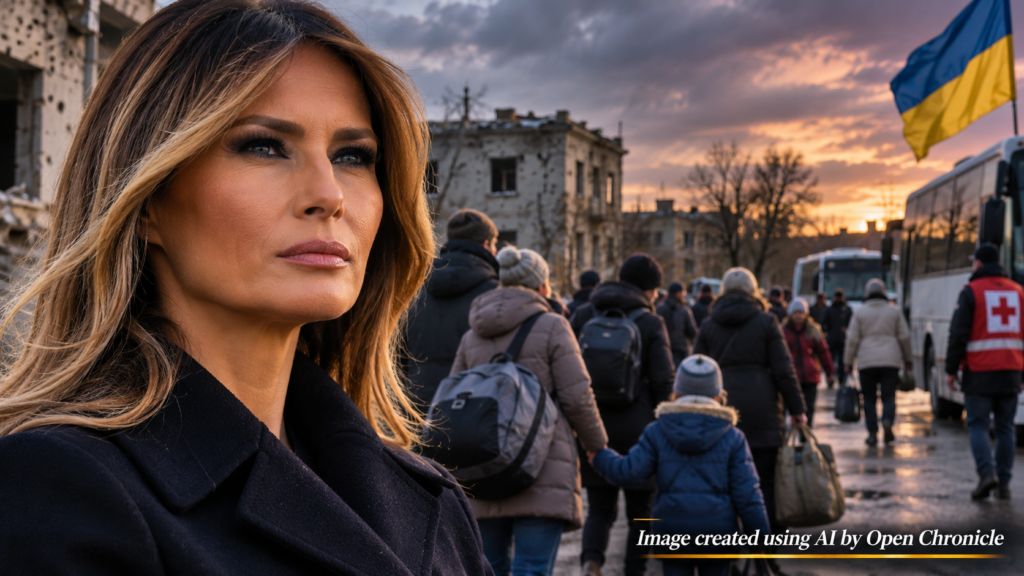
The US first lady has described a five-day humanitarian operation in Russian-controlled southern Ukraine as a success, expressing hope that cooperation between Moscow and Kyiv could open the way for further humanitarian initiatives and wider peace efforts.
By Open Chronicle
November 2, 2026 | World News | Russia–Ukraine War
US First Lady Melania Trump announced on Sunday that a temporary humanitarian ceasefire in Oleshky, a Russian-controlled city in Ukraine’s southern Kherson region, had concluded after nearly 800 civilians were evacuated during a five-day pause in fighting.
The arrangement, which began on October 27 and ended as scheduled on November 1, was intended to allow humanitarian assistance to reach the city and provide civilians with an opportunity to leave an area affected by prolonged hostilities.
In a statement published on the social media platform X, the first lady described the operation as successful and praised the cooperation between Ukrainian and Russian representatives.
“The mission was a success, delivering critical aid to the region and enabling the evacuation of nearly 800 people,” she wrote.
Melania Trump also commended Moscow and Kyiv for their “leadership and cooperation” during the operation, expressing hope that the humanitarian arrangement could provide a foundation for broader efforts to end the war.
Although the ceasefire was limited in duration and geographical scope, its reported completion represents an example of direct humanitarian coordination between representatives of two countries whose military confrontation continues.
A Humanitarian Pause in a Divided Region
Oleshky lies on the eastern bank of the Dnipro River, opposite the Ukrainian-controlled city of Kherson.
The city has remained under Russian control during a prolonged period of fighting in southern Ukraine, where the river has become a major dividing line between opposing military positions.
Communities in the region have faced severe humanitarian challenges, including damaged infrastructure, disrupted public services, restrictions on movement and the persistent danger of military attacks.
For civilians living close to the front line, opportunities to leave safely can be limited by insecurity, damaged transport routes and the difficulty of coordinating passage through contested territory.
The temporary ceasefire was designed to create a humanitarian window in which aid could be delivered and residents could depart without being exposed to ongoing military operations.
According to the statements provided by the participants, nearly 800 people were evacuated before the arrangement expired.
The reported operation also demonstrated the importance of practical communication between officials responsible for humanitarian issues, even when broader political and military negotiations remain difficult.
Ukrainian Human Rights Commissioner Confirms Conclusion
Ukraine’s Parliament Commissioner for Human Rights, Dmytro Lubinets, confirmed that the humanitarian ceasefire had ended and said both sides had fulfilled their commitments.
According to Lubinets, the arrangement allowed humanitarian supplies to reach Oleshky while enabling civilians to leave the city safely.
He attributed the coordination of the initiative to the US first lady and said it was implemented in cooperation with Russian Human Rights Commissioner Yana Lantratova.
The involvement of human rights representatives was central to the reported operation, providing a channel for communication focused on civilian protection rather than the wider military and territorial disputes between Russia and Ukraine.
Lubinets emphasized that the mechanism established during the ceasefire should not necessarily end with the completion of the evacuation.
“It is important to maintain this mechanism of cooperation so that we can continue helping people and saving lives,” he said.
His comments suggest that officials are considering whether the contacts established during the Oleshky operation could support further humanitarian arrangements.
Discussions Underway on Further Humanitarian Initiatives
Lubinets said he and Lantratova were exploring opportunities for additional humanitarian initiatives following the conclusion of the ceasefire.
No detailed timetable or locations for possible future operations were specified in the information released about those discussions.
Nevertheless, the prospect of continued contact is significant in a conflict where humanitarian arrangements often depend on difficult negotiations over access, security guarantees and the movement of civilians.
Future initiatives could require agreement on evacuation routes, the delivery of essential supplies and the protection of personnel involved in humanitarian work.
Such operations also depend on the ability of both parties to maintain commitments on the ground, particularly in areas where military activity can resume with little warning.
The successful implementation of a temporary arrangement does not, by itself, indicate that a wider ceasefire or political settlement is imminent.
However, it may establish procedures and communication channels that can be used in subsequent humanitarian negotiations.
Melania Trump’s Diplomatic Role
The first lady’s involvement has attracted attention because humanitarian diplomacy is not traditionally conducted through the office of the US president’s spouse.
In this case, the reported coordination placed Melania Trump in a visible role involving representatives from both sides of the Russia–Ukraine conflict.
Her public statements have focused on the humanitarian consequences of the war and the possibility of building confidence through limited cooperation.
By praising both Moscow and Kyiv for their participation, she presented the Oleshky operation as an example of what might be achieved when immediate civilian needs are separated from wider political disagreements.
“I hope Oleshky serves as a foundation for lasting peace between both nations,” she stated.
That aspiration remains distinct from the political realities of the conflict.
Russia and Ukraine continue to disagree over fundamental questions of territory, sovereignty, security guarantees and the conditions under which hostilities could end.
A humanitarian arrangement involving one city cannot resolve those disagreements, but it may demonstrate that limited agreements are possible when both parties identify a shared objective.
What the Ceasefire Means for Civilians
For the people evacuated from Oleshky, the immediate significance of the operation is humanitarian rather than diplomatic.
The temporary pause reportedly allowed hundreds of residents to leave a dangerous environment and gain access to safer locations.
For those who remained, the expiry of the ceasefire raises questions about future access to food, medical assistance, electricity and other essential services.
Humanitarian organizations operating in conflict areas frequently face challenges in reaching vulnerable populations, particularly older residents, people with disabilities and those unable to travel without assistance.
The experience in Oleshky illustrates why even short pauses in fighting can have substantial consequences for civilians.
Five days may be insufficient to address the needs of an entire community, but a negotiated period of safe passage can allow evacuations and assistance that would otherwise be extremely difficult.
The reported cooperation also highlights the importance of preserving humanitarian communication channels regardless of developments on the battlefield.
A Limited Agreement, Not a Wider Peace Settlement
Despite the positive assessments from Melania Trump and the Ukrainian human rights commissioner, the Oleshky ceasefire should be understood as a localized humanitarian arrangement.
It did not constitute a nationwide cessation of hostilities, nor did it establish a comprehensive agreement between Russia and Ukraine.
The distinction is important because humanitarian diplomacy can produce practical results without resolving the political disputes responsible for a conflict.
Temporary ceasefires may also be vulnerable to changing military conditions, disagreements over implementation or renewed fighting after their scheduled conclusion.
The reported completion of the Oleshky arrangement therefore represents a potential model for further civilian protection measures rather than evidence of an imminent end to the war.
Whether it leads to additional operations will depend on the willingness of Ukrainian and Russian officials to continue their cooperation and establish workable arrangements in other affected areas.
A Possible Opening for Future Cooperation
The conclusion of the Oleshky ceasefire has produced cautious expressions of optimism from those involved.
Melania Trump has framed the operation as a humanitarian success with potential diplomatic implications, while Dmytro Lubinets has emphasized the practical value of maintaining cooperation between human rights representatives.
The reported evacuation of nearly 800 civilians provides a concrete measure of the arrangement’s immediate humanitarian impact.
Yet the wider significance of the initiative will depend on what follows.
If the contacts established during the operation result in further evacuations, aid deliveries or agreements to protect civilians, the Oleshky experience could become an important reference point for humanitarian diplomacy in the Russia–Ukraine war.
For now, the operation stands as a reminder that limited cooperation can produce meaningful results even during an unresolved and destructive conflict.
The ceasefire has ended, but the possibility of further humanitarian cooperation remains open.
Sources and Further Reading
Primary reporting and statements referenced in the supplied material:
1. Melania Trump | Public Statement on X
November 1, 2026
Announcement of the conclusion of the Oleshky humanitarian operation and the reported evacuation of nearly 800 civilians.
2. Dmytro Lubinets | Ukrainian Parliament Commissioner for Human Rights
November 1, 2026
Statement concerning the conclusion of the ceasefire, humanitarian access and cooperation with Russian representatives.
3. Yana Lantratova | Russian Human Rights Representative
Russian human rights representative named in the supplied account. Referenced in connection with coordination of the humanitarian arrangement.
Editorial Note
This article is based on the information and attributed statements supplied for publication. The reported evacuation total, the precise terms of the ceasefire and the roles of individual participants have not been independently verified for this version. The humanitarian arrangement should not be interpreted as a broader peace agreement or a nationwide ceasefire.