
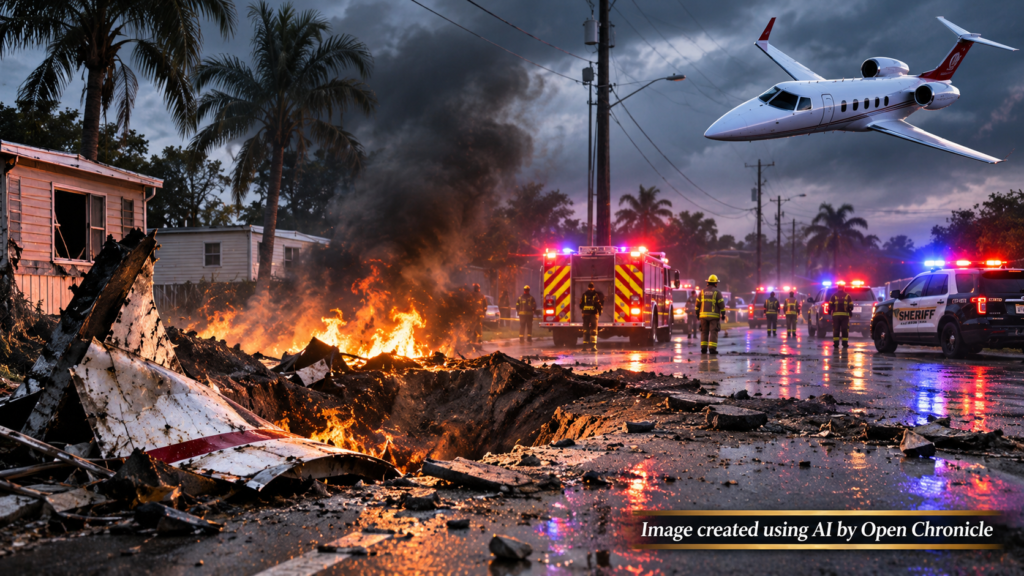
All nine people aboard a Learjet 60 were killed when the aircraft plunged into a Palm Beach County neighbourhood, leaving a crater, burning wreckage and widespread disruption. Hundreds of residents were evacuated as investigators began examining the aircraft’s final moments.
By Open Chronicle
November 2, 2026 | United States | Aviation
A business jet carrying nine people crashed into a residential area of Palm Beach County, Florida, on Sunday, November 1, killing everyone aboard and leaving behind a scene of extraordinary destruction.
The Learjet 60 struck the ground near Cresthaven at approximately 12:50 p.m. local time, erupting into a fireball that scattered aircraft wreckage across the surrounding area and damaged nearby infrastructure.
What remained after the flames subsided was a large crater, twisted metal and fragments of an aircraft that had been almost completely destroyed by the impact.
Images and videos circulating after the crash showed debris strewn near residential properties, with sections of the aircraft severely damaged by the force of the collision and subsequent fire.
The aircraft had reportedly departed Austin, Texas, and was travelling to the Bahamas when it went down near Military Trail, approximately 14 kilometres from Mar-a-Lago, President Donald Trump’s Florida residence.
US Transportation Secretary Sean Duffy confirmed that all nine people aboard had died.
The Federal Aviation Administration said it would support the National Transportation Safety Board, which is responsible for leading the investigation into the accident.
The cause of the crash has not been determined.
A Sudden Descent and a Devastating Explosion
The final moments of the Learjet’s flight were captured in footage recorded by witnesses and motorists travelling near the crash site.
The recordings reportedly show the aircraft descending at a steep angle before striking the ground and erupting into flames.
The impact produced an intense fireball, followed by thick smoke rising above the neighbourhood.
The aircraft struck a section of roadway close to homes and passing vehicles, creating a crater and sending debris into the surrounding area.
Although the crash occurred near occupied residential properties, the initial accounts indicated that the nine fatalities were confined to those aboard the aircraft.
The proximity of the impact to homes and traffic nevertheless created an immediate danger for people on the ground.
Florida Governor Ron DeSantis described the accident as catastrophic, comparing the aircraft’s final descent to a missile.
“When you see that video, it’s a jarring thing. It’s like a missile coming down, and a massive explosion, debris going everywhere,” DeSantis told reporters.
His description reflected the speed and violence of the impact, although the footage alone cannot establish the aircraft’s precise flight conditions or the cause of its descent.
For investigators, the extensive destruction of the airframe will make the examination of the wreckage particularly important.
Around 600 Residents Evacuated
The consequences of the crash extended well beyond the aircraft and its occupants.
Emergency authorities evacuated approximately 600 residents from a nearby mobile home community as firefighters, law enforcement officers and other emergency personnel secured the area.
The crash reportedly damaged water lines and nearby residential properties, including at least one mobile home that suffered substantial destruction.
Palm Beach County Commissioner Joel Flores said officials were working to ensure that displaced residents had somewhere to stay.
“We have about 600 people that we have to make sure that they have shelter tonight,” Flores said.
The evacuation created an additional challenge for local authorities, who had to coordinate emergency accommodation while maintaining access for investigators and recovery teams.
Residents were also affected by road closures and disruption to essential infrastructure.
The Palm Beach County Sheriff’s Office closed both directions of Military Trail between Cresthaven Boulevard and 10th Avenue North, advising motorists to avoid the area and use alternative routes.
Officials indicated that repairs could take at least 30 days, depending on the extent of damage to the roadway and underground infrastructure.
The closure is expected to affect local traffic and access to nearby neighbourhoods while recovery and reconstruction work continues.
Emergency Crews Confront a Mass Casualty Scene
Palm Beach County Fire Rescue declared a mass casualty incident following the crash, mobilising a substantial emergency response.
Firefighters were confronted with burning aircraft debris, damaged infrastructure and the possibility of additional hazards in the surrounding area.
Aircraft accidents involving fuel fires can present significant risks even after the initial flames have been extinguished.
Emergency crews must assess unstable wreckage, damaged utilities and potential fuel contamination while ensuring that residents and responders remain safe.
The force of the Learjet’s impact also complicated the recovery operation, with debris scattered across a wide area.
Authorities worked to secure the crash site and preserve evidence for federal investigators.
For the affected community, the immediate priorities were public safety, temporary shelter and the restoration of essential services.
The investigation into the aircraft’s loss of control will proceed alongside those local recovery efforts.
Final Mayday Calls Reveal the Crew’s Desperate Struggle
Recordings of communications between the Learjet’s crew and air traffic controllers provide a disturbing account of the aircraft’s final minutes.
Before the emergency, the crew had reported moderate turbulence, precipitation and the presence of ice on the aircraft.
The pilot initially described the icing as manageable and discussed the possibility of reaching smoother air.
The situation deteriorated shortly after the crew requested permission to climb.
According to the recorded exchanges, the aircraft suddenly began losing altitude at an extraordinary rate.
“Mayday, Mayday, we’re descending 10,000 feet per minute,” the pilot told controllers.
Moments later, the crew reported that the aircraft was in an overspeed condition and descending at approximately 20,000 feet per minute.
An overspeed condition occurs when an aircraft exceeds an established operating speed limit, potentially placing additional stress on its structure and complicating efforts to regain control.
The controller attempted to assist, allowing the crew discretion over its altitude and asking what help was needed.
As the emergency intensified, the pilot warned that the aircraft was going to crash.
The final recorded communications included a desperate acknowledgment that the crew had run out of time.
Flight tracking information subsequently indicated a descent rate exceeding 32,000 feet per minute during the final stages of the flight.
These figures illustrate the severity of the emergency, but they do not establish why the aircraft entered its uncontrolled descent.
What Caused the Learjet to Crash?
The National Transportation Safety Board is leading the federal investigation, with assistance from the Federal Aviation Administration.
Investigators will examine several possible factors, including the weather conditions encountered by the aircraft, its mechanical condition and the crew’s response to the developing emergency.
The reported presence of ice is particularly relevant because ice accumulation can alter an aircraft’s aerodynamic characteristics.
Depending on its location and severity, icing can reduce lift, increase drag and affect the aircraft’s handling.
However, the crew’s report of icing does not establish that ice caused the crash.
The reported turbulence, precipitation and subsequent overspeed condition will also form part of the investigation.
Investigators will need to determine whether the aircraft experienced an aerodynamic upset, a technical malfunction, a loss of control or some combination of contributing circumstances.
Weather reports indicated thunderstorms and heavy rainfall across parts of southern Florida around the time of the accident.
The relationship between those conditions and the Learjet’s descent remains undetermined.
Flight tracking records and air traffic control recordings can help investigators reconstruct the sequence of events, but neither provides a complete explanation of the accident.
Investigators Face a Complex Reconstruction
The extensive destruction of the aircraft presents a significant challenge for investigators.
Federal specialists will examine recovered components, assess damage patterns and review the aircraft’s maintenance and operational history.
They will also study available radar information, flight tracking data, weather observations and recorded communications.
The investigation is expected to establish the sequence of events that led from the initial reports of turbulence and icing to the aircraft’s rapid descent and final impact.
A central question will be whether the aircraft became uncontrollable because of environmental conditions, mechanical problems, operational factors or a combination of circumstances.
Investigators must also distinguish between events that occurred during the emergency and factors that actually caused it.
The reported overspeed condition, for example, may have been a consequence of the steep descent rather than the event that initiated the emergency.
Until the investigation produces findings, attributing the crash to any single factor would be premature.
A Community Left Facing the Aftermath
While federal investigators work to determine the cause, residents near the crash site face the immediate consequences of the disaster.
The damaged roadway, disrupted utilities and evacuation of hundreds of people have transformed an aviation accident into a wider community emergency.
For families forced to leave their homes, uncertainty remains over when they will be able to return and whether additional repairs will be necessary.
Local authorities must also manage the restoration of damaged infrastructure while preserving the crash site for investigators.
The loss of nine lives aboard the aircraft remains the central tragedy.
Yet the circumstances of the impact demonstrate how a catastrophic aviation emergency can extend beyond those directly involved in the flight.
The Learjet’s final descent lasted only moments. The investigation, recovery and rebuilding efforts are likely to continue considerably longer.
For now, the crater left beside Military Trail stands as a stark reminder of the violence of the impact, while investigators work to understand what brought the aircraft down.
Sources and Further Reading
1. Reuters | Nine People Dead in Learjet Crash in South Florida, Officials Say
November 1, 2026
Confirmation of the nine fatalities, aircraft route and federal investigation.
2. Associated Press | Jet Nosedives and Erupts Into Fireball Near Busy Roadway in South Florida
November 2, 2026
Reporting on the crash, emergency response, evacuations and final flight communications.
3. Aviation International News | Florida Learjet Crash Claims Nine
November 2, 2026
Aviation industry reporting on the aircraft, icing conditions and final descent.
4. AeroTime | Nine Killed in Florida Learjet Crash After Icing Reports
November 2, 2026
Analysis of flight tracking data, weather conditions and the ongoing investigation.
5. India Today | Florida Learjet Crash: ATC Audio Captures Final Mayday Before Nine Killed
November 2, 2026
Reporting on the crew’s final radio communications.
Editorial Note
This report draws on official statements, aviation reporting and preliminary accounts of the November 1, 2026, Learjet 60 crash in Palm Beach County, Florida. The number of fatalities and the reported evacuation of approximately 600 residents are based on information released by authorities. Details concerning the aircraft’s final descent, icing conditions and emergency communications remain subject to the National Transportation Safety Board’s investigation. No definitive cause of the accident has been established.