
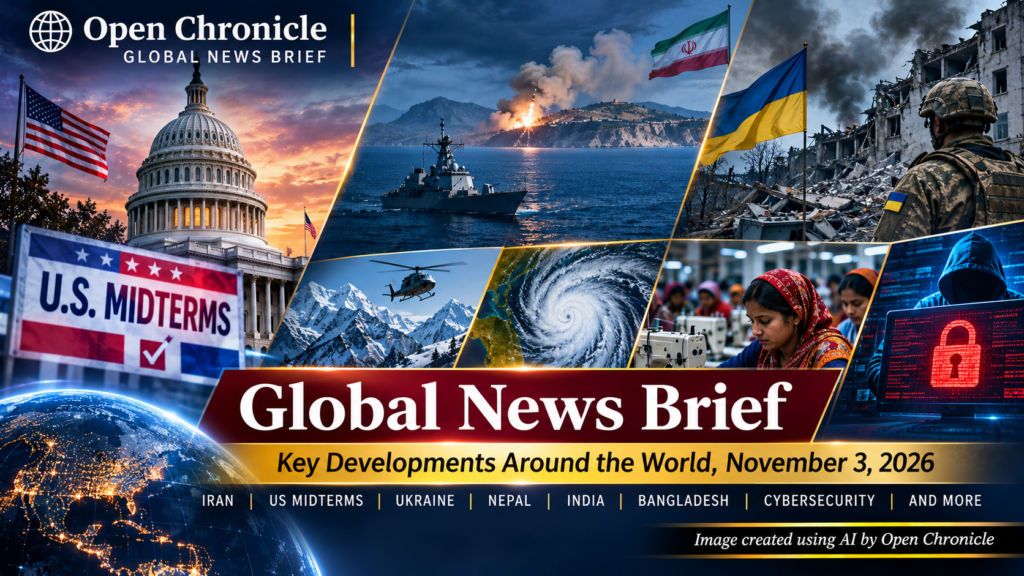
US strikes on an Iranian island raise tensions in the Strait of Hormuz as Washington pursues diplomacy with Tehran. Americans vote in consequential congressional elections, Russia and Ukraine prepare for new peace talks, and fresh violence, natural disasters and economic protests dominate developments across several continents.
By Open Chronicle
3 November 2026 | World News | Global News Brief
The world enters November 3 facing a series of overlapping political, military and economic challenges, with developments in the Middle East and the United States commanding international attention.
American forces have carried out limited strikes against Iranian targets near the Strait of Hormuz, even as President Donald Trump signals that a negotiated agreement with Tehran remains possible. The operation comes as US voters head to the polls in midterm elections that will determine control of Congress.
Meanwhile, Washington is preparing to bring Russian and Ukrainian representatives together in Abu Dhabi for another round of peace negotiations. Fighting in Ukraine continues, with reports of deadly Russian strikes and damage to civilian infrastructure.
Elsewhere, a helicopter collision in Nepal’s Everest region has killed an Indian national, Cyclone Murasu has struck India’s eastern coast, and garment workers in Bangladesh are continuing protests over wages.
In the digital sphere, North Korea has rejected US accusations linking it to a multibillion-dollar cryptocurrency theft, while Australia’s restrictions on social media access for children face a major constitutional challenge.
These are the principal international developments shaping Tuesday’s news agenda.
Middle East: US Strikes Iranian Island as Diplomacy Continues
American forces target Qeshm Island in the Strait of Hormuz
The United States has conducted limited military strikes against Iranian targets on Qeshm Island, a strategically important location near the Strait of Hormuz.
US officials described the operation as defensive, saying it was intended to counter threats from Iranian forces using surface-to-air missiles against American military assets.
Iranian state media reported several explosions on the island.
The strikes followed reports of confrontations involving Iranian forces and American aircraft operating near the waterway.
Washington has not presented the operation as the beginning of a renewed large-scale military campaign. Nevertheless, the action demonstrates how quickly military tensions can intensify while diplomatic negotiations remain underway.
Qeshm Island occupies an important position near the Strait of Hormuz, one of the world’s most strategically significant maritime routes.
Disruption to shipping through the strait has already affected international energy markets and commercial transportation.
The latest strikes therefore carry implications beyond the immediate confrontation between Washington and Tehran.
Trump says an agreement with Iran remains possible
Despite the military action, President Donald Trump has suggested that an agreement with Iran could be reached.
In comments published on Monday, Trump said Tehran wanted a settlement and indicated that negotiations might produce results.
Vice President JD Vance also expressed optimism about diplomatic progress.
Iranian officials have acknowledged continuing indirect discussions, with Qatar and Pakistan playing important mediation roles.
However, substantial disagreements remain.
Tehran has demanded changes to American restrictions affecting Iranian ports and maritime trade, while Washington continues to seek guarantees addressing military and regional security concerns.
The combination of renewed military action and diplomatic engagement reflects the fragile nature of the current confrontation.
A negotiated settlement could reduce pressure on shipping and energy markets, but the latest incidents underline the risk that further military exchanges could undermine those efforts.
United States: Midterm Elections Put Control of Congress at Stake
Millions of Americans are voting in congressional elections that could significantly reshape the political environment for the remainder of Donald Trump’s presidency.
All 435 seats in the House of Representatives are being contested, alongside the Senate seats scheduled for election and numerous state and local offices.
The results will determine whether Republicans retain control of Congress or whether Democrats gain the ability to challenge the administration’s legislative agenda more directly.
The campaign has been dominated by economic concerns, immigration, healthcare, political polarisation and the consequences of American foreign policy.
The war involving Iran and its effect on energy prices have also become part of the political debate.
Control of Congress will influence government spending, legislative negotiations, congressional oversight and the administration’s ability to advance domestic priorities.
The elections are also being closely watched internationally.
Governments in Europe, Asia and the Middle East are assessing how the outcome could affect American commitments on security, trade and diplomatic negotiations.
Supreme Court decision and election administration
The US Supreme Court has also attracted attention following reports concerning California’s ballot-counting procedures.
The court’s reported refusal to intervene in a dispute involving the counting of ballots has become part of the wider discussion about election administration.
Election officials across the country are preparing for close scrutiny of voting procedures, ballot processing and the announcement of results.
Final outcomes in closely contested races may not be known immediately, particularly where large numbers of mailed or provisional ballots require verification.
At the time of publication, voting is underway and no final nationwide congressional outcome has been established.
Ukraine: Washington Announces New Peace Talks in Abu Dhabi
The United States plans to bring Russian and Ukrainian representatives together in Abu Dhabi on November 10 and 11 for another round of negotiations aimed at ending the war.
US special envoy Steve Witkoff announced that the discussions would address security arrangements, military de-escalation, humanitarian measures and possible steps towards a settlement.
Witkoff and Jared Kushner are expected to participate in the American delegation.
The Kremlin has confirmed the planned meeting, with Russian officials indicating that Vladimir Medinsky will lead Moscow’s representatives.
Ahead of the talks, American negotiators are also expected to consult European partners in Brussels.
Those discussions will involve security guarantees for Ukraine, Europe’s future defence arrangements and economic assistance for reconstruction.
The diplomatic initiative comes as Russia and Ukraine remain divided over the conditions required for a lasting agreement.
Territorial control, security guarantees and the future relationship between Ukraine and Western defence institutions remain central obstacles.
The announcement of new negotiations does not indicate that a ceasefire or peace agreement has been reached.
Russian Strikes Cause Heavy Casualties in Ukraine
Reports from Ukraine describe another wave of Russian attacks against cities and infrastructure.
Ukrainian reporting indicates that strikes in the Zaporizhzhia region killed 29 people, while an attack affecting a hospital in Kharkiv left dozens injured.
Some reports placed the number of injured in the Kharkiv incident at 73, with patients requiring evacuation.
The reported casualty figures remain subject to official confirmation and revision.
The attacks also reportedly affected energy infrastructure in several regions, increasing concerns about electricity supplies as colder weather approaches.
Ukraine has repeatedly warned that attacks against its energy network could undermine heating, water services and essential civilian operations.
President Volodymyr Zelenskyy has urged Washington to maintain pressure on Moscow, arguing that diplomatic efforts must be accompanied by measures capable of discouraging further military escalation.
The continuing attacks illustrate the difficulty facing negotiators.
Even as preparations advance for the Abu Dhabi meeting, military operations remain intense and civilian populations continue to bear the consequences.
Nepal: Helicopter Collision Near Everest Kills Indian Tourist
A midair collision involving two helicopters in Nepal’s Everest region has killed an Indian national and injured three other people.
The accident occurred near Pheriche, a settlement frequently used by trekkers and climbers travelling in the Mount Everest region.
According to Nepalese reporting, the aircraft belonged to Air Dynasty and Fishtail Air.
The helicopters collided at approximately 8:11 a.m. local time while attempting to land.
The deceased passenger was identified as Basantkumar Balaramudu, approximately 47, from Chennai, India.
The injured included the pilots of both helicopters and another passenger, identified as a New Zealand citizen of Indian origin.
Emergency teams transported some of the injured to hospitals for treatment.
The Everest region relies heavily on helicopters for tourism, medical evacuations and access to remote mountain settlements.
However, the combination of high altitude, rapidly changing weather, mountainous terrain and concentrated aircraft movements creates operational challenges.
Authorities are expected to investigate the circumstances of the collision, including aircraft positioning and landing procedures.
The cause had not been conclusively established in the initial reports.
India: Cyclone Murasu Strikes Eastern Coast
Cyclone Murasu made landfall near Ongole in Andhra Pradesh on Tuesday morning, bringing strong winds and heavy rainfall to India’s eastern coastline.
According to the India Meteorological Department, the storm reached sustained wind speeds of approximately 100 to 110 kilometres per hour.
Authorities evacuated thousands of residents from vulnerable areas and introduced precautionary measures, including school closures and disruptions to transport services.
Rail services and some flights were suspended as emergency teams prepared for flooding, damaged infrastructure and coastal storm surges.
Meteorological authorities warned that water levels could rise significantly in low-lying coastal areas.
Murasu is the second cyclone to affect parts of the region within a week.
The earlier storm, Cyclone Arnab, caused deaths, damaged homes and agricultural infrastructure, and flooded extensive areas of farmland.
The succession of storms has increased pressure on emergency services and local communities still recovering from previous damage.
Agriculture is particularly vulnerable because heavy rainfall and flooding can destroy crops shortly before harvesting.
Authorities are continuing to assess the damage caused by Murasu as the system weakens over land.
Bangladesh: Garment Workers Continue Wage Protests
Garment workers in Bangladesh have entered a fourth day of protests demanding higher wages and improved working conditions.
The demonstrations reflect continuing economic pressure on employees in one of the country’s most important export industries.
Bangladesh is a major global producer of ready-made garments, supplying international clothing brands and retailers.
The industry employs millions of workers and generates a substantial share of the country’s export earnings.
However, workers have complained that wages have failed to keep pace with rising living costs.
Reports indicate that protesters are demanding a significant increase in minimum pay, with some calling for wages to double.
The demonstrations have disrupted activity in parts of the garment sector and increased pressure on factory owners and government authorities.
The dispute highlights a broader challenge facing export-oriented manufacturing economies.
International buyers seek competitive production costs, while workers face increasing expenses for food, housing and transportation.
A prolonged confrontation could affect production schedules and international supply chains.
The immediate question is whether negotiations can produce an agreement capable of addressing workers’ demands without triggering further disruption.
North Korea Rejects US Accusations Over Binance Cryptocurrency Theft
North Korea has rejected allegations by the United States that a state-linked hacking group was responsible for a cryptocurrency theft involving more than $6 billion from Binance.
The Federal Bureau of Investigation attributed the attack to a North Korean hacking operation identified as TraderTraitor.
Kim Yo Jong, the influential sister of North Korean leader Kim Jong Un, dismissed the allegations in a statement carried by the Korean Central News Agency.
She accused Washington of using the incident to portray North Korea as a state involved in international cybercrime.
The reported theft, estimated by different sources at approximately $6 billion to $6.3 billion, could rank among the largest cryptocurrency thefts ever recorded.
Binance has said it has taken steps to replace stolen assets and restore withdrawal services.
The exchange has also sought to reassure customers about its financial position.
American authorities have previously linked North Korean hacking groups to cryptocurrency thefts, arguing that illicit digital assets can help finance prohibited weapons programmes.
Pyongyang has consistently denied those accusations.
The latest dispute adds another source of tension to relations between Washington and North Korea, where efforts to revive high-level diplomacy remain uncertain.
The FBI’s attribution represents an official US investigative conclusion, not an admission of responsibility by North Korea.
Australia: High Court Examines Social Media Ban for Children
Australia’s High Court has begun examining legal challenges to the country’s restrictions on social media accounts for children under 16.
The legislation, which came into effect in December 2025, requires major social media platforms to take reasonable steps to prevent underage users from maintaining accounts.
The restrictions cover services including Facebook, Instagram, Threads, Reddit, Snapchat, TikTok, Twitch, X and YouTube.
Reddit and the Digital Freedom Project are challenging the law on constitutional grounds.
They argue that the restrictions impose an unjustified burden on political communication and prevent younger Australians from participating in important public discussions.
Reddit has also questioned whether its platform should fall within the legislation’s definition of an age-restricted social media service.
The Australian government maintains that the restrictions are justified by the need to protect children from online harms.
It argues that any burden on political communication is limited and proportionate to the legislation’s objectives.
According to Australian reporting, nearly five million accounts have been blocked across affected platforms since the law took effect.
The court proceedings are expected to examine the relationship between child protection, freedom of political communication and the responsibilities of technology companies.
The outcome could influence how other countries approach age restrictions and digital safety legislation.
Europe: Supermarket Cyberattacks Raise Infrastructure Concerns
European authorities are examining a series of suspected cyberattacks affecting refrigeration systems in supermarkets and food retailers.
Incidents reported in Belgium, Luxembourg, Sweden and other countries involved abnormal increases in refrigerator and freezer temperatures.
The disruptions followed similar attacks in France during October, when hundreds of supermarkets experienced refrigeration problems.
Some incidents resulted in substantial food losses and reports of overheating equipment.
The attacks have raised questions about the security of connected industrial control systems used to manage commercial refrigeration.
Such equipment can be monitored and adjusted remotely, creating vulnerabilities when systems are exposed to the internet without adequate protection.
The European Commission is reportedly examining the incidents as concerns grow about the wider implications for operational technology.
The attacks demonstrate how cybersecurity failures can produce consequences beyond stolen data, affecting physical equipment, commercial operations and food safety.
For retailers, the challenge is to identify vulnerable controllers, restrict unauthorised access and ensure that essential refrigeration functions remain protected.
Poland: Security Measures Intensify Near Kaliningrad
Polish authorities have reportedly increased security operations near the border with Russia’s Kaliningrad region amid concerns about sabotage and hostile activities.
The developments come during a period of heightened tension between Moscow and NATO members bordering Russian territory.
Kaliningrad occupies a strategically sensitive position between Poland and Lithuania.
The Russian exclave contains military infrastructure and is frequently discussed in assessments of security around the Baltic Sea.
Poland has strengthened border protection and internal security measures in response to the broader regional threat environment.
Reports of counterterrorism deployments and additional security operations underline Warsaw’s concerns about potential destabilisation.
However, individual reports of suspected sabotage require independent verification before responsibility can be attributed to any state or organisation.
The situation is being closely watched because security incidents near NATO borders can carry wider diplomatic and military consequences.
Israel and Gaza: Ceasefire Pressures Continue
Reports of further violence in Gaza have raised questions about the durability of the existing ceasefire arrangements.
Palestinian medical sources reported casualties following Israeli military activity, including deaths and injuries.
The Israeli government continues to face domestic political pressure, with reports of divisions affecting parliamentary support and coalition stability.
Opposition parties are seeking to challenge Prime Minister Benjamin Netanyahu’s political position.
The situation remains fluid, and competing claims about individual military incidents require careful attribution.
In the occupied West Bank, additional reports describe Israeli land seizures and operations affecting Palestinian communities.
These developments continue to complicate efforts to stabilise the wider Israeli and Palestinian conflict.
Humanitarian organisations have repeatedly warned that civilian protection, access to essential supplies and the preservation of medical services remain urgent concerns.
Other Developments Around the World
European energy security faces renewed uncertainty
European governments are monitoring natural gas supplies ahead of winter amid continued instability in the Middle East.
Disruption to energy markets and uncertainty surrounding the Strait of Hormuz have increased concerns about prices and supply availability.
The situation reinforces Europe’s exposure to international energy shocks, even as governments continue efforts to diversify supply sources.
South Korea investigates passport data leak
South Korean authorities are investigating the reported exposure of passport information belonging to President Lee Jae Myung and other senior officials.
Reports indicate that data relating to approximately 168 individuals may have been affected.
The incident has raised concerns about the handling of sensitive personal information within government systems.
Czech public media workers protest political interference
Employees at Czech public broadcasting organisations have launched industrial action amid allegations of political interference.
The dispute reflects wider European concerns about the independence of publicly funded media and the relationship between governments and national broadcasters.
Spain prepares support for rail disaster victims
Spanish authorities are continuing to address the consequences of a major rail accident that killed dozens of people.
The government is preparing assistance for victims and their families, while transport officials face questions about railway safety and the circumstances surrounding the disaster.
South Korea and Türkiye expand strategic cooperation
South Korea and Türkiye have announced additional cooperation involving nuclear energy financing, defence and infrastructure.
The discussions reflect growing efforts by both countries to expand industrial partnerships and technological cooperation.
India and Pakistan confront severe air pollution
Air pollution has reached dangerous levels in parts of northern India and Pakistan, including Delhi and Lahore.
The deterioration in air quality comes as seasonal atmospheric conditions and emissions intensify pollution concerns.
Authorities face pressure to protect public health and introduce measures to reduce exposure.
Global Outlook: Diplomacy, Elections and Security Dominate the Agenda
The developments of November 3 reveal an international environment in which political uncertainty and security concerns are increasingly interconnected.
The American midterm elections will shape the domestic balance of power in Washington, but their consequences could extend to US foreign policy and international negotiations.
The latest military strikes against Iran demonstrate the fragility of diplomatic efforts in the Middle East, particularly when vital energy routes remain exposed to confrontation.
In Europe, the proposed Abu Dhabi negotiations offer another opportunity to address the war in Ukraine, although continuing attacks underline the distance between diplomatic initiatives and conditions on the ground.
Meanwhile, events in South Asia highlight the human and economic consequences of natural disasters, industrial disputes and aviation accidents.
The cryptocurrency dispute involving North Korea and the legal challenge to Australia’s social media restrictions illustrate the growing importance of technology in international security and public policy.
Across these developments, one common challenge emerges: governments are being required to respond simultaneously to military threats, economic instability, technological risks and growing public demands for accountability.
As November 3 unfolds, the most consequential developments may be determined not only by decisions taken in Washington, Tehran or Moscow, but also by how effectively governments respond to the pressures affecting ordinary people.
Sources and Further Reading
The following sources provide independent reporting and context for the principal developments covered in this edition.
1. Reuters | US Carries Out Defensive Strikes on Iran’s Qeshm Island. November 3, 2026. Reporting on the American operation, statements from US officials and military tensions in the Strait of Hormuz. Read the Reuters report
2. Associated Press | US Conducts Defensive Strikes Against Iranian Targets. November 2, 2026. Independent reporting on the strikes and diplomatic negotiations. Read the Associated Press report
3. Reuters | US to Mediate Trilateral Talks With Ukraine and Russia in Abu Dhabi. November 3, 2026. Details of the planned November 10 and 11 negotiations and consultations with European allies. Read the Reuters report
4. Reuters | Kremlin Confirms Ukraine Peace Talks in Abu Dhabi. November 3, 2026. Confirmation of the meeting and Russian participation. Read the Reuters report
5. Associated Press | Heavy Rain Falls in Eastern India After Second Cyclone in a Week. November 3, 2026. Reporting on Cyclone Murasu, evacuations and damage risks. Read the Associated Press report
6. OnlineKhabar | Two Helicopters That Collided Had Flown From Lukla and Gorakshep to Pheriche. November 3, 2026. Details of the Nepal accident, casualties and rescue operations. Read the Nepalese report
7. Reuters | North Korea Rejects US Allegations Over Binance Cryptocurrency Theft. November 3, 2026. Reporting on the FBI’s attribution, North Korea’s denial and the consequences for Binance. Read the Reuters report
8. ABC News Australia | High Court to Consider Whether Under-16 Social Media Ban Is Unconstitutional. November 3, 2026. Coverage of the legal challenges, government arguments and constitutional questions. Read the ABC News report
Editorial Note
This Global News Brief was prepared on November 3, 2026, using the supplied international news feed and additional reporting from Reuters, Associated Press, ABC News Australia and other identified publications. Major developments concerning Iran, the planned Ukraine peace talks, Cyclone Murasu, the Nepal helicopter collision, the Binance dispute and Australia’s social media legislation were cross-checked against published reports. Several secondary items, including some casualty figures, political developments and security incidents, are based on the supplied news headlines and have not been independently confirmed in full. They should be treated as provisional pending further verification. Events remain developing, and details may change as official statements and additional reporting become available.