
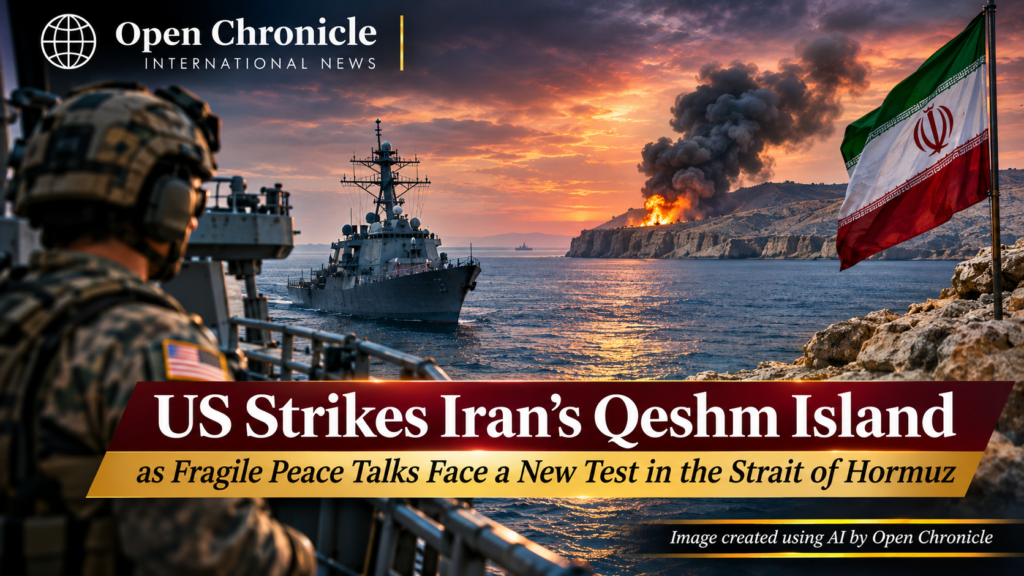
American forces have struck Iranian military targets near one of the world’s most important shipping routes, even as President Donald Trump suggests an agreement with Tehran remains possible. The confrontation exposes the fragile balance between military pressure, diplomacy and global energy security.
By Open Chronicle
November 3, 2026 | Middle East | International Security
The United States has carried out limited military strikes against Iranian targets on Qeshm Island, near the Strait of Hormuz, in a confrontation that threatens to complicate efforts to negotiate an end to the conflict between Washington and Tehran.
American officials described the operation, conducted on Monday, November 2, as a defensive response to threats against US military aircraft. Iranian state media reported several explosions on the island, while accounts from the region indicated that additional blasts were heard near the Iranian mainland.
The strikes came only hours after President Donald Trump suggested that a diplomatic agreement with Iran remained within reach.
That contrast has become the central feature of the latest crisis. Washington is attempting to preserve its military position in the Gulf while pursuing negotiations intended to prevent another major escalation.
For Tehran, the operation represents a further challenge to negotiations already complicated by disputes over maritime access, economic restrictions and the conditions for ending hostilities.
For international markets, the immediate concern is the Strait of Hormuz, a narrow maritime corridor whose security affects oil supplies, commercial shipping and energy prices across the world.
Although American officials have indicated that the operation was limited, the strikes demonstrate that military confrontation remains possible even as mediators attempt to bring both sides closer to an agreement.
What Happened on Qeshm Island?
The operation took place late on Monday, November 2, when US forces attacked targets on Qeshm Island, situated off Iran’s southern coast in the strategically sensitive Strait of Hormuz.
According to American officials cited by Reuters, the strikes were directed against Iranian forces using surface-to-air missile systems that threatened US military assets.
One official described the action as defensive, while another indicated that the operation did not represent a return to major combat operations.
CNN separately reported that three American officials confirmed the strikes, with one linking the decision to an incident in which Iranian forces had fired at a US aircraft.
The Wall Street Journal reported that the operation formed part of a series of smaller American strikes carried out in recent weeks, some of which had not previously been publicly acknowledged.
Iran’s official IRNA news agency reported several explosions on Qeshm Island. Witnesses described aircraft flying overhead shortly before the blasts.
Iranian media also reported explosions near Bandar Lengeh, a port city on the mainland.
The exact number of targets, the extent of the damage and any casualties had not been independently established in the initial reporting.
The Pentagon referred questions about the operation to US Central Command, which had not issued a detailed public account at the time of the Reuters report.
The absence of a comprehensive military statement leaves important questions unanswered, including the precise objectives of the strikes and whether further operations are planned.
Why Qeshm Island Matters
Qeshm is not an isolated military location.
It occupies a strategically important position near the entrance to the Strait of Hormuz, the narrow waterway connecting the Persian Gulf with the Gulf of Oman and the wider Indian Ocean.
The island’s geography gives Iran a significant position from which to monitor maritime traffic and support military operations in the surrounding waters.
Iranian forces have developed capabilities intended to challenge hostile naval and aerial operations in the region, including coastal missile systems, drones and air defence equipment.
The Islamic Revolutionary Guard Corps plays an important role in Iran’s military posture around the strait.
For the United States, maintaining access to these waters is central to its regional security commitments and the protection of commercial shipping.
For Iran, the ability to influence maritime activity provides both a defensive advantage and an important source of diplomatic leverage.
This makes Qeshm particularly sensitive during periods of military confrontation.
An incident involving aircraft or missile systems around the island can quickly acquire wider significance because of the surrounding concentration of military forces and commercial vessels.
The latest strikes therefore cannot be understood solely as an isolated exchange between American and Iranian units.
They occurred in one of the world’s most economically important maritime environments.
The Incident That Reportedly Triggered the Strikes
American officials have linked the operation to threats against US aircraft.
According to reports citing US officials, Iranian forces fired at an American aircraft operating near the Strait of Hormuz.
The subsequent American response reportedly targeted equipment associated with Iranian air defence capabilities.
Separately, Iran’s Islamic Revolutionary Guard Corps claimed that it had intercepted or destroyed American unmanned aircraft in the region.
Iranian statements referred to reconnaissance drones south of Qeshm Island and an MQ-9 drone east of the strait.
Those claims had not been independently verified in the initial reporting.
The two accounts illustrate the difficulty of establishing a complete picture during rapidly developing military incidents.
American officials describe the strikes as measures to protect their forces.
Iranian authorities present their military activity in the Gulf as part of the defence of Iranian territory and sovereignty.
Determining the exact sequence of events requires more than statements from either government.
Independent evidence, including imagery, operational records and verified information about aircraft movements, would be necessary to establish the full circumstances.
For now, the confirmed central development is that American officials acknowledged limited strikes against Iranian targets, while Iranian media reported explosions in the affected area.
Trump Signals Diplomacy Even as Military Operations Continue
The timing of the strikes is particularly significant.
Earlier on Monday, President Donald Trump suggested that progress towards an agreement with Iran remained possible.
Writing on Truth Social, Trump indicated that Tehran wanted a settlement and expressed confidence that negotiations could produce results.
Vice President JD Vance also described the diplomatic discussions in positive terms.
Speaking to reporters, Vance said the administration believed progress had been made and that further negotiations would continue.
The comments followed several days of indirect exchanges involving regional mediators.
Qatar and Pakistan have played important roles in transmitting proposals and attempting to narrow differences between Washington and Tehran.
Iranian Foreign Minister Abbas Araghchi confirmed that consultations were continuing through intermediaries.
However, optimism expressed by American officials does not mean the two sides have agreed on the principal conditions for ending the conflict.
Indeed, the latest strikes illustrate the tension between the administration’s diplomatic messaging and its continuing willingness to use military force.
For negotiators, the challenge is to prevent such incidents from destroying the limited confidence required for further discussions.
Iran Says an Agreement Remains Distant
Despite positive signals from Washington, Iranian officials have cautioned that substantial disagreements remain.
A senior Iranian official told Reuters on Tuesday that the United States and Iran were still far from reaching an agreement.
According to that account, mediators were working to narrow differences over a proposed settlement, but Tehran continued to reject demands it considered excessive.
Iran has linked progress towards an agreement to the lifting of American restrictions affecting its maritime trade and ports.
Tehran has also insisted that the conditions for reopening the Strait of Hormuz must be addressed before broader negotiations can advance.
The Iranian position places maritime access at the centre of the diplomatic process.
Washington, meanwhile, is seeking assurances that Iranian forces will not threaten American military assets or commercial navigation.
These competing priorities create a difficult negotiating environment.
Iran wants relief from measures that have constrained its economy and maritime activity.
The United States wants security guarantees that would reduce the likelihood of renewed confrontation.
Neither objective can easily be separated from the military balance in the Gulf.
The latest strikes may therefore reinforce the demands of both sides rather than accelerate agreement.
The Strait of Hormuz and the Global Economy
The economic implications of the confrontation extend far beyond Iran and the United States.
Under normal conditions, the Strait of Hormuz carries approximately one fifth of the world’s oil consumption, making it one of the most important energy transit routes.
Oil exporters in the Persian Gulf depend heavily on access to the waterway.
Importing economies in Asia and Europe are also exposed to disruptions because international oil prices respond to changes in supply expectations.
The conflict that began in late February has already severely disrupted shipping through the strait.
Commercial operators face increased security risks, uncertainty over maritime access and higher costs associated with transporting energy supplies.
Even limited military incidents can affect market sentiment.
The possibility of further strikes, missile attacks or restrictions on shipping creates uncertainty about future supplies.
That uncertainty can influence oil prices before any additional physical disruption occurs.
For households and businesses, the consequences may eventually be reflected in fuel costs, transportation expenses and the price of goods.
The relationship is not automatic, however. Retail energy prices also depend on taxation, refining capacity, exchange rates, inventories and domestic market conditions.
Nevertheless, the Strait of Hormuz remains a central source of vulnerability for the international energy system.
Oil Markets React to the Threat of Renewed Escalation
The reaction in energy markets illustrates how closely investors are following developments in the Gulf.
On Monday, oil prices fell by more than 7 percent as reports of diplomatic progress encouraged hopes that the conflict might be moving towards a settlement.
Those expectations changed after news emerged of the American strikes.
By approximately 10:43 GMT on Tuesday, Brent crude had risen to $106.13 a barrel, while US West Texas Intermediate crude reached $97.91.
The movements reflected renewed uncertainty about the prospects for peace and the security of Middle Eastern energy supplies.
The sharp changes in prices over a short period demonstrate how sensitive the market has become to political and military developments.
Even when a strike causes no confirmed damage to oil production facilities, the possibility of escalation can affect expectations about future supply.
For energy importers, this uncertainty complicates economic planning.
For oil exporters, higher prices may increase revenues in the short term, but prolonged disruption to shipping can create serious operational and commercial problems.
The consequences are therefore not uniform.
Much depends on whether the confrontation remains limited or develops into a broader campaign affecting maritime infrastructure and energy production.
The American Midterm Elections Add Political Pressure
The strikes occurred immediately before the November 3 midterm elections in the United States.
American voters are choosing representatives who will determine the balance of power in Congress during the remaining two years of Trump’s presidency.
The conflict with Iran has become an important political issue, particularly because of its economic consequences.
Higher fuel prices, concerns about military escalation and the costs associated with prolonged regional instability have contributed to public debate over the administration’s foreign policy.
Trump had previously suggested that additional military operations against Iran might be considered after the elections.
However, his comments on Monday appeared to signal a preference for continued negotiations rather than an immediate return to large-scale combat.
The limited strikes complicate that message.
They allow the administration to argue that it is responding to threats against American forces while maintaining that a broader diplomatic settlement remains possible.
Whether voters interpret that combination as a necessary security measure or as evidence of continuing instability is a matter for the electorate.
There is no established basis for attributing the timing of the operation to a particular electoral objective.
Nevertheless, the proximity of the strikes to Election Day gives the incident considerable political significance.
Regional Powers Face a Difficult Diplomatic Balance
The confrontation has also placed pressure on governments throughout the Gulf.
Qatar has emerged as a central intermediary in the negotiations, working with other regional partners to transmit proposals between Washington and Tehran.
Pakistan has also participated in diplomatic efforts.
These governments have an interest in preventing a renewed escalation that could threaten regional stability and international trade.
For Gulf countries, the risks are particularly direct.
Military operations in the Strait of Hormuz can affect ports, shipping companies, energy infrastructure and commercial activity.
A broader conflict could also expose neighbouring states to retaliatory attacks or interruptions to essential services.
Saudi Arabia and Iran have continued discussions concerning regional security arrangements, reflecting an effort to preserve diplomatic channels despite continuing tensions.
China and Russia have also expressed opposition to renewed large-scale military operations.
Their positions reflect both geopolitical interests and concerns about the economic consequences of a prolonged disruption to energy supplies.
The challenge for mediators is to develop an agreement that addresses immediate military risks while creating sufficient confidence for negotiations on more difficult questions.
Three Possible Paths for the Crisis
The immediate future of the confrontation depends on decisions that have not yet been announced.
Three broad developments deserve particular attention.
A limited military confrontation followed by continued negotiations
The United States and Iran could continue diplomatic exchanges while attempting to contain military incidents around the Strait of Hormuz.
Under this scenario, mediators would seek practical arrangements to reduce threats to aircraft and commercial shipping.
Such measures might provide the conditions for broader discussions without requiring an immediate settlement of every disagreement.
Renewed military escalation
Further incidents involving aircraft, missiles or maritime traffic could lead to additional strikes and retaliation.
This would increase the risk of disruption to shipping and could place greater pressure on regional governments.
The possibility is particularly concerning because military operations around the strait take place in a relatively confined geographical area.
Misinterpretation or an unexpected confrontation could rapidly intensify an already unstable situation.
A negotiated arrangement to reopen the strait
Diplomatic efforts could produce an agreement involving restrictions on military activity, changes to maritime access and reciprocal measures intended to rebuild confidence.
Such an arrangement would not necessarily resolve every dispute between Washington and Tehran.
However, restoring more predictable commercial navigation would represent an important practical achievement.
These are possible developments rather than forecasts. Available reporting does not establish which outcome will occur.
What Comes Next?
Several questions remain unresolved following the strikes.
The first concerns the military situation.
American officials have characterised the operation as limited, but a fuller account of the targets and damage has not been publicly established.
The second concerns Iran’s response.
Tehran must decide whether to answer the operation militarily, diplomatically or through measures affecting maritime activity.
The third concerns the negotiations.
Mediators are attempting to narrow differences between the two governments, but the conditions for reopening the Strait of Hormuz and beginning broader discussions remain contested.
Finally, international energy markets will continue to respond to indications of either escalation or diplomatic progress.
A meaningful reduction in military tensions could improve expectations about shipping and supply.
Further confrontation could reverse those expectations.
For now, the situation remains uncertain.
The American strikes have not been presented by Washington as the beginning of a major new offensive.
But they have demonstrated that the military confrontation has not ended.
A Dangerous Moment for Diplomacy
The events surrounding Qeshm Island reveal the central contradiction of the current crisis.
The United States and Iran are discussing how to end their confrontation while their armed forces remain engaged in potentially dangerous operations.
Each side considers its military position essential to its security.
Each also faces substantial costs if the conflict intensifies.
For Washington, the challenge is to protect American forces and regional interests without undermining the negotiations it says it wants to pursue.
For Tehran, the challenge is to preserve its security and bargaining position while seeking relief from restrictions that have affected its economy.
For countries dependent on the Strait of Hormuz, the priority is more immediate: restoring confidence that commercial shipping can operate without the constant threat of military confrontation.
The latest strikes may remain a limited episode.
They could also become another obstacle in a diplomatic process already burdened by deep disagreements.
The central question is no longer simply whether Washington and Tehran want an agreement. It is whether they can prevent another military incident from destroying the opportunity to reach one.
Sources and Further Reading
The following references support the factual reporting, military context, diplomatic developments and energy market analysis presented in this article.
1. Reuters | US Carries Out Defensive Strikes on Iran’s Qeshm Island
November 3, 2026 | Military Reporting
Reporting by Phil Stewart, Steve Holland and Jasper Ward on the American operation, statements from US officials and the circumstances surrounding the strikes.
2. Associated Press | US Strikes Iranian Targets in the Strait of Hormuz, Leaving Unclear What Comes Next
November 3, 2026 | Independent News Reporting
Independent reporting on the operation, Iranian accounts of explosions, the American political context and diplomatic efforts.
3. Reuters | Iran Says Agreement With US Remains Distant Despite Diplomatic Efforts
November 3, 2026 | International Diplomacy
Reporting on Tehran’s negotiating position, Qatari mediation and the unresolved conditions for reopening the Strait of Hormuz.
4. Reuters | Oil Rises as Iran Says War Deal Remains Distant
November 3, 2026 | Energy Markets
Coverage of energy market movements, the reaction to the Qeshm strikes and concerns about continued disruption to international oil supplies.
5. CNN | US Military Conducts Strikes on Iran’s Qeshm Island in Defensive Operation
November 2, 2026 | US Military and National Security
Reporting by Alayna Treene and Kevin Liptak, citing three US officials concerning the operation and the reported threat to an American aircraft.
6. Axios | Trump Says He Is in No Rush to Decide on Renewed Strikes Against Iran
November 2, 2026 | US Foreign Policy
Reporting on the administration’s deliberations, diplomatic initiatives and competing approaches to the confrontation.
7. Al Jazeera | Explosions Hit Iran’s Qeshm Island as US Media Report Strikes
November 3, 2026 | Regional Reporting
Regional reporting on explosions, Iranian military claims and developments surrounding the Strait of Hormuz.
8. Reuters | Iran Says Contacts Over Ending War Continue After Talks Finish Without Breakthrough
November 2, 2026 | Diplomatic Background
Reporting on mediation involving Qatar and Pakistan, Iran’s proposed settlement framework and outstanding differences with Washington.
Editorial Note
This article was prepared on November 3, 2026, using reporting from Reuters, Associated Press, CNN, Axios and other international news organisations. The United States has acknowledged limited strikes against Iranian targets near Qeshm Island, but the precise damage, casualties and full sequence of military events have not been independently established. American descriptions of the operation as defensive are attributed to US officials, while Iranian claims concerning American aircraft and military activity are presented as statements requiring independent verification. Diplomatic discussions remain ongoing, and no final agreement between Washington and Tehran has been announced. The analysis of possible military, diplomatic and economic consequences represents Open Chronicle’s editorial assessment based on the available reporting.