
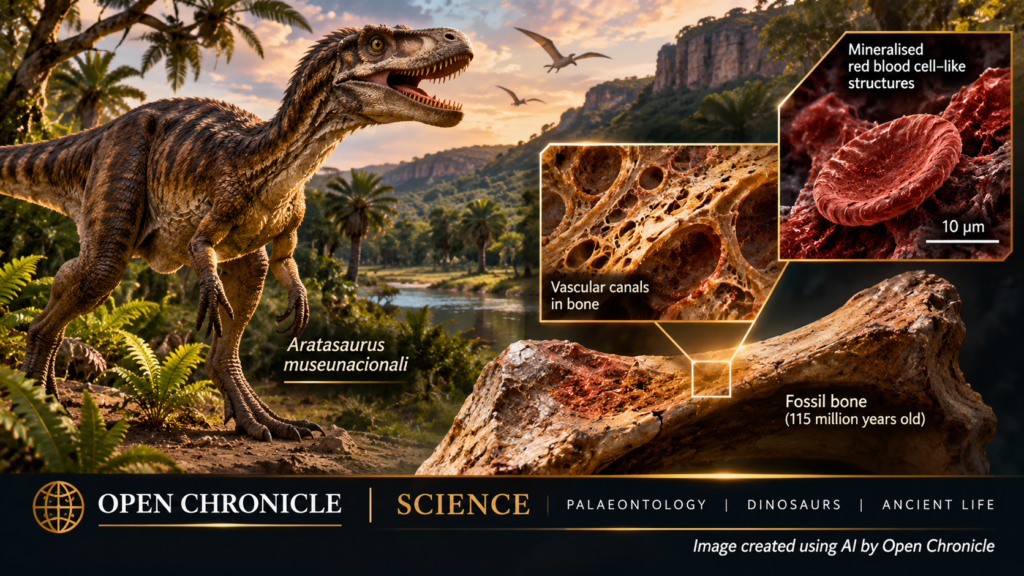
Researchers examining a Cretaceous dinosaur from Brazil have identified microscopic structures and chemical signatures associated with blood, opening new possibilities for studying prehistoric biology while prompting scientific debate over what has truly survived.
By Open Chronicle News Desk
November 6, 2026 | Open Chronicle Science | Palaeontology & Fossil Discoveries
For more than a century, dinosaur fossils have allowed scientists to reconstruct the skeletons, movements and evolutionary relationships of animals that disappeared millions of years ago.
But a remarkable investigation into a fossil discovered in northeastern Brazil suggests that ancient bones may preserve something far more delicate than their original structure.
Researchers have reported chemical traces associated with blood inside the fossilised remains of Aratasaurus museunacionali, a small carnivorous dinosaur that lived approximately 115 million years ago.
The findings, published in the Proceedings of the National Academy of Sciences in early November 2026, raise the possibility that molecular remnants of ancient biological material can survive across geological timescales once considered incompatible with such preservation.
The research team identified microscopic structures resembling red blood cells and detected chemical signatures associated with heme, an iron-containing component of haemoglobin.
These findings do not mean that scientists have recovered liquid dinosaur blood, living cells or intact genetic material.
Instead, they suggest that some chemically altered traces of ancient biological substances may remain preserved within mineralised fossils.
The discovery could provide new ways to investigate the physiology of extinct animals, while also highlighting the difficulties of distinguishing original biological material from geological processes and contamination.
A Dinosaur From Brazil’s Ancient Cretaceous World
The fossil belongs to Aratasaurus museunacionali, a theropod dinosaur discovered in Brazil’s Ceará state.
During the Early Cretaceous, approximately 115 million years ago, northeastern Brazil was part of a changing landscape of rivers, lakes and sedimentary environments.
The region’s geological formations have preserved an extraordinary record of prehistoric life, including fish, reptiles, insects, plants and dinosaurs.
Aratasaurus belonged to the broader evolutionary lineage of theropods, a group that includes some of the most famous predatory dinosaurs and ultimately gave rise to modern birds.
Unlike enormous predators such as Tyrannosaurus rex, this animal was relatively small.
The fossil examined by researchers belonged to an individual estimated to have been around four years old when it died.
Its remains were recovered from a gypsum mining area, where geological conditions helped preserve portions of its skeleton.
The specimen had already attracted scientific interest because of its evolutionary significance.
Now, the investigation of its internal bone structures has revealed an entirely different dimension of its scientific value.
What Scientists Found Inside the Bone
Bones are living tissues supplied by blood vessels.
During an animal’s lifetime, microscopic vascular canals transport blood and nutrients through the skeleton.
After death, these spaces may become filled with minerals as the bone undergoes fossilisation.
Researchers examining the Aratasaurus specimen investigated these internal canals using advanced microscopic techniques.
They identified small structures with shapes resembling red blood cells.
The structures were preserved within the mineralised bone, rather than existing as free-floating biological cells.
Their location was significant because it corresponded to spaces that would originally have contained blood vessels.
However, appearance alone cannot establish that a microscopic structure is a preserved blood cell.
Natural mineral formations and microbial activity can sometimes produce shapes resembling biological material.
To investigate further, the scientists examined the chemical composition of the structures and their surrounding environment.
The Chemical Signature of Ancient Blood
One of the most important findings involved chemical evidence associated with heme.
Heme is an iron-containing molecular structure that forms part of haemoglobin, the protein responsible for transporting oxygen in vertebrate blood.
In living animals, haemoglobin allows red blood cells to carry oxygen from respiratory organs to tissues throughout the body.
The research team used sophisticated analytical techniques, including mass spectrometry, to search for chemical compounds associated with this biological system.
They reported signatures consistent with heme-related material within the fossil.
The combination of microscopic structures and chemical evidence supported the interpretation that remnants associated with the dinosaur’s blood had been preserved.
Nevertheless, the researchers did not recover complete haemoglobin molecules in their original biological state.
The detected compounds had undergone chemical changes during fossilisation.
The scientific significance lies in the possible preservation of molecular information, not the survival of fresh blood.
How Could Blood-Related Material Survive for 115 Million Years?
The survival of biological traces over such an immense period is one of the most intriguing aspects of the investigation.
Under ordinary conditions, soft tissues and complex biological molecules begin degrading soon after death.
Microorganisms, oxygen, water and temperature changes contribute to their breakdown.
Over millions of years, fossilisation typically replaces or surrounds original biological material with minerals.
Yet under exceptional conditions, some chemical signatures may remain detectable.
The researchers suggested that mineral interactions played a central role in the preservation of the Aratasaurus material.
One mineral of particular interest was hausmannite, a manganese oxide.
Its presence may have helped stabilise microscopic structures and influence the chemical processes occurring within the fossil.
Rapid burial, restricted oxygen availability and other environmental factors may also have contributed.
These mechanisms could explain how the original biological material was transformed into mineral-associated chemical residues without losing every trace of its identity.
The discovery therefore challenges the assumption that fossilisation necessarily destroys all molecular evidence of an organism’s original tissues.
A Scientific Discovery That Is Already Being Debated
The research has attracted attention because of its potential implications for molecular palaeontology.
However, the identification of ancient blood cells remains scientifically contentious.
Palaeontologist Mary Schweitzer, whose research has helped establish the possibility of preserving original biological components in dinosaur fossils, has questioned aspects of the microscopic evidence.
One concern involves the shape of the reported structures.
Unlike human red blood cells, those of living birds and reptiles contain nuclei.
Their morphology therefore differs from the familiar flattened discs commonly associated with human blood.
Some structures identified in the fossil do not display all the characteristics expected of red blood cells from a dinosaur closely related to birds.
Schweitzer has questioned whether the microscopic structures can be confidently identified as blood cells.
At the same time, the chemical evidence remains significant.
The detection of heme-related compounds within the fossil’s vascular structures provides an additional line of evidence that deserves further investigation.
The debate illustrates an important distinction between identifying ancient chemical signatures and reconstructing the original biological structures that produced them.
The researchers consider their evidence compelling, but independent replication and further comparative studies will be valuable in assessing the findings.
Does This Mean Scientists Could Recover Dinosaur DNA?
The discovery naturally raises a question familiar to anyone who has watched Jurassic Park.
Could scientists eventually recover dinosaur DNA and recreate extinct species?
The answer, based on current scientific knowledge, remains no.
The researchers did not recover intact dinosaur DNA.
Nor did they identify complete, functioning blood cells capable of supporting biological processes.
The structures examined were mineralised, and the molecules had undergone extensive chemical alteration.
DNA is particularly vulnerable to degradation over time.
Even under favourable preservation conditions, its molecular structure breaks down.
Finding heme-related compounds does not establish that intact genetic information has survived for 115 million years.
The scientific value of the discovery is therefore not the possibility of cloning dinosaurs.
It is the prospect of recovering chemical information that may reveal aspects of their biology.
What Ancient Blood Chemistry Could Tell Us About Dinosaurs
Blood plays a central role in animal physiology.
It transports oxygen, nutrients and other substances throughout the body.
In vertebrates, haemoglobin is particularly important because it allows oxygen to be carried efficiently.
The evolution of blood chemistry is connected to changes in metabolism, activity and environmental adaptation.
If scientists can reliably identify blood-derived molecules in ancient fossils, they may eventually gain new insights into these processes.
For example, comparisons between fossilised chemical signatures and those found in living birds and reptiles could help researchers investigate evolutionary changes in oxygen transport.
Such investigations might contribute to debates about dinosaur metabolism.
Were particular species highly active animals with elevated metabolic demands?
How did their physiology respond to environmental conditions?
What biological characteristics did they share with modern birds?
The present discovery does not answer these questions directly.
However, it suggests that fossils may contain molecular evidence capable of supporting future research into them.
The Role of Brazilian Scientific Institutions
The investigation also highlights the importance of Brazil’s palaeontological heritage.
The Chapada do Araripe region is internationally recognised for its exceptional fossil record.
Its geological formations have preserved numerous organisms from the Cretaceous Period, including species that have transformed scientific understanding of prehistoric ecosystems.
The Aratasaurus specimen was discovered in 2008 near Santana do Cariri.
Its subsequent study involved Brazilian institutions, including the Regional University of Cariri and the National Museum of the Federal University of Rio de Janeiro.
Researchers from Curtin University, Johns Hopkins University and Japanese scientific institutions also participated in the international collaboration.
The project demonstrates how fossils collected and preserved in museum collections can generate important discoveries many years after their original excavation.
A specimen initially studied for its skeletal anatomy may later reveal chemical information that earlier technologies could not detect.
For Brazilian palaeontology, the research reinforces the scientific importance of maintaining fossil collections and supporting international research partnerships.
Could the Discovery Help Scientists Search for Life Beyond Earth?
One of the most intriguing implications concerns astrobiology.
Astrobiologists investigate how life originates, evolves and leaves detectable evidence in different environments.
An important challenge is understanding which biological signatures can survive for extremely long periods.
On Earth, fossilisation demonstrates that organisms can leave mineralised traces long after their original tissues have disappeared.
The Aratasaurus findings suggest that certain molecular signatures may also persist under exceptional geological conditions.
This could influence the development of methods used to search for ancient life elsewhere in the Solar System.
Mars is a particularly relevant example.
The planet contains geological formations that preserve evidence of ancient water and sedimentary environments.
If life ever existed there, researchers would need to identify chemical or structural traces that survived billions of years of environmental change.
Understanding how minerals preserve biological signatures on Earth could help scientists distinguish potential biosignatures from non-biological processes on other planets.
However, the discovery provides no evidence that extraterrestrial life exists.
Its contribution is methodological.
It may help scientists understand what kinds of ancient biological information can survive and how to recognise them.
The Future of Molecular Palaeontology
The study forms part of a growing scientific effort to investigate fossils at the molecular level.
Advanced imaging techniques and increasingly sensitive chemical instruments allow researchers to examine structures that were previously inaccessible.
These methods can reveal information about ancient proteins, pigments, lipids and other biological compounds.
But molecular palaeontology also faces significant challenges.
Researchers must establish whether detected substances originated from the fossilised organism or entered the specimen through contamination.
They must distinguish biological structures from mineral formations that resemble cells or tissues.
And they must determine how chemical transformations during fossilisation affect the interpretation of ancient molecules.
The Aratasaurus investigation addresses several of these difficulties by combining different analytical techniques.
Future studies may test the findings using additional specimens and independent laboratories.
Researchers are also investigating how biological material becomes mineralised under conditions resembling those found in ancient sedimentary environments.
Such experiments could help explain why some fossils preserve extraordinary molecular details while others retain only their skeletal structure.
Conclusion | A New Window Into Prehistoric Life
The discovery of heme-related molecules inside a 115-million-year-old dinosaur fossil represents an important advance in the investigation of ancient biological preservation.
The research provides strong chemical evidence that traces associated with blood can remain detectable across immense geological timescales.
It also raises questions about the interpretation of microscopic structures and the processes that allowed such material to survive.
Scientists have not recovered fresh dinosaur blood, living cells or intact DNA.
What they have identified is potentially more valuable for understanding the fossil record: evidence that mineralised bones may preserve molecular information about organisms that disappeared millions of years ago.
If further research supports these findings, scientists may be able to investigate aspects of dinosaur physiology that once seemed permanently beyond reach.
The discovery also reinforces the importance of museum collections, international scientific cooperation and the continuing development of analytical technology.
After 115 million years, a dinosaur from ancient Brazil may still have something extraordinary to tell us about the biology of prehistoric life.
Sources and Further Reading
1. PNAS | Heme Signatures in Mineralized Red Blood Cells Within Vascular Canals of a 115-Million-Year-Old Dinosaur Bone
2 November 2026. Original peer-reviewed research describing the chemical and microscopic evidence from Aratasaurus museunacionali, including heme-related molecules, vascular structures and mineral preservation.
2. Curtin University | Dinosaur Blood: Oldest Discovery Rewrites What Fossils Can Reveal
3 November 2026. Official research announcement explaining the discovery, its analytical methods, the role of hausmannite and potential implications for molecular palaeontology.
3. Universidade Regional do Cariri | Brazilian Dinosaur Fossil Preserves Evidence of Blood
3 November 2026. Institutional reporting on the discovery in Ceará, the participation of Brazilian scientists and the significance of the Araripe fossil collections.
4. Reuters | Evidence of Red Blood Cells Seen in Dinosaur Fossil From Brazil
2 November 2026. Independent coverage of the chemical findings, the fossil’s geological context and the distinction between mineralised blood-related traces and intact biological material.
5. ABC News Australia | Mineralised Red Blood Cells Detected in Dinosaur Bone
3 November 2026. Scientific reporting examining the discovery, preservation mechanisms and expert debate over whether the microscopic structures can be conclusively identified as blood cells.
Editorial Note
This article is based on research published online in PNAS on November 2, 2026, and accompanying institutional and independent scientific reporting.
The study reports heme-related molecular signatures within mineralised structures interpreted as ancient red blood cells. While the chemical evidence is significant, aspects of the microscopic identification remain subject to scientific debate.
The discovery does not establish the survival of liquid blood, living cells, intact dinosaur DNA or complete functional haemoglobin proteins.