
By Open Chronicle News Desk
20 November 2026 | Asia | International Relations
| Asia
By Open Chronicle News Desk | November 20, 2026 | Asia & International Relations
The unprecedented meeting between the leaders of China, the United States and Russia produced a declaration on peace and nuclear security. Yet behind the diplomatic spectacle, the world’s most dangerous conflicts remain unresolved, raising questions about whether Beijing has helped open a new era of cooperation or simply demonstrated its growing geopolitical influence.
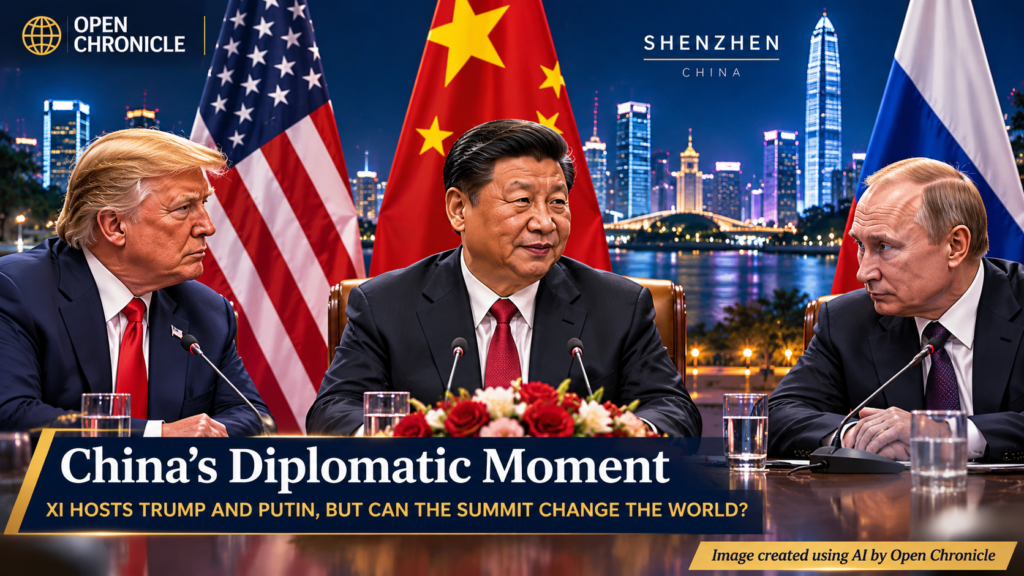
SHENZHEN, China. Three of the world’s most powerful leaders gathered in southern China on November 19 for a summit with extraordinary diplomatic symbolism.
Chinese President Xi Jinping hosted US President Donald Trump and Russian President Vladimir Putin for their first trilateral meeting, bringing together the leaders of three nuclear powers at a time of intense international instability.
The meeting, held on the sidelines of the Asia Pacific Economic Cooperation summit, concluded with a four-point declaration covering nuclear risk reduction, United Nations reform, energy security and the jurisdiction of international courts.
But there was a striking contrast between the significance of the gathering and the limited substance of its conclusions.
There was no agreement to end Russia’s war against Ukraine, no new nuclear arms reduction treaty and no comprehensive framework for resolving the conflicts destabilising the Middle East.
The summit may nevertheless have changed something important: the diplomatic balance between the three countries themselves.
A diplomatic victory for Beijing
For Xi Jinping, hosting the summit offered an opportunity to present China as an indispensable centre of international diplomacy.
Beijing has spent years arguing that global governance should reflect a more multipolar international system, with a greater role for emerging powers and less dependence on Western institutions.
The Shenzhen meeting allowed China to demonstrate that ambition in unusually visible terms.
Rather than participating in a diplomatic initiative organised by Washington or Moscow, Xi brought the American and Russian presidents to Chinese territory.
The symbolism was unmistakable.
China was not merely another participant in negotiations between great powers. It was the host, the organiser and a central figure in the diplomatic conversation.
That distinction matters because international influence is measured not only by military capabilities or economic output, but also by a government’s ability to convene rivals and shape negotiations.
The meeting strengthened Beijing’s claim to be a major diplomatic power, even though it did not establish China as a neutral mediator or produce a settlement to the conflicts under discussion.
The Financial Times described the summit as an important diplomatic success for Xi while highlighting the risk that other countries could interpret the meeting as an attempt by powerful states to divide international influence among themselves.
What the three leaders actually agreed
The declaration contained four principal commitments.
THE SHENZHEN DECLARATION | 19 NOVEMBER 2026
| United Nations | Support for reforms intended to improve the organisation’s effectiveness. |
| Energy security | Plans to increase refined petroleum supplies and maintain stable energy flows. |
| International justice | Emphasis on state consent, official immunities and limits on the exercise of international criminal jurisdiction. |
| Nuclear security | Agreement to pursue dialogue on nuclear risks and nonproliferation. |
Based on the official declaration published by the White House and China’s Ministry of Foreign Affairs.
These commitments provide a basis for future discussions, but they are not equivalent to enforceable international agreements.
The nuclear language is particularly revealing.
All three leaders reaffirmed the principle that nuclear war cannot be won and must never be fought.
However, they did not announce verified reductions in nuclear arsenals, inspection mechanisms, a negotiation timetable or a new arms control treaty.
For governments concerned about nuclear proliferation, the declaration is therefore a diplomatic opening rather than a concrete security breakthrough.
Ukraine: The conflict the declaration did not resolve
One of the most consequential omissions was Russia’s war against Ukraine.
Putin acknowledged that Ukraine was among the international conflicts relevant to the meeting, and Trump had expressed interest in using the summit to advance diplomatic solutions.
Yet the joint declaration did not establish a ceasefire, specify conditions for negotiations or address Ukraine’s territorial sovereignty.
This absence raises a fundamental question about the effectiveness of high-level diplomacy when the parties cannot agree on the central issues driving a war.
Ukraine and its European partners also face a separate concern: whether negotiations involving Washington, Moscow and Beijing could eventually produce proposals affecting European security without sufficient European or Ukrainian participation.
The historical comparison is particularly sensitive because twentieth-century great-power conferences often determined the political future of smaller countries.
For Europe, the challenge is ensuring that diplomatic engagement among major powers does not weaken the principle that Ukraine must participate in decisions concerning its future.
For China, meanwhile, maintaining relations with Russia while cultivating diplomatic cooperation with Washington remains a difficult balancing act.
Nuclear diplomacy without nuclear disarmament
The Shenzhen summit brought together leaders whose countries possess substantial nuclear capabilities.
That alone made nuclear security an unavoidable subject.
The declaration’s commitment to further dialogue may help create channels for discussing strategic stability, crisis communication and proliferation risks.
But the distinction between dialogue and disarmament is essential.
A meaningful arms control framework would require negotiators to address issues such as the number and deployment of nuclear weapons, verification procedures, transparency and compliance.
None of those mechanisms was established in the published declaration.
The absence of binding commitments means the summit should not be interpreted as the beginning of a verified nuclear reduction programme.
Its significance lies in reopening or reinforcing the possibility of discussions, not in having achieved disarmament.
The International Criminal Court and a controversial commitment
One of the declaration’s most politically sensitive provisions concerned the jurisdiction of international criminal institutions.
The three governments emphasised state consent and the immunities of state officials, while warning against abuses of jurisdiction by the International Criminal Court and similar bodies.
This language carries implications beyond technical legal disagreements.
Supporters of stronger state sovereignty may view it as a defence against politically motivated international prosecutions.
Critics may see it as a potential challenge to international accountability, particularly where allegations of war crimes or crimes against humanity involve senior political leaders.
The declaration did not amend the Rome Statute or alter the ICC’s legal authority.
Nevertheless, the inclusion of this provision demonstrates that the three governments share certain concerns about the reach of international judicial institutions, even while disagreeing on many other aspects of international politics.
The strategic calculations of Trump, Xi and Putin
Although the leaders signed the same declaration, their strategic objectives were not identical.
For Xi Jinping, the meeting strengthened China’s image as a diplomatic convenor and offered an opportunity to present Beijing as a stabilising influence in global affairs.
For Donald Trump, the summit provided a high-profile platform for pursuing direct engagement with rival powers and promoting his preferred approach to international negotiations.
For Vladimir Putin, participation reinforced Russia’s position as a major actor in international security discussions despite its continuing war against Ukraine.
These overlapping interests explain why the leaders could agree on broad principles without resolving their deeper disagreements.
China and the United States remain economic and technological competitors.
Washington and Moscow continue to face profound disagreements over European security.
China and Russia maintain a strategic relationship, but their long-term interests are not identical.
The declaration did not remove these contradictions.
Instead, it demonstrated that rival powers can sometimes cooperate diplomatically while continuing to compete strategically.
Why it matters
The Shenzhen summit highlights a possible evolution in international diplomacy.
For much of the post-Cold War period, major security initiatives were strongly influenced by American leadership and Western institutions.
China’s ability to host the presidents of the United States and Russia illustrates a more complex diplomatic environment in which several centres of power compete to shape international decisions.
However, a multipolar diplomatic system does not automatically produce a more peaceful world.
It can create new opportunities for dialogue, but it can also intensify competition over influence, territorial disputes and the rules governing international institutions.
The critical test is whether diplomatic symbolism leads to practical commitments.
Without measurable progress on arms control, conflict resolution and international security, the summit’s immediate achievements remain limited.
The Bigger Picture | A new diplomatic order or a return to great-power politics?
The most important consequence of Shenzhen may be the precedent it establishes.
The leaders of three major powers demonstrated that they could meet directly, issue a common declaration and publicly acknowledge shared responsibilities for international stability.
That is significant in an era of geopolitical confrontation.
But the gathering also exposed the limitations of diplomacy conducted primarily among powerful states.
The security interests of Europe, the sovereignty of Ukraine, the concerns of smaller Asian countries and the humanitarian consequences of ongoing conflicts cannot be resolved solely through agreements between Washington, Beijing and Moscow.
A durable international order requires more than cooperation among its strongest members.
It also requires credible institutions, respect for international law and meaningful participation by countries whose futures are affected by great-power decisions.
Shenzhen demonstrated that dialogue remains possible.
Whether it can produce lasting peace is an entirely different question.
What to Watch Next
The next phase will reveal whether the declaration develops into a sustained diplomatic process.
Particular attention should be paid to whether the three governments announce a timetable for nuclear risk discussions, whether China assumes a more active role in Ukraine diplomacy, whether Washington and Beijing make progress on their economic disputes, and whether European governments seek a stronger voice in any future security negotiations.
For now, the summit represents a diplomatic milestone rather than a decisive geopolitical settlement.
Sources and Further Reading
Official government declarations and independent international reporting supporting the analysis of the Shenzhen summit, its diplomatic outcomes and its wider geopolitical implications.
White House | U.S., Russia and China Heads of State Declaration toward Peace
November 19, 2026. Official four-point declaration.
Ministry of Foreign Affairs of China | Shenzhen Declaration
November 19, 2026. Official Chinese publication of the declaration.
Reuters | Trump, Xi and Putin Release Peace Declaration
November 19, 2026. Independent reporting on the summit’s outcomes and limitations.
Associated Press | Takeaways From the Historic Summit
November 20, 2026. Diplomatic consequences and unresolved conflicts.
Financial Times | China’s Diplomatic Moment
November 20, 2026. Analysis of Beijing’s geopolitical gains and the risks of great-power diplomacy.
OPEN CHRONICLE NEWS DESK | INTERNATIONAL RELATIONS | NOVEMBER 20, 2026
Editorial Transparency
This article was prepared by Open Chronicle News Desk using official statements issued by the governments of the United States and China, supplemented by independent reporting from Reuters, Associated Press and the Financial Times. The article distinguishes the commitments formally included in the Shenzhen declaration from political interpretations and potential future diplomatic outcomes. Assessments concerning China’s geopolitical influence, great-power competition, international justice and the future of global security represent independent editorial analysis. Information reflects reporting available on November 20, 2026.
Explore International Relations
Discover more reporting and analysis on diplomacy, international security, global governance and the changing balance of power.
Return to International Relations →