
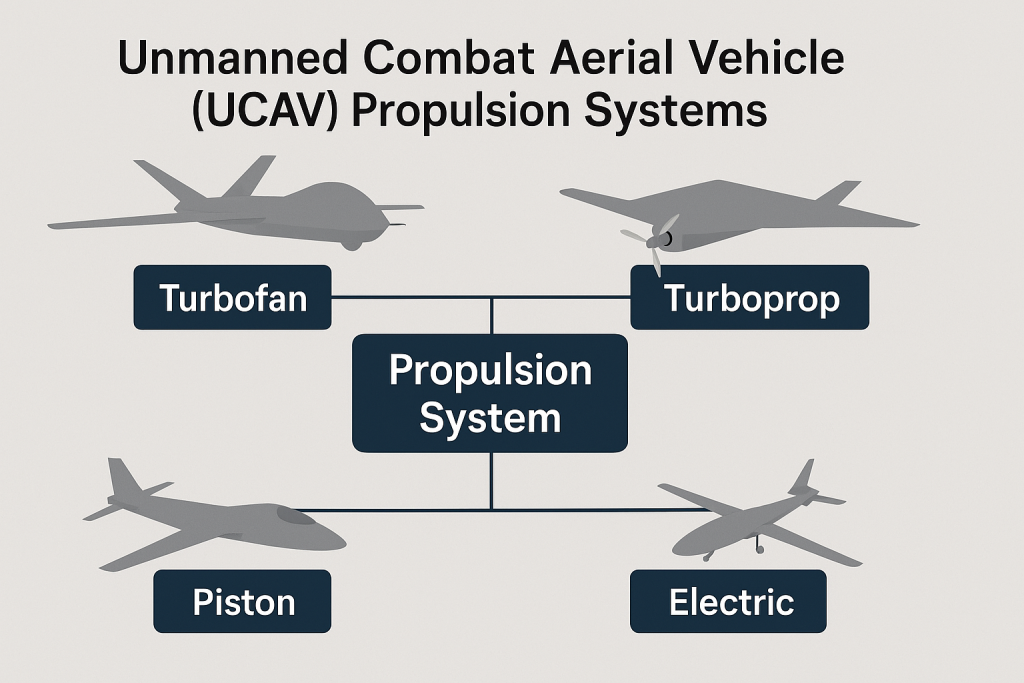
Image Credentials: Image Title: Unmanned Combat Aerial Vehicle (UCAV) Propulsion Systems Source: AI-Generated Image (DALL-E) Date: April 2025 Attribution: Created by AI-generated imagery (DALL-E)
Unmanned Combat Aerial Vehicle (UCAV) Propulsion Systems are the powerplant technologies used to enable the autonomous or remotely piloted flight of combat drones. These systems are a critical component of UCAV design, determining operational range, payload capacity, maneuverability, stealth characteristics, and speed. Over the past two decades, propulsion technologies for UCAVs have advanced significantly, supporting both high-end stealth combat platforms and lower-cost attritable drones.
Overview
UCAV propulsion systems vary based on mission profile, performance requirements, and technological maturity. They typically include one or more of the following propulsion types:
-
Turbofan Engines – These are Common in high-performance, jet-powered UCAVs.
-
Turboprop Engines – Suitable for medium-altitude, long-endurance drones.
-
Piston Engines – Found in smaller, tactical UCAVs.
-
Electric Propulsion – Emerging in small, stealthy, and low-observable drones.
-
Hybrid Propulsion – Combining electric and fuel-based systems for endurance and tactical flexibility.
Propulsion systems must integrate with airframe stealth, thermal management, and electronic warfare capabilities to reduce detectability and increase survivability in contested environments.
Types of Propulsion Systems
Turbofan Engines
Turbofan engines are used in high-speed, high-altitude UCAVs such as the Kratos XQ-58 Valkyrie and China’s CH-7. These engines offer high thrust-to-weight ratios and are often adapted from commercial or manned military aircraft powerplants, like the Williams FJ33.
Key Characteristics:
-
High subsonic to transonic speeds
-
Compact and stealth-compatible
-
Higher fuel consumption than prop or hybrid systems
-
Limited loiter capability
Turboprop Engines
Turboprops offer better fuel economy for UCAVs intended for long-endurance ISR (Intelligence, Surveillance, Reconnaissance) or light attack roles, such as the Avenger ER or Bayraktar Akıncı.
Key Characteristics:
-
Medium-speed, high-endurance operations
-
Efficient fuel consumption
-
Larger propeller signature (limited stealth)
-
Used for mixed-role missions
Piston Engines
Used in lower-cost or tactical UCAVs like the MQ-1 Predator, piston engines are simple and robust but have limited performance.
Key Characteristics:
-
Low maintenance
-
Inexpensive
-
Ideal for expendable or support UCAVs
-
Noisy and less efficient at high altitudes
Electric Propulsion
Electric systems are gaining traction for small, expendable UCAVs or those that require extremely low acoustic and thermal signatures. Examples include loitering munitions or drones launched from mother platforms.
Key Characteristics:
-
Virtually silent
-
Low infrared signature
-
Limited range and payload
-
Dependence on battery tech or solar power
Hybrid Propulsion
Hybrid systems offer a combination of fuel-based and electric power, allowing for better endurance and tactical flexibility. They are currently in experimental use for extended ISR missions and autonomous operations.
Key Characteristics:
-
Improved range and efficiency
-
Quiet operation during loiter phases
-
Complex integration and weight considerations
Propulsion and Stealth
UCAV propulsion systems are often tightly integrated with stealth features. Inlet shaping, S-ducts, and exhaust masking are used to reduce radar and infrared signatures. Jet-powered UCAVs, such as the Northrop Grumman X-47B, feature carefully engineered engine placements to minimize detectability.
Future Trends
The future of UCAV propulsion is focused on:
-
Improved fuel efficiency for greater range
-
Electric and hybrid propulsion for low-observable missions
-
Swarm compatibility with lightweight, scalable engines
-
Artificial Intelligence (AI)-driven energy management
-
Alternative fuels for sustainability and logistics flexibility
Efforts are also underway to develop modular propulsion platforms, enabling the same UCAV design to be tailored for different missions through plug-and-play powerplants.
Notable UCAV Propulsion Examples
| UCAV Model | Propulsion System | Powerplant | Notes |
|---|---|---|---|
| XQ-58 Valkyrie | Jet | Williams FJ33 | Stealthy, attritable jet UCAV |
| MQ-9 Reaper | Turboprop | Honeywell TPE331 | Long-endurance ISR platform |
| CH-7 | Jet | Unknown turbofan | High-speed stealth UCAV |
| Bayraktar TB2 | Piston | Rotax 912 | Tactical drone, proven in conflicts |
| Switchblade 600 | Electric | Proprietary | Loitering munition, quiet operation |
References
-
Kratos Defense & Security. “XQ-58 Valkyrie Datasheet.” 2024.
-
U.S. Air Force Research Laboratory. “LCAAT Program Brief.” 2023.
-
Aviation Week. “Next-Gen UCAV Propulsion Technologies.” July 2022.
-
Defense News. “Hybrid Propulsion and the Future of Stealth Drones.” March 2023.
-
SIPRI Yearbook 2024. “Unmanned Systems and Military Balance.”
Explore this subject
Continue exploring related Open Chronicle Encyclopedia entries through the categories associated with this article.

Staff Writers at Open Chronicle produce trusted journalism, strategic analysis and authoritative reference content across global affairs, geopolitics, defense, science, history, technology, business, culture and sport. Their work combines accurate reporting with historical perspective and analytical depth, helping readers understand not only what is happening, but why it matters. Beyond daily news coverage, Staff Writers contribute to the Open Chronicle Encyclopedia, investigative features, original research projects and long-form reports, building a comprehensive knowledge platform designed to inform, educate and preserve reliable information for a global audience.