
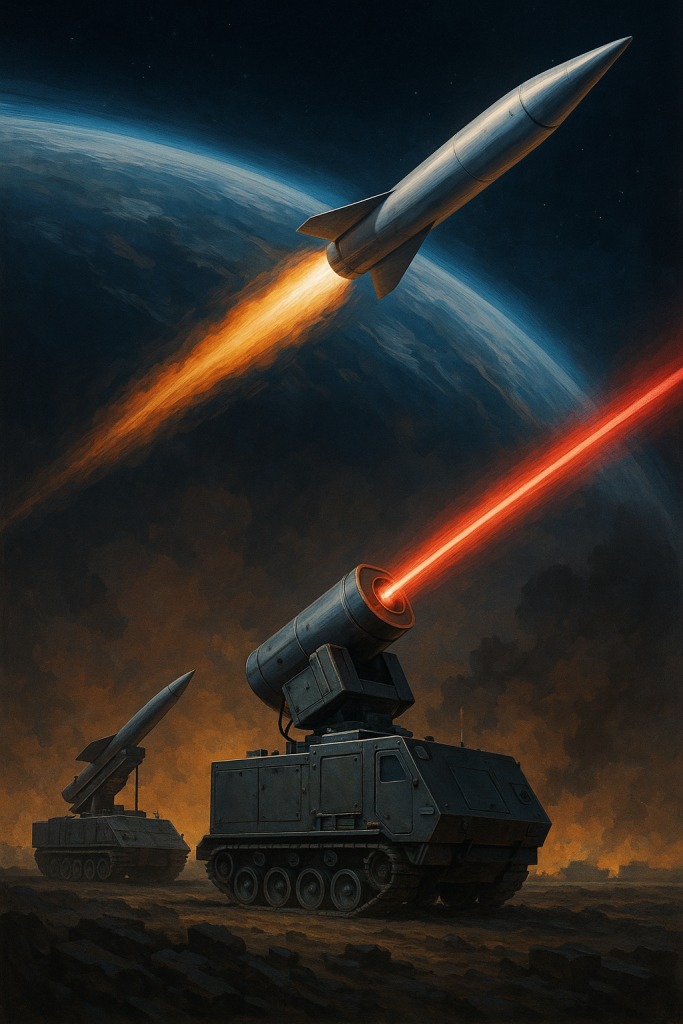
Image Credentials: Image Title: Hypersonic and Directed Energy Weapons in the Tech Cold War Source: (sora.chatgpt) Date: May 2025 Attribution: Created by AI-generated imagery (sora.chatgpt), it does not depict a real-world scene.
By Open Chronicle
Hypersonic weapons and directed energy weapons (DEWs) represent a new frontier in the ongoing Tech Cold War between major powers, particularly the United States, China, and Russia. These technologies are poised to transform modern warfare and strategic deterrence, making them critical elements in the global race for military supremacy in the 21st century.
Overview
Hypersonic weapons travel at speeds of Mach 5 or greater (five times the speed of sound), allowing them to evade traditional missile defense systems. Directed energy weapons use focused energy, such as lasers or microwaves, to disable or destroy targets with speed-of-light precision and minimal collateral damage.
Both technologies have dual-use potential, combining military and civilian applications, and are central to the rapidly evolving landscape of strategic deterrence and national defense.
Hypersonic Weapons
Types
-
Hypersonic Glide Vehicles (HGVs): Launched from rockets, these vehicles glide through the atmosphere at high speeds with maneuverability.
-
Hypersonic Cruise Missiles (HCMs): Powered throughout their flight by advanced engines such as scramjets.
Strategic Advantages
-
Speed: Reduces reaction times for defense systems.
-
Maneuverability: Enables evasion of existing missile defenses.
-
Precision: Capable of targeting critical infrastructure with pinpoint accuracy.
Leading Developers
-
China: Tested the DF-ZF HGV and advanced missile systems believed to include fractional orbital bombardment capabilities.
-
Russia: Deployed the Avangard HGV and Kinzhal air-launched ballistic missile in Ukraine.
-
United States is developing systems like the Conventional Prompt Strike (CPS) and the Air-Launched Rapid Response Weapon (ARRW).
Directed Energy Weapons (DEWs)
Types
-
High-Energy Lasers (HELs): Use optical energy to damage or destroy targets.
-
High-Powered Microwaves (HPMs): Disrupt electronic systems.
-
Particle Beams: Still mostly experimental.
Applications
-
Missile Defense: Neutralize incoming projectiles or drones.
-
Counter-UAV Systems: Protect military bases and assets from small drones.
-
Satellite Disruption: Potential to disable adversarial space assets.
Development Status
-
United States: The U.S. Navy and Army have deployed laser systems like HELIOS and DE M-SHORAD in limited roles.
-
China: Reports suggest the development of ship- and ground-based lasers for anti-drone and missile defense.
-
Russia: Claims to have deployed the Peresvet laser system for targeting satellites or missile guidance.
Geopolitical Implications
Arms Race Dynamics
Hypersonic and DEW capabilities have intensified the arms race among great powers, undermining existing strategic stability and arms control frameworks, such as the New START Treaty, which does not cover these technologies.
Deterrence and First-Strike Risk
Hypersonic weapons reduce warning times, increasing the risk of miscalculation or accidental escalation during a crisis. DEWs offer a more “deniable” form of interference with adversaries’ satellites or electronics.
Export and Proliferation
Smaller states may eventually acquire hypersonic or DEW capabilities, leading to regional arms races and new proliferation challenges.
Key Challenges
-
Thermal management and materials for hypersonic vehicles remain major engineering hurdles.
-
Power generation and storage limit the battlefield deployment of high-energy lasers.
-
Command and control systems must adapt to handle the speed and complexity of new weapons.
Future Outlook
-
Integration of AI and sensor fusion to guide hypersonic weapons in contested environments.
-
Space-based DEWs could become viable within the next two decades.
-
Ongoing development of defensive technologies to counter hypersonic threats, such as glide-phase interceptors.
References
-
U.S. Department of Defense. (2024). Hypersonic Weapons Strategy
-
Congressional Research Service. (2023). Directed Energy Weapons: Background and Issues for Congress
-
Center for Strategic and International Studies (CSIS). (2023). Missile Defense and the Hypersonic Threat
-
Jane’s Defence Weekly. (2023). China’s Advances in Hypersonic Glide Vehicles
-
NATO Science & Technology Organization. (2023). Directed Energy Weapons and Military Applications
-
Russian Ministry of Defence. (2022). Deployment of Avangard Hypersonic Missiles
-
China Aerospace Studies Institute (CASI). (2023). Hypersonic and DEW Capabilities in the PLA
Explore this subject
Continue exploring related Open Chronicle Encyclopedia entries through the categories associated with this article.

Staff Writers at Open Chronicle produce trusted journalism, strategic analysis and authoritative reference content across global affairs, geopolitics, defense, science, history, technology, business, culture and sport. Their work combines accurate reporting with historical perspective and analytical depth, helping readers understand not only what is happening, but why it matters. Beyond daily news coverage, Staff Writers contribute to the Open Chronicle Encyclopedia, investigative features, original research projects and long-form reports, building a comprehensive knowledge platform designed to inform, educate and preserve reliable information for a global audience.