
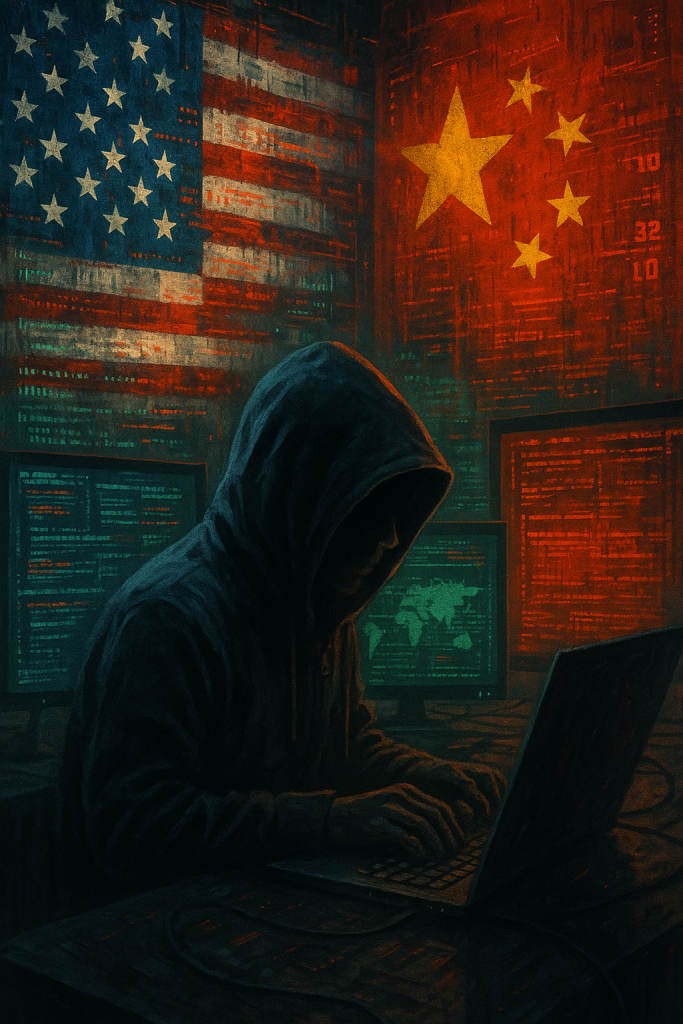
Image Credentials: Image Title: Cyber Warfare and Digital Espionage in the Tech Cold War Source: (sora.chatgpt) Date: May 2025 Attribution: Created by AI-generated imagery (sora.chatgpt), it does not depict a real-world scene.
Cyber warfare and digital espionage are among the most strategically significant elements in the ongoing Tech Cold War, a global technological and geopolitical rivalry largely between the United States and China, with contributions from Russia, Iran, North Korea, and other state and non-state actors. These forms of asymmetric conflict have evolved into tools of statecraft, economic competition, and covert geopolitical influence.
Overview
Cyber warfare refers to the use of digital attacks by one state to disrupt the critical systems of another, including infrastructure, communications, defense networks, and the economy. Digital espionage involves covert operations to extract sensitive data from governments, corporations, and individuals.
These tools are increasingly used in peacetime as a substitute for traditional kinetic conflict, enabling states to exert influence, gather intelligence, and destabilize adversaries with plausible deniability.
Strategic Significance
State-Sponsored Cyber Attacks
Nation-states are heavily investing in offensive cyber capabilities to conduct operations that range from surveillance to disruption and destruction. Major incidents include:
-
Stuxnet (2010): Widely believed to be a joint U.S.-Israeli cyberattack that crippled Iran’s nuclear centrifuges.
-
SolarWinds Hack (2020): Attributed to Russia’s SVR, this breach compromised U.S. federal agencies and private firms.
-
Microsoft Exchange Hack (2021): Attributed to the Chinese group Hafnium, impacting tens of thousands of servers globally.
-
NotPetya Attack (2017): Allegedly deployed by Russian hackers against Ukraine, causing billions in collateral damage worldwide.
Digital Espionage
Digital espionage has become a priority for intelligence agencies. Cyber-enabled spying targets:
-
Government communications and classified data
-
Trade secrets and IP from private corporations
-
Diplomatic cables and military plans
-
Activists, journalists, and diaspora groups
China’s APT (Advanced Persistent Threat) groups, like APT10 and APT41, are frequently cited in U.S. intelligence reports as conducting large-scale theft of intellectual property and sensitive defense data [1].
Tools and Methods
-
Zero-day exploits: Unknown vulnerabilities used to infiltrate systems before a patch is available.
-
Spear-phishing: Highly targeted email attacks to compromise specific users.
-
Botnets and malware: Used to launch distributed denial-of-service (DDoS) attacks or install backdoors.
-
Supply chain attacks: Compromising software or hardware components at the source (e.g., SolarWinds).
-
Deep packet inspection: Used by authoritarian regimes for surveillance and censorship.
National Cyber Strategies
| Country | Cyber Doctrine Highlights |
|---|---|
| United States | Cyber Command (CYBERCOM), Defend Forward strategy, CISA for domestic cyber defense |
| China | Integrated cyber capabilities under PLA Strategic Support Force, Great Firewall, influence campaigns |
| Russia | Active cyber sabotage and influence operations through groups like Fancy Bear and Cozy Bear |
| Iran | Offensive cyber ops targeting Middle Eastern and Western infrastructure |
| North Korea | Cyber theft and ransomware (e.g., WannaCry), crypto heists to evade sanctions |
Civilian Infrastructure as a Target
Critical national infrastructure—such as power grids, transportation systems, financial institutions, and hospitals—has increasingly become a target of state-sponsored cyber aggression. These attacks aim to create societal panic, economic instability, or extract concessions without crossing conventional warfare thresholds.
Corporate Espionage and Economic Impact
Digital espionage enables states to bypass expensive R&D and directly acquire competitive technologies from foreign firms. Key sectors targeted include:
-
Aerospace
-
Semiconductors
-
Pharmaceuticals
-
Artificial Intelligence
-
5G telecommunications
The FBI estimates that Chinese economic espionage costs the U.S. economy $225–$600 billion annually [2].
Disinformation and Psychological Warfare
In addition to espionage and sabotage, cyber capabilities are used for influence operations, including:
-
Election interference (e.g., U.S. 2016, French 2017)
-
Disinformation campaigns on social media
-
Deepfakes and AI-generated propaganda
These efforts aim to undermine trust in institutions, sow division, and destabilize democratic processes.
Global Cybersecurity Landscape
In response, governments and alliances are adopting new cybersecurity frameworks:
-
NATO’s Cyber Defense Pledge
-
EU’s Cybersecurity Act
-
QUAD and Five Eyes cyber cooperation
-
Zero Trust architectures in enterprise security
-
Public-private cyber task forces to protect digital infrastructure
Future Outlook
As quantum computing, AI, and IoT proliferate, the attack surface for cyber warfare expands. States are likely to continue investing in cyber deterrence, resilience, and attribution technologies. Without global norms or enforceable treaties, digital conflict remains a gray zone that blurs the line between war and peace.
References
-
U.S. Department of Justice. (2020). Indictment of APT41 Chinese Hackers.
-
Federal Bureau of Investigation. (2021). China: The Greatest Threat to U.S. Economic Security.
-
Center for Strategic and International Studies (CSIS). (2023). Significant Cyber Incidents Since 2006.
-
European Union Agency for Cybersecurity (ENISA). (2022). Threat Landscape Report.
-
NATO. (2016). Cyber Defense Pledge.
-
Office of the Director of National Intelligence (ODNI). (2021). Annual Threat Assessment.
Explore this subject
Continue exploring related Open Chronicle Encyclopedia entries through the categories associated with this article.

Staff Writers at Open Chronicle produce trusted journalism, strategic analysis and authoritative reference content across global affairs, geopolitics, defense, science, history, technology, business, culture and sport. Their work combines accurate reporting with historical perspective and analytical depth, helping readers understand not only what is happening, but why it matters. Beyond daily news coverage, Staff Writers contribute to the Open Chronicle Encyclopedia, investigative features, original research projects and long-form reports, building a comprehensive knowledge platform designed to inform, educate and preserve reliable information for a global audience.