
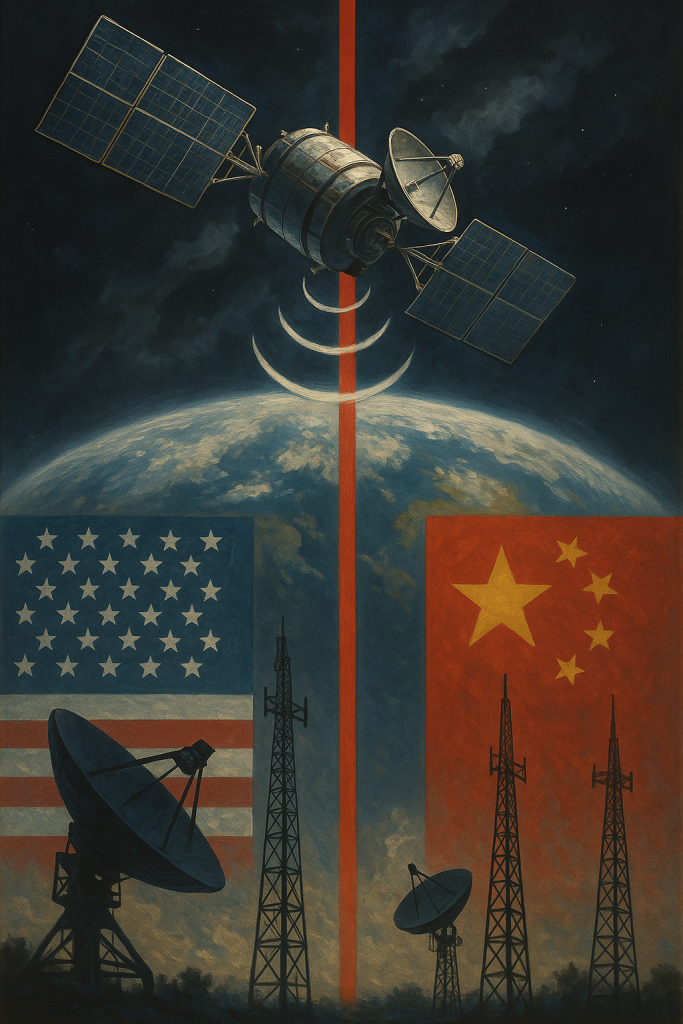
Image Credentials: Image Title: Satellite and Communication Technologies in the Tech Cold War Source: (sora.chatgpt) Date: May 2025 Attribution: Created by AI-generated imagery (sora.chatgpt), it does not depict a real-world scene.
By Open Chronicle
Satellite and communication technologies have emerged as a key battleground in the ongoing Tech Cold War, a strategic and geopolitical conflict between major world powers, particularly the United States and China. These technologies are essential for military dominance, global connectivity, surveillance, navigation, and economic competitiveness in the 21st century.
Overview
Satellites enable a wide array of capabilities, including secure military communications, global positioning systems (GPS), earth observation, internet coverage, and early warning systems for missile defense. In the context of the Tech Cold War, control over these systems and the ability to deny or disrupt them represents a form of strategic leverage.
Communication Technologies
Communication technologies such as 5G, undersea cables, and space-based internet constellations are equally critical. They underpin national infrastructure, military coordination, economic systems, and even influence operations.
Strategic Importance
Military Applications
-
Secure communications between command centers, military assets, and allies
-
Surveillance and reconnaissance for battlefield awareness
-
Positioning, navigation, and timing (PNT) through satellite constellations (e.g., GPS, BeiDou)
-
Electronic warfare capabilities and space-based early-warning systems
Civil and Economic Applications
-
Global broadband through Low Earth Orbit (LEO) satellite constellations
-
Weather forecasting, agriculture monitoring, and disaster response
-
Satellite internet access in remote or underserved regions
-
Critical infrastructure communication via undersea cables and satellite links
US-China Competition in Space and Communications
Satellite Systems
-
United States: Operates GPS, a global navigation satellite system, and maintains a broad array of reconnaissance, communication, and commercial satellites. SpaceX’s Starlink aims to provide global broadband coverage via thousands of LEO satellites.
-
China: Has developed BeiDou, a global navigation satellite system rivaling GPS. It operates military and civilian satellites through its space agency, CNSA, and state-owned enterprises like CASC.
China has rapidly expanded its space and satellite programs, aiming for self-reliance and technological dominance in orbit. It launched over 60 satellites in 2023 alone, many with dual-use (civilian and military) capabilities.
5G and Beyond
-
Huawei, China’s telecom giant, has led 5G infrastructure deployments globally, raising security concerns in the West.
-
The US and its allies have restricted Huawei’s access to markets and technologies, citing espionage risks and national security threats.
-
The race is now extending into 6G, with both superpowers investing in future communication standards and satellite-terrestrial integration.
Undersea Cable Networks
Undersea fiber-optic cables carry over 95% of global internet traffic. China’s HMN Tech and US-led firms (e.g., SubCom) are competing to build and control these vital arteries of global communication.
Geopolitical Flashpoints
-
Satellite collisions and space debris risks increase with the proliferation of LEO constellations.
-
Anti-satellite (ASAT) weapons testing by China, Russia, and others has raised alarms over the militarization of space.
-
The Global South is a contested arena where both China and the West seek influence by offering satellite-based internet and communication infrastructure.
International Regulation and Challenges
-
The Outer Space Treaty (1967) governs the peaceful use of outer space, but lacks enforcement against modern military use or commercial monopolization.
-
Spectrum allocation for satellite internet is another emerging arena of international competition.
-
Cybersecurity threats to satellite networks, such as jamming, spoofing, and hacking, are growing as more assets go online.
Technological Developments
-
LEO constellations: Starlink (U.S.), OneWeb (UK/India), Guowang (China)
-
Quantum communication satellites: China’s Micius satellite pioneered secure quantum key distribution (QKD) in space
-
Autonomous satellite servicing and defense: Emerging tech for repair, refueling, or disabling other satellites
-
Software-defined radio: Enabling flexible, reprogrammable communications in space and military operations
Future Outlook
The satellite and communication technology race is reshaping global power dynamics. Strategic developments expected over the next decade include:
-
The weaponization of orbit and the potential arms race in space
-
The global expansion of LEO-based broadband internet
-
Quantum-secured global communications networks
-
Increasing fragmentation of internet infrastructure along national or bloc lines
References
-
US Department of Defense. (2024). Space Policy Review
-
China National Space Administration (CNSA). (2023). BeiDou Progress Report
-
European Space Agency (ESA). (2023). Space Security and Debris Mitigation
-
Center for Strategic and International Studies (CSIS). (2023). Space Threat Assessment
-
The Economist. (2023). Why Satellite Internet Is the Next Big Tech Frontier
-
Financial Times. (2024). Huawei’s Role in Global 5G Infrastructure Under Scrutiny
-
International Telecommunication Union (ITU). (2023). Spectrum Allocation Challenges
Explore this subject
Continue exploring related Open Chronicle Encyclopedia entries through the categories associated with this article.

Staff Writers at Open Chronicle produce trusted journalism, strategic analysis and authoritative reference content across global affairs, geopolitics, defense, science, history, technology, business, culture and sport. Their work combines accurate reporting with historical perspective and analytical depth, helping readers understand not only what is happening, but why it matters. Beyond daily news coverage, Staff Writers contribute to the Open Chronicle Encyclopedia, investigative features, original research projects and long-form reports, building a comprehensive knowledge platform designed to inform, educate and preserve reliable information for a global audience.