
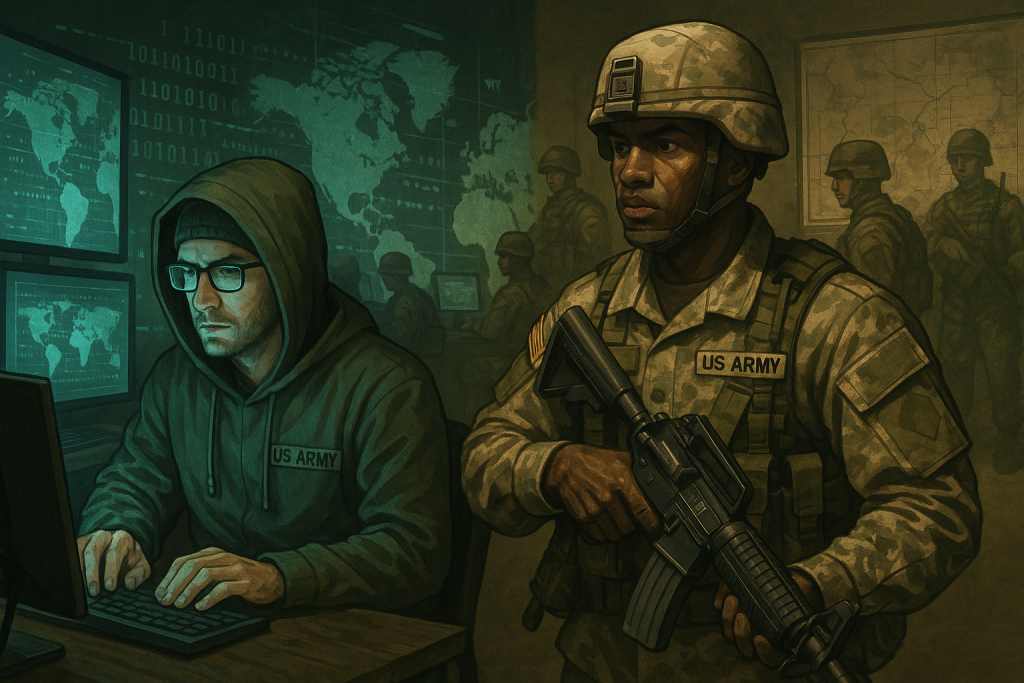
Image Credentials: Image Title: Cultural Change in Military Organizations: Hackers and Warriors in the US Army Source: (sora.chatgpt) Date: July 2025 Attribution: Created by AI-generated imagery (sora.chatgpt), it does not depict a real-world scene.
By Open Chronicle Staff
The US Army, like any organization, is subject to cultural shifts that reflect broader societal transformations. In recent years, one of the most significant changes has been the intersection of two traditionally separate worlds within the military: hackers and warriors. As technology continues to evolve, so does the Army’s approach to warfare, introducing a new era of conflict that combines both kinetic operations and cyber warfare. This article examines the cultural change in military organizations, focusing on the integration of hackers and warriors in the US Army, the challenges involved, and the implications for future operations.
Traditionally, the military has been divided into distinct spheres: the physical warriors, such as infantry, armor, and artillery, and the cyber warriors, who engage in hacking, digital espionage, and the protection of critical infrastructure. The former is typically viewed as an operational force, while the latter, primarily concerned with technology and intelligence, has been a support function. However, as military operations increasingly involve information warfare, cyber-attacks, and the use of cutting-edge technologies, this divide has become less clear-cut.
In the early days of cyber warfare, hacking was largely seen as a niche field, populated by individuals who worked behind the scenes. These “hackers” were often seen as unconventional operators, not in line with the traditional image of soldiers. However, the rise of state-sponsored cyber-attacks, data breaches, and the increasing importance of cybersecurity have fundamentally shifted how the military views this skill set. The military now recognizes the strategic value of digital warfare and seeks to integrate hackers into its broader operational structure.
In 2009, the US Cyber Command (USCYBERCOM) was established to strengthen the US military’s capacity in cyberspace operations. This represented a major shift in military culture, emphasizing the need for skilled cyber professionals to function alongside conventional forces. The concept of cyber warfare, where both offensive and defensive cyber operations play a key role in achieving military objectives, quickly became central to US defense strategy.
As a result, the Army began to recognize the importance of bridging the cultural gap between hackers and traditional warriors. In 2016, the Army established the Cyber Branch, a new specialty area for Army officers. This move acknowledged the growing need for personnel who not only understood military operations but were also adept in the complex world of cyberspace. Today, Army Cyber Command operates as a fully integrated command, where cyber warriors work hand-in-hand with traditional combat units, providing strategic advantages in a rapidly evolving battlefield.
One of the biggest obstacles to integrating hackers into the military culture has been overcoming cultural resistance. The Army, like many military organizations, has a deeply ingrained warrior ethos, emphasizing physical strength, discipline, and traditional combat skills. Hackers, on the other hand, often work in a very different environment, one that prioritizes technical expertise, agility, and innovation over physical prowess.
This disparity has led to challenges in communication and collaboration. Traditional warriors may view hackers as outsiders who do not conform to the same values and standards that are typically expected of soldiers. Hackers may, in turn, feel that they are not fully understood by the military establishment or that their skill set is undervalued. These cultural differences, if not properly managed, can result in friction, hindering the integration process.
Additionally, military culture has always valued hierarchy, structure, and predictability, qualities that may seem at odds with the fast-paced, sometimes chaotic nature of hacking and cyber operations. While hackers may be accustomed to working in fluid, decentralized environments, military operations are highly structured and often follow rigid protocols.
In order to facilitate the integration of hackers and warriors, the Army has placed a significant emphasis on training and education. Army Cyber Command runs a range of programs designed to upskill personnel in both technical and leadership aspects of cyber warfare. These programs are structured to create a shared understanding of both traditional military operations and cyber-specific tactics.
For example, the Army Cyber Institute at West Point has developed specialized courses that aim to train future leaders who can navigate both the physical and digital realms. These courses combine traditional military training with cutting-edge cyber education, ensuring that officers understand the strategic value of cyber operations in modern warfare.
Furthermore, the Army has adopted “jointness” as a central principle of training, meaning that soldiers, sailors, airmen, and marines are encouraged to work together across branches. This approach has helped break down cultural barriers and foster collaboration between traditional warriors and cyber specialists. Hackers are now viewed not as peripheral figures but as integral parts of the broader military machine.
The integration of hackers and warriors in the Army is not just a matter of cultural change; it has significant operational implications. In modern conflicts, the line between physical and cyber warfare is increasingly blurred. Hackers can disrupt enemy communications, disable critical infrastructure, or gather intelligence, all without ever firing a shot. Conversely, traditional warriors can engage in kinetic operations that are supported by cyber capabilities, creating a more dynamic, multidimensional battlefield.
The future of military operations will likely see more collaborative efforts between hackers and warriors, with a focus on information warfare. This shift will require military organizations to evolve further, embracing new forms of warfare and new skill sets. As cyber-attacks and information manipulation become more common in global conflicts, the Army will need to continue its efforts to integrate these capabilities into its strategic framework.
The cultural shift in the US Army, where hackers and warriors are working together, represents a profound change in the way the military operates. While challenges remain in overcoming cultural resistance and adapting to new forms of warfare, the Army is making significant strides toward creating a more integrated, versatile force. As cyber capabilities become increasingly critical to national security, the integration of hackers into the military’s cultural fabric will continue to shape the future of warfare. The Army’s ability to adapt to this new reality will determine its effectiveness in combating both traditional and non-traditional threats in an ever-evolving global landscape.
References
Books and Articles
Cavelty, Myriam Dunn. Cyber-Security and Global Interdependence: Mutual Vulnerabilities and Challenges for the Information Age. New York: Routledge, 2013.
Libicki, Martin C. Cyberspace in Peace and War. Washington, DC: National Defense University Press, 2016.
McChrystal, Stanley, David Silverman, and Chris Fussell. Team of Teams: New Rules of Engagement for a Complex World. New York: Penguin Random House, 2015.
Rid, Thomas. Cyber War Will Not Take Place. Oxford: Oxford University Press, 2013.
Rubel, Robert. “The Need for Wargaming in the Navy.” CIMSEC. Accessed July 29, 2025. https://cimsec.org.
Reports
Department of Defense. Cyber Strategy: U.S. Department of Defense. U.S. Government, 2018. https://www.defense.gov/Portals/1/Documents/pubs/2018-National-Defense-Strategy-Summary.pdf.
U.S. Army Cyber Command. Cyber Command Strategic Vision. U.S. Army Cyber Command, 2020. https://www.arcyber.army.mil.
Government Publications
Department of Defense. U.S. Cyber Command: A Critical Component of Our National Defense. U.S. Department of Defense, 2017. https://www.defense.gov.
U.S. Army. Army Cyber Operations. U.S. Army, 2021. https://www.army.mil/armycymru.
Official Documents and Proceedings
U.S. Army Cyber Command. Cyber Operations: A Changing Paradigm in Modern Warfare. U.S. Army Cyber Command Strategic Briefing, 2019. https://www.arcyber.army.mil.
West Point. The Army Cyber Institute: Education and Training for the Digital Age. West Point Official Reports, 2022. https://www.usma.edu.
Websites
National Defense University. “Cyber Warfare: Military Implications and Strategy.” National Defense University Press. Accessed July 29, 2025. https://www.ndu.edu.
U.S. Army Cyber Command. “U.S. Army Cyber Command Overview.” U.S. Army Cyber Command Official Site. Accessed July 29, 2025. https://www.arcyber.army.mil.