
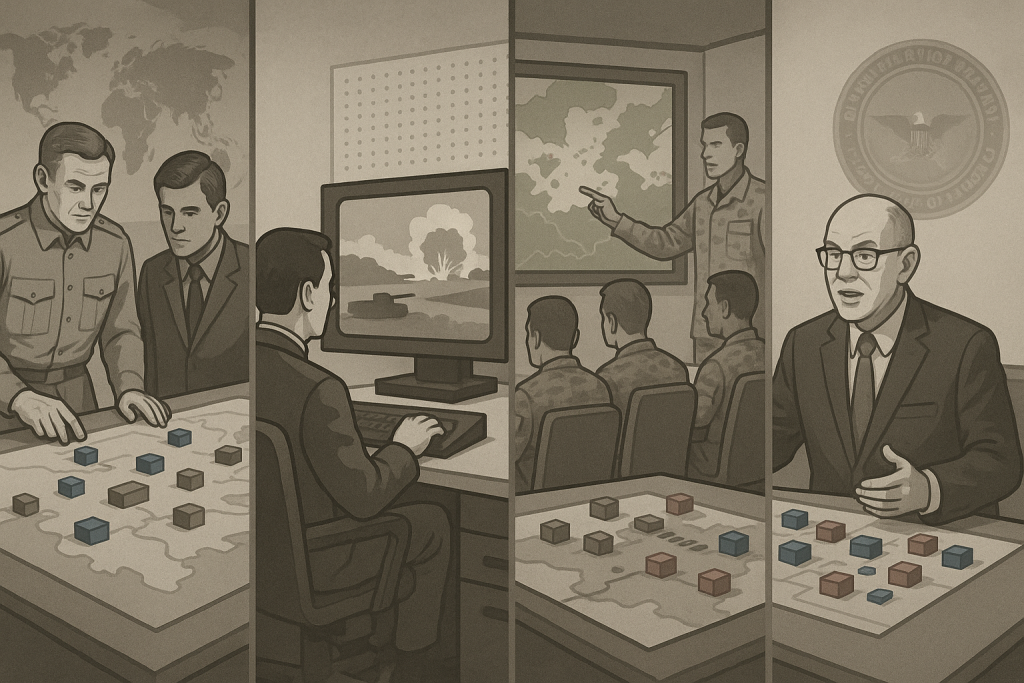
Image Credentials: Image Title: Reinforcing the Future of Wargaming: Developing the Next Generation of Military Decision-Makers Source: (sora.chatgpt) Date: July 2025 Attribution: Created by AI-generated imagery (sora.chatgpt), it does not depict a real-world scene.
By Open Chronicle Staff
Since the reinvigoration of wargaming by the U.S. Department of Defense (DoD) in 2014, wargames have become an essential tool for shaping strategies, testing new technologies, and preparing military forces for a complex, uncertain future. Yet, despite a noticeable increase in the number of wargames being conducted across the services, there remains an inconsistency in their quality and relevance. One of the central challenges to a robust wargaming culture within the military is the lack of skilled, uniformed personnel who are well-versed in the art of wargaming.
This article aims to explore the gaps in wargaming education within the U.S. military and present strategies for creating a comprehensive pipeline of officers and commanders who can design, execute, and analyze wargames effectively. By enhancing wargaming capabilities at the operational and strategic levels, the military can increase its preparedness, improve decision-making, and reinforce its ability to face adversaries in both conventional and hybrid warfare environments.
The Evolution of Wargaming Education
Wargaming has been a part of military education for centuries, dating back to the earliest strategic exercises conducted by military thinkers and planners. In the 20th century, the introduction of modeling and simulation (M&S) systems fundamentally transformed how wargames were conducted. These technological advancements, while highly valuable for certain types of analysis, led to a decline in the use of traditional, human-centric wargaming.
In the 1960s and 70s, the rise of computer-based simulations helped shape defense acquisitions and operational planning, particularly during the Cold War. Yet, wargames themselves, which involved real-time decision-making and human judgment, were increasingly sidelined. This trend was compounded by the focus on counterinsurgency and irregular warfare after the Gulf War, where wargames did not align well with the needs of these types of conflicts.
However, by the early 2010s, a growing recognition emerged within the DoD that traditional wargaming methods were irreplaceable in providing the nuanced analysis and real-world scenario testing needed to stay ahead of emerging threats. Under the leadership of Deputy Secretary of Defense Robert Work, wargaming was reinvigorated, emphasizing its importance in the future of military strategy, force structure, and technological innovation.
The Need for Wargaming Professionals
The resurgence of interest in wargaming highlights a crucial gap in the military’s capacity to effectively use these tools. While wargames are an integral part of operational planning, many commands still rely on external contractors to conduct wargames or pull together ad hoc teams with little to no formal wargaming training. This approach compromises the quality and consistency of wargames, as it fails to cultivate a cadre of military professionals with expertise in wargaming.
Every military officer, from company commanders to flag officers, should be capable of designing and conducting wargames. Wargaming is not just a technical skill but a mindset, one that encourages creativity, strategic thinking, and an understanding of complex operational environments. The military must establish a professional development pathway for officers to acquire and continuously refine their wargaming expertise.
Wargaming Education at the Naval Postgraduate School (NPS)
The Naval Postgraduate School (NPS) has long been at the forefront of wargaming education, with a legacy that stretches back to its founding in 1909. In recent years, NPS has positioned itself as a key institution in the development of military wargamers. Through its Wargaming Applications course, NPS prepares naval officers and service members from across the DoD and allied forces to tackle real-world strategic challenges using wargaming as a tool.
The curriculum at NPS is rigorous and hands-on, offering students the opportunity to work on wargames designed to address current and future challenges faced by the fleet. These wargames are conducted at various classification levels, from unclassified to Top Secret/SCI, allowing students to engage with issues ranging from contested logistics to emerging technologies and operational concepts like Distributed Maritime Operations and Expeditionary Advanced Base Operations.
Beyond the resident courses, NPS has implemented Mobile Education Teams (MET), which take wargaming expertise directly to units and commands. Since 2011, NPS has conducted over 50 MET workshops across four continents, directly supporting the creation of wargaming capabilities within various organizations, including U.S. Naval Forces Europe and Africa (NAVEUR-AF), the U.S. Marine Corps, and NATO. These workshops empower military personnel to design and conduct their wargames, ensuring a sustainable, organic wargaming capability within the force.
Integrating Wargaming into Military Education and Career Development
To address the critical need for wargaming expertise within the military, it is necessary to integrate wargaming education into the broader professional military education (PME) pipeline. This means creating a formal wargaming track for military officers that spans from junior officer training all the way to flag officer development. Wargaming should become a foundational skill for officers at all levels, and it should be embedded in key professional development courses, such as the Joint Professional Military Education (JPME) system and the U.S. Naval War College’s curriculum.
Moreover, each fleet or major command should establish its wargaming cell, staffed by officers who are trained in wargaming and supported by a continuous cycle of education and certification. This would ensure that wargaming remains a central part of the planning process and that officers with wargaming expertise are consistently involved in operational decisions.
Recommendations for Building a Wargaming Capability in the Fleet
To foster a sustainable wargaming culture within the Navy, the following steps are critical:
-
Designate Wargaming Personnel: Every fleet and Marine Expeditionary Force (MEF) should designate a minimum of 10 officers per command to become wargamers. These officers should undergo wargaming certification, participate in wargames, and maintain their skills through regular exercises.
-
Embed Wargaming in Staff Training: Fleet staff members, especially in operational planning, logistics, and assessment roles, should receive specialized wargaming training. This will create a cross-functional team that can respond to the complex and fast-changing nature of modern warfare.
-
Increase Educational Quotas for Wargamers: To support this effort, Type Commanders should increase the number of unrestricted line officers (URL) attending the NPS Operations Research (OR) program, which integrates wargaming theory and practice. This would directly feed into operational billets for OR officers, ensuring that wargaming expertise is deeply embedded within the fleet.
-
Regular Wargaming Exercises: To maintain readiness, fleet staffs should conduct wargames for all major plans at least once a year. These wargames should be integrated into the planning cycle, ensuring that all significant strategies are tested and adapted regularly.
-
Professional Certification and Career Incentives: Establish a formal certification system for wargaming practitioners, akin to an additional qualification designator (AQD) or Navy Officer Billet Classification (NOBC). This would provide career incentives for officers to specialize in wargaming and help identify officers with the right skill set for advanced wargaming roles.
Conclusion
Wargaming is not merely a technical or academic exercise; it is a critical tool for military decision-making, strategy development, and operational readiness. The Naval Postgraduate School has played an indispensable role in advancing wargaming education, but the challenge remains to scale this capability across the entire fleet. By establishing a dedicated pipeline of wargamers, integrating wargaming into professional military education, and ensuring a continuous cycle of training and certification, the Navy can cultivate a generation of decision-makers who are better prepared for the challenges of tomorrow’s multi-domain battlespace.
As the security environment continues to evolve and new threats emerge, the Navy must ensure that its officers possess the skills and experience to confront uncertainty with confidence. Wargaming is the key to that preparedness, and the time to invest in its future is now.
Bibliography
-
Alberts, David S., and Richard E. Hayes. Power to the Edge: Command and Control in the Information Age. Washington, DC: DoD Command and Control Research Program, 2003.
-
Camm, Frank, et al. Wargaming for Defense: A Strategy for Enhancing Military Decision-Making. Santa Monica, CA: RAND Corporation, 2017.
-
Department of Defense. Defense Innovation Initiative: A Plan to Foster Innovation in Defense Strategy and Capabilities. Washington, DC: U.S. Department of Defense, 2014.
-
Harris, Robert E., and James P. Thomas. “The Relevance of Wargaming in Modern Military Operations.” Defense Horizons 2, no. 3 (2016): 27–34.
-
Hughes, Wayne L. Modern Wargaming: A Guide to Simulation and Modeling. New York: Routledge, 2020.
-
Lambeth, Benjamin S. Air Power in the New Counterinsurgency Era: The Strategic Importance of the Military’s Role in Irregular Warfare. Santa Monica, CA: RAND Corporation, 2013.
-
Miller, James L., and Kenneth R. Horn. Simulation and Gaming in Military Education: The Role of Wargaming in Training Future Leaders. Fort Leavenworth, KS: U.S. Army Command and General Staff College Press, 2019.
-
Naval Postgraduate School. Wargaming Applications for the U.S. Navy and U.S. Marine Corps. Monterey, CA: Naval Postgraduate School, 2022.
-
Tripp, Michael, and Alex Borkowski. The Art of Wargaming: A Guide for Professionals and Hobbyists. Annapolis, MD: U.S. Naval Institute Press, 2021.
-
U.S. Navy Warfare Development Command. Wargaming as a Force Multiplier: The Strategic Role of Wargames in Naval Operations. Norfolk, VA: NWDC, 2017.
-
Vego, Milan. Joint Operational Warfare: Theory and Practice. Newport, RI: U.S. Naval War College, 2018.
-
Work, Robert. The Future of Warfare: A Critical Examination of Wargaming and Operational Planning. Washington, DC: National Defense University Press, 2015.