
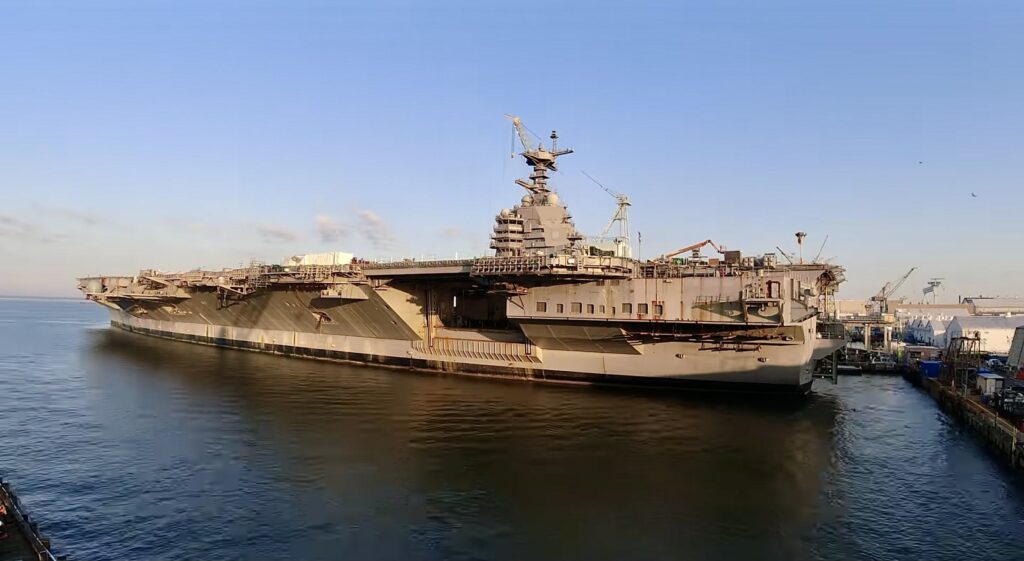
Image: from WarshipCam X @WarshipCam
By Liam Scott | Staff Writer with Agencies
The future USS John F. Kennedy (CVN 79), the United States Navy’s next Ford-class aircraft carrier, reached a key milestone on September 29, 2025, when it completed its first nuclear propulsion tests at Newport News Shipbuilding, Huntington Ingalls Industries (HII) confirmed. The vessel was maneuvered in the James River with the aid of tugboats before returning to the pier for further trials, signaling significant progress in its path toward operational readiness.
Despite this achievement, delays in the carrier’s construction and testing schedule mean the Navy will face a temporary gap in carrier availability following the planned 2026 retirement of USS Nimitz. Construction of John F. Kennedy began after contracts were awarded in 2009, with major structural milestones including keel laying in August 2015, the installation of the 588-ton island in May 2019, and completion of the forward catapults and bow section by July 2019. Testing has proceeded gradually, beginning with the Electromagnetic Aircraft Launch System (EMALS) trials in 2022, combat system checks in 2023, and dead-load aircraft launches between February and April 2024.
The adoption of a single-phase delivery approach has extended the ship’s construction scope, ensuring the carrier will be fully equipped from the outset to operate F-35C Joint Strike Fighters and the Enterprise Air Surveillance Radar, fulfilling congressional requirements for all Ford-class carriers to be ready for fifth-generation aircraft upon delivery.
Future USS John F. Kennedy (CVN 79) Gerald R. Ford-class aircraft carrier being turned for propulsion tests in Newport News, Virginia – posted September 29, 2025
SRC: YT- HII pic.twitter.com/8xxN0lCt2O
— WarshipCam (@WarshipCam) September 30, 2025
Two advanced systems remain central to the program’s delays. The Advanced Arresting Gear (AAG) replaces hydraulic arresting systems with an electromagnetic turbo-electric engine capable of safely recovering a wider range of aircraft, including lighter unmanned aerial vehicles, while reducing stress on airframes. Development challenges have slowed its certification. The Advanced Weapons Elevators (AWE), which use electromagnetic linear motors to transport ordnance from magazines to the flight deck, aim to increase operational throughput compared with traditional cable and hydraulic elevators. Installation and reliability issues similar to those experienced on USS Gerald R. Ford have required adjustments, leaving final certification ongoing in 2025. These technical hurdles, combined with workforce shortages and supply chain disruptions, contributed to a revised delivery date of March 2027.
The John F. Kennedy features a revised radar and sensor suite, integrating the AN/SPY-3 X-band multifunction radar with the new AN/SPY-6(V)3 Enterprise Air Surveillance Radar (EASR) operating in the S band. The SPY-6(V)3, a three-faced fixed array radar using gallium nitride semiconductors and digital beamforming, offers 360-degree coverage and detection sensitivity up to 35 times greater than legacy SPY-1D systems. This configuration reduces procurement costs and aligns carrier radar systems with Flight III Arleigh Burke destroyers, providing advanced volume search, target tracking, and fire control capabilities.
Once commissioned, John F. Kennedy will be a nuclear-powered carrier of approximately 100,000 tons full load, 337 meters long, with a 41-meter waterline beam and a 78-meter flight deck. Propulsion is provided by two Bechtel A1B reactors, each generating more power than the A4W reactors of the Nimitz class, supplying electricity to four shafts capable of speeds exceeding 30 knots. The reactors are designed for 20 to 25 years of operation before refueling. The ship will carry around 4,660 personnel, fewer than Nimitz-class carriers due to automation and improved systems layout. Defensive armaments include Mark 29 and Mark 49 missile launchers, three Phalanx Block 1B close-in weapon systems, and four .50 caliber heavy machine guns. The flight deck, measuring 333 by 78 meters, will support more than 80 aircraft, with surge capacity for up to 90, including F/A-18E/F Super Hornets, EA-18G Growlers, E-2 Hawkeyes, C-2 or CMV-22 aircraft, F-35C fighters, MH-60 helicopters, and unmanned systems.
Programmatic delays have prompted the Navy to consider partial acceptance of the vessel before full delivery to reduce the operational gap following Nimitz’s retirement. Homeporting at Naval Base Kitsap-Bremerton is projected no earlier than 2029, requiring nearly four years of infrastructure upgrades to meet the ship’s higher electrical demands. The move will bring approximately 2,800 personnel and dependents to the region, with the carrier’s reduced crew reflecting Ford-class efficiencies.
Contracts for John F. Kennedy included a $3.35 billion fixed-price incentive award and a $941 million cost-plus-incentive modification in June 2015 to cover final design, construction, and material procurement. While the ship was launched in October 2019 and christened in December 2019, it is now expected to be delivered in March 2027. As the second of ten planned Ford-class carriers, CVN 79 will replace USS Nimitz and operate into the 2050s, alongside successors such as Enterprise (CVN 80) and Doris Miller (CVN 81). The original USS John F. Kennedy (CV 67), decommissioned in 2007, has been dismantled in Texas, closing one chapter of the name as its nuclear-powered successor nears fleet service.