
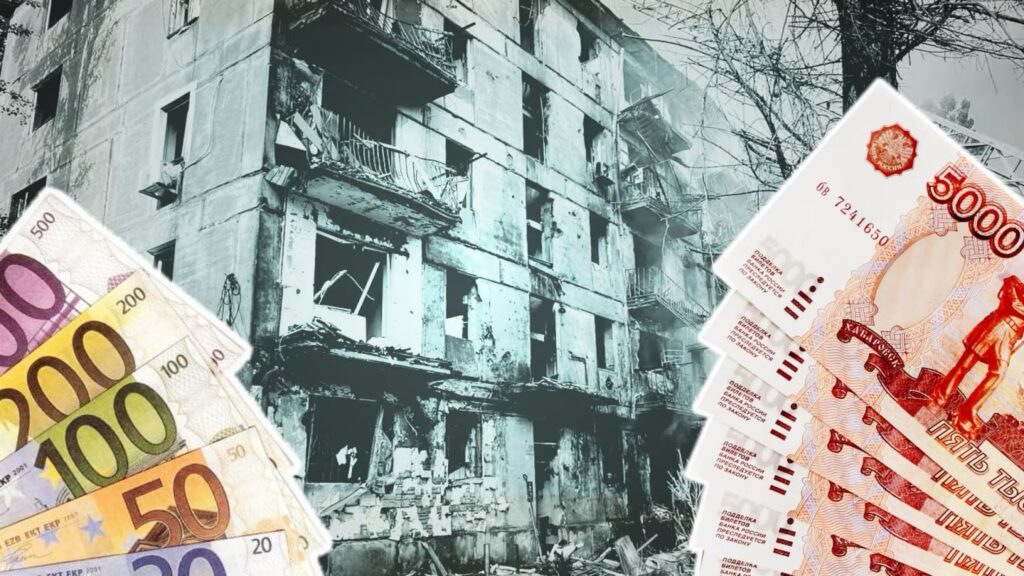
Image: from Clash Report X@clashreport
By Open Chronicle Staff with Agencies
BRUSSELS – The European Union reached a critical agreement on Friday to indefinitely freeze the Russian central bank assets held within Europe. This move removes a major administrative and political obstacle, paving the way for the bloc to use the substantial holdings to back a massive loan package for Ukraine.
The decision, passed with 25 votes in favor and opposition only from Hungary and Slovakia, keeps the estimated €120 billion in sovereign Russian assets immobilized until a further decision is made. Previously, these assets were frozen based on sanctions that required unanimous renewal every six months, a process repeatedly threatened by the veto power of Hungary’s Prime Minister Viktor Orbán and Slovakia.
🇪🇺🇷🇺 EU appropriates €300 billion of Russian assets, freezing them indefinitely
But that doesn't mean the funds will be used for a Reparations Loan for Ukraine just yet
The final call will be made at the EU summit on December 18–19
Time to say goodbye to the EU financial… pic.twitter.com/EfPmoYSu0P
— The Other Side Media (@TheOtherSideRu) December 12, 2025
By adopting a qualified majority vote mechanism for the indefinite freeze, the EU has strategically mitigated the risk of a political blockade that could have forced the bloc to return the funds to Moscow.
The primary goal of this indefinite freeze is to solidify support for the EU’s plan to utilize the frozen assets to underwrite a loan of up to €165 billion for Ukraine. This funding is intended to cover Kyiv’s urgent military and civilian budgetary needs throughout 2026 and 2027.
🚨 JUST IN: European Union Indefinitely Freezes $246 Billion in Russian Assets. Brussels has invoked rare emergency powers under Article 122 to bypass unanimous voting rules, sidestepping Hungary and Slovakia to pave the way for a massive Ukraine bailout! pic.twitter.com/UJOj0L0Pjz
— WORLD NEWS (@_MAGA_NEWS_) December 12, 2025
Under the current proposal, the loan would only be paid back by Ukraine once Russia has compensated Kyiv for war damages. This structure effectively transforms the loan into an advanced donation, anticipating future Russian reparations.
However, opposition remains, particularly from Belgium, which hosts the majority of the frozen assets (around €185 billion held at the Brussels-based securities depository Euroclear). The Belgian government is seeking solid guarantees from all EU governments that it will not be left solely responsible in the event of legal action from Moscow. The European Council is set to meet on December 18 to finalize the loan details and resolve these remaining issues.
The EU plan works by allowing Euroclear, which holds titles from the Russian central bank, to invest the resulting cash from maturing bonds into zero-coupon bonds issued by the European Commission. Since Russia legally maintains ownership of the capital but not the interest generated by the assets, the EU intends to use this interest to fund the Reparations Loan.
Russian authorities have condemned the proposal as an illegal seizure of assets and announced they would pursue legal action against Euroclear in a Moscow court.
European Commissioner for the Economy, Valdis Dombrovskis, swiftly rejected the judicial challenge, describing the action as “speculative and unfounded.” He stressed that the EU’s proposal is “legally solid and is in total conformity with EU and international law. The assets are not seized and the principle of sovereign immunity is respected.”
In response to the EU’s Friday decision, Hungarian Prime Minister Viktor Orbán stated on Facebook that the indefinite freeze, carried out by qualified majority, would cause “irreparable damage to the bloc” and vowed to do everything possible to “restore order.” European Council President António Costa, however, welcomed the vote on X, calling it the essential first step toward using immobilized Russian assets for the loan to Ukraine.