
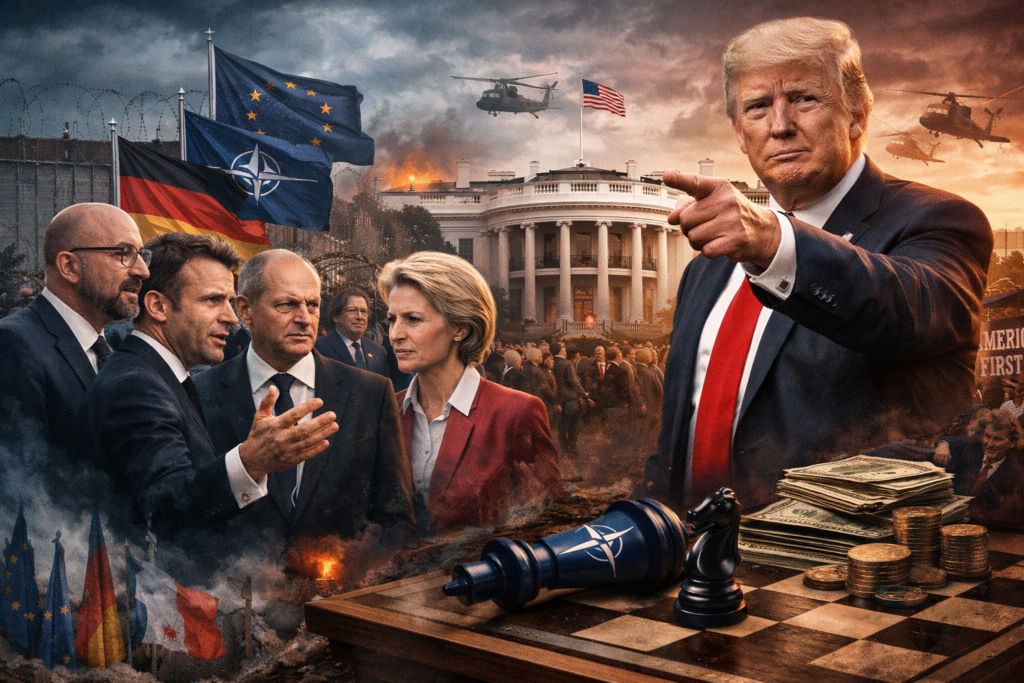
Image Credentials: Image Title: Europe in the Age of Trump’s New World Order Source: (sora.openai) Date: December 2025. Attribution: This image was created using AI-generated imagery (sora.openai) and does not depict a real-world scene.
By Madison Walker | Senior Editor
The return of Donald Trump to the White House has triggered a profound reassessment of Europe’s place in global politics. What once seemed like a temporary disruption during his first term has now hardened into a new strategic reality. European governments no longer assume that the United States can be gently steered, persuaded behind closed doors, or balanced by traditional diplomacy. Instead, they are confronting the implications of an American president who openly questions long-standing alliances and demands a more transactional form of global engagement.
This shift has left many European leaders unsettled. The transatlantic relationship, which for decades formed the backbone of European security, is no longer taken for granted. For the first time since the end of the Second World War, Europe faces the possibility that the United States may not see its defense as a strategic imperative, but as a conditional commitment tied to financial contributions, political alignment, and domestic priorities in Washington.
Under Trump’s renewed leadership, the United States has made clear that loyalty and shared values matter less than measurable returns. In this worldview, NATO is no longer a collective shield based on mutual trust, but a service that must be paid for. Countries that do not meet defense spending targets are portrayed not as allies under strain, but as liabilities.
This approach fundamentally alters how Europe is perceived. The continent is no longer a strategic equal partner in maintaining global order, but a set of customers who must justify their value. For European policymakers, this represents a cultural and political shock. Decades of cooperation built on shared democratic identity are being replaced by blunt calculations of cost and benefit.
The psychological impact of this change is just as significant as the military one. European leaders had long hoped that Trump’s first presidency was an anomaly, something that could be endured until a return to traditional American leadership. That assumption has now collapsed. The second Trump administration has made it clear that this approach is not temporary, but a defining feature of US foreign policy going forward.
As a result, European capitals are facing a harsh truth. If Washington is no longer a guaranteed security anchor, Europe must begin to act as a more autonomous strategic actor. That means higher defense spending, deeper military integration, and more political unity, all of which are difficult in a continent marked by divergent interests and historical sensitivities.
Moving toward strategic independence is easier said than done. Europe has economic strength, technological capacity, and a large population, yet it lacks a unified command structure and a single political voice in security matters. Many countries still rely heavily on American intelligence, logistics, and nuclear deterrence.
Trump’s pressure, however, is accelerating debates that have long been postponed. European defense cooperation, once seen as optional or symbolic, is becoming a necessity. The idea of a European pillar within NATO, or even outside it, is gaining new urgency as governments realize that dependence on Washington carries increasing risk.
Despite the tension, Europe does not seek a rupture with the United States. Economic ties, intelligence sharing, and cultural links remain too deep to be discarded. What has changed is the emotional and political foundation of the relationship. Trust has been replaced by caution, and long-term planning is now shaped by uncertainty rather than confidence.
Trump’s new world order forces Europe to grow up strategically. Whether this leads to a stronger and more united continent, or to deeper fragmentation, will depend on how effectively European leaders respond to this moment. One thing is already clear. The era in which Europe could rely on American leadership without question is over, and a new chapter in transatlantic history has begun.