
Image: from PLA_Overwhelm X@junshiguancha
By Open Chronicle Staff with Agencies | December 27, 2025
DALIAN, China — Emerging intelligence and satellite imagery analysis suggest that China has officially crossed a major naval threshold: the construction of its first nuclear-powered aircraft carrier. This vessel—the fourth in the People’s Liberation Army Navy (PLAN) inventory—represents a profound shift in Beijing’s ability to project power far beyond its immediate coastal waters.
China begins construction of nuclear-powered aircraft carrier.
Satellite Imagery suggests that China's 4th aircraft carrier will rely on twin nuclear reactors for propulsion.
Fourth aircraft carrier will likely displace about 100,000 tonnes at full load. pic.twitter.com/rqjbO35uHl
— Varun Karthikeyan (@Varun55484761) December 18, 2025
Evidence from the Dalian Shipyards
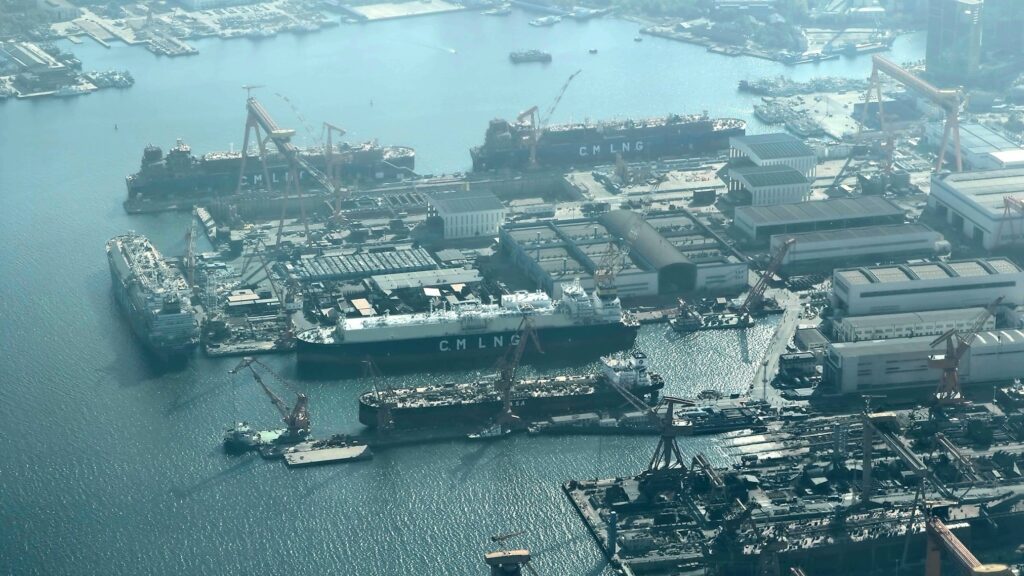
According to a report by the National Institute for Basic Policy Research (NIPPR), recent satellite imagery of the Dalian Shipbuilding Industry Co., Ltd. facility shows activity consistent with the start of a technically complex, nuclear-powered project. Unlike China’s previous carriers, the Liaoning and Shandong, which were conventionally powered, the footprint of this new project indicates a massive leap in scale and complexity.
Key Technical Observations:
-
Massive Keel Blocks: In February 2025, large wooden supports (keel blocks) exceeding 886 feet (270 meters) were spotted, signaling the assembly of a mammoth hull.
-
Internal Structural Frames: By November 10, 2025, a structure measuring 492 feet by 141 feet was visible in the dock. Inside, two rectangular frames (approx. 52 ft x 45 ft) were identified—components that were notably absent during the construction of the conventionally powered Shandong.
-
Nuclear Consistency: NIPPR notes that these features align with the requirements for housing nuclear reactors and specialized propulsion systems.
A Shift in Strategic Doctrine
Currently, China’s carrier fleet operates primarily within the First Island Chain (stretching from Japan through Taiwan to the Philippines), protected by a massive Anti-Access/Area-Denial (A2/AD) umbrella. However, a nuclear-powered carrier changes the calculus.
Why Nuclear Power Matters:
-
Unlimited Range: Unlike conventionally powered ships, a nuclear carrier can operate globally without the need for frequent refueling, allowing China to “show the flag” in the Indian Ocean and the deep Pacific.
-
Post-2027 Planning: While the Pentagon warns of a potential move on Taiwan by 2027, this carrier is not expected to enter service until the 2030s. This suggests the vessel is intended for a “Post-Taiwan” era, where China seeks to maintain its status as a dominant global maritime power.
120,000 ton nuclear supercarrier is being built in China.
One of the 2 nuclear reactor containment structure is clearly visible. pic.twitter.com/X6zz6H47TY
— Zhao DaShuai 东北进修🇨🇳 (@zhao_dashuai) November 12, 2025
Infrastructure Expansion at Qingdao
Japan’s Ministry of Defense has reported a simultaneous, massive expansion at the PLAN base in Qingdao, the current homeport of the Liaoning. The expansion includes:
-
Enhanced Piers: Upgraded to accommodate larger, nuclear vessels.
-
Demagnetization Facilities: Critical for reducing a ship’s magnetic signature to avoid detection.
-
New Naval Airfield: Dedicated carrier landing training facilities and extensive hangars for next-generation fighter jets.
The Production Advantage
A sobering reality for Western observers is China’s industrial capacity. While the United States often takes over six years to complete a single carrier, China’s shipyards are currently the most robust in the world.
The NIPPR report highlights that China’s ability to mass-produce these systems could eventually make even nuclear-powered carriers “expendable and replaceable” in a high-intensity conflict. This “quantity with quality” approach marks a significant departure from traditional naval doctrines that view carriers as irreplaceable strategic assets.
Carrier Fleet Comparison
| Ship | Type | Propulsion | Status |
| Liaoning (Type 001) | Training/Active | Conventional | In Service |
| Shandong (Type 002) | Active | Conventional | In Service |
| Fujian (Type 003) | Testing | Conventional (EMALS) | Sea Trials |
| New Project (Type 004) | Strategic | Nuclear | Under Construction |
Conclusion
China is not merely modernizing; it is expanding. Despite economic or political headwinds, the leadership in Beijing is moving toward a “blue water” navy capable of challenging US naval supremacy in the open ocean. Through a combination of industrial will and nuclear technology, the PLAN is preparing for a future where its reach extends well beyond the shores of Asia.