
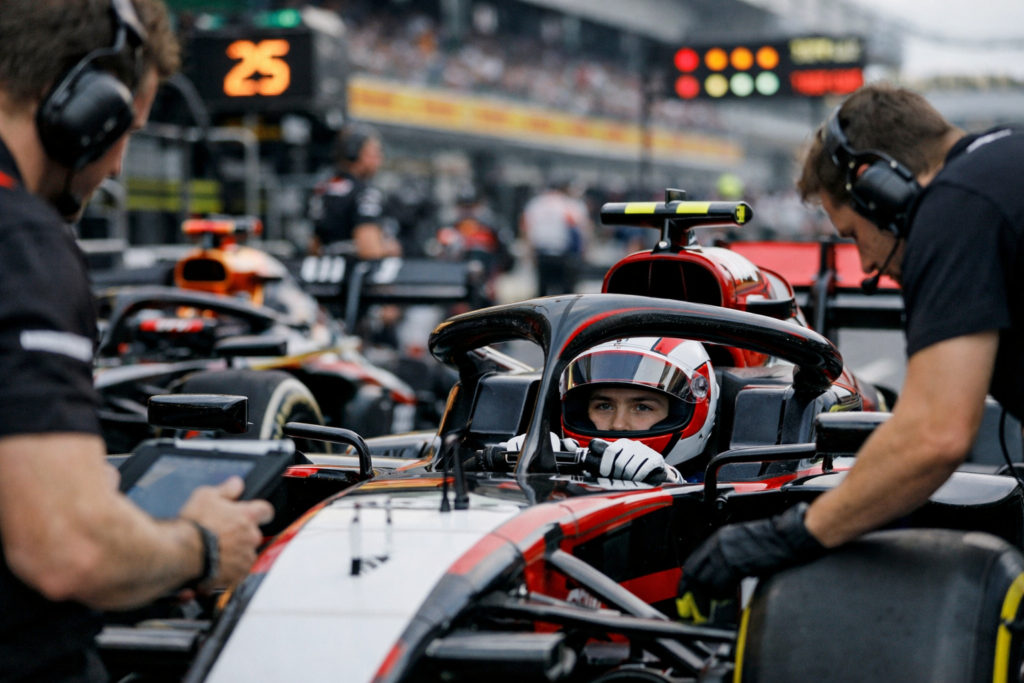
Image Credentials: Image Title: F1 Young Driver Free Practice Requirements (2025) Source: (sora.openai) Date: December 2025. Attribution: This image was created using AI-generated imagery (sora.openai) and does not depict a real-world scene.
The Young Driver Free Practice Requirements are a set of mandatory sessions within the FIA Formula One World Championship designed to provide aspiring talent with seat time in current-specification machinery. Significant revisions to these regulations were implemented for the 2025 season, doubling the mandatory participation frequency to foster better integration of junior drivers into the sport.
Overview of the 2025 Regulation
In an effort to address the limited testing opportunities available to junior drivers, the FIA and Formula One Management (FOM) increased the “Young Driver” mandate. Starting in 2025, every team on the grid is required to allocate two Free Practice 1 (FP1) sessions per car to a young driver during the course of the season.
Key Changes from Previous Seasons
-
2022–2024 Requirement: Each team had to run a young driver once per season, per car (total of two sessions per team).
-
2025 Requirement: Each team must now run a young driver twice per season, per car (total of four sessions per team).
Criteria for “Young Driver” Status
To qualify as a “young driver” under the 2025 Sporting Regulations, a participant must meet specific criteria defined by the FIA:
-
Experience Limit: The driver must not have participated in more than two Formula 1 World Championship races during their career.
-
Licence Requirement: The driver must possess a valid Free Practice Only Super Licence or a full FIA Super Licence.
-
Eligible Machinery: The sessions must be conducted using a car that conforms to the current season’s technical regulations.
Strategic Implementation
Teams generally choose their FP1 outings based on track characteristics and championship standings.
-
Track Selection: Teams typically avoid “high-stakes” or high-risk circuits (e.g., Monaco, Baku, or Las Vegas) for these sessions, preferring traditional European circuits like Circuit de Barcelona-Catalunya or Silverstone.
-
Championship Impact: Because these sessions take away valuable track time from regular race drivers, teams often schedule them late in the season once the championship order is more established, or early in the year at tracks where they have extensive simulation data.
Purpose and Impact
The increase to four mandatory sessions per team serves several strategic purposes:
-
Bridging the Gap: With the reduction of private testing, young drivers in Formula 2 and other junior categories often struggle to adapt to the complexity of modern F1 power units and aerodynamics.
-
Talent Evaluation: It allows teams to evaluate academy drivers under real-world Grand Prix weekend pressure, helping them make more informed decisions for future race seats.
-
Commercial Value: These sessions provide additional exposure for junior driver sponsors and academy partners.
References
-
FIA (Fédération Internationale de l’Automobile). (2024). 2025 Formula One Sporting Regulations – Issue 1. [Official PDF]. Available at fia.com.
-
FIA Communications Department. (October 17, 2024). “World Motor Sport Council approves changes to 2025 and 2026 Sporting and Technical Regulations.” [Press Release].
-
Noble, J. (2024). “F1 to double young driver FP1 sessions from 2025.” Motorsport.com.
-
Benson, A. (2024). “F1 young driver rules: Teams must run rookies four times a year from 2025.” BBC Sport.
-
Formula One Management (FOM). (2024). “Rules and Regulations: Understanding the 2025 changes for young drivers.” F1.com.
-
Medland, C. (2024). “Junior drivers to get double the F1 track time under new 2025 rules.” Racer.
-
Grand Prix Drivers’ Association (GPDA). (2024). “Collective statement on the increase of rookie FP1 participation for 2025.”
Back to 2025 Formula One Season Portal
Explore this subject
Continue exploring related Open Chronicle Encyclopedia entries through the categories associated with this article.

Staff Writers at Open Chronicle produce trusted journalism, strategic analysis and authoritative reference content across global affairs, geopolitics, defense, science, history, technology, business, culture and sport. Their work combines accurate reporting with historical perspective and analytical depth, helping readers understand not only what is happening, but why it matters. Beyond daily news coverage, Staff Writers contribute to the Open Chronicle Encyclopedia, investigative features, original research projects and long-form reports, building a comprehensive knowledge platform designed to inform, educate and preserve reliable information for a global audience.