
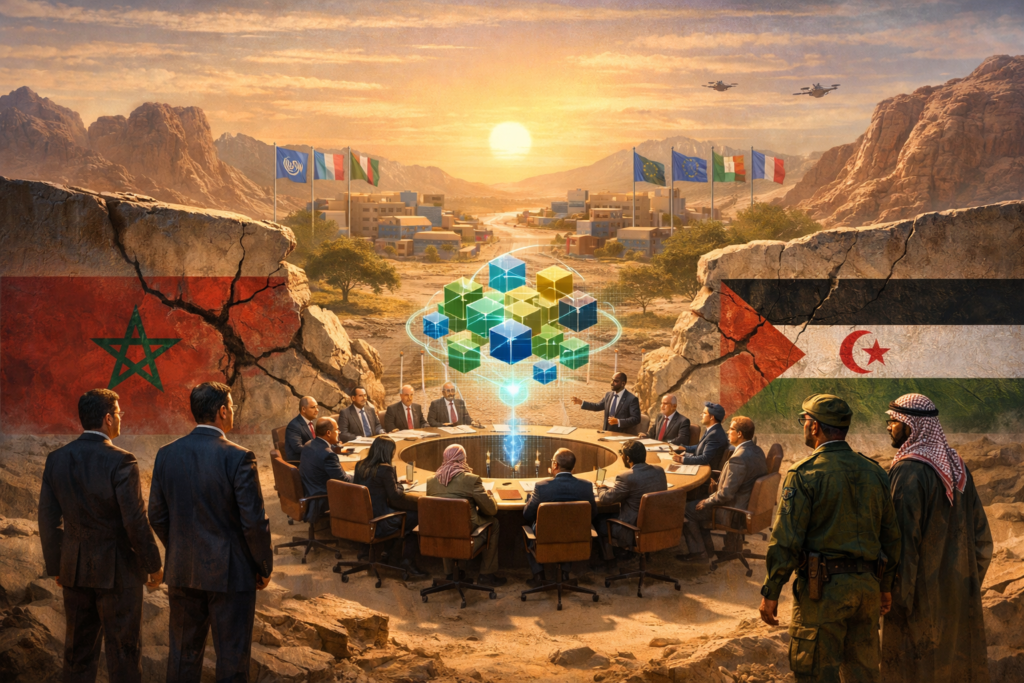
Image Credentials: Image Title: Western Sahara: Beyond the Binary—A New Political Landscape After Resolution 2797 Source: (sora.openai) Date: December 2025. Attribution: This image was created using AI-generated imagery (sora.openai) and does not depict a real-world scene.
By Open Chronicle Staff with Agencies | December 29, 2025
UNITED NATIONS — For decades, the conflict in Western Sahara was defined by a rigid, zero-sum confrontation between Morocco and the Polisario Front. However, the adoption of UN Security Council Resolution 2797 on October 31, 2025, has signaled a profound shift. The debate is no longer binary; a new, multi-dimensional political structure is emerging, challenging long-held legal orthodoxies and sovereign certainties.
While the resolution has not ended the dispute, it has cracked the deadlock by acknowledging a more complex reality on the ground, one where a “third voice” is beginning to find its resonance.
The Three Pillars of the Current Conflict
The Sahrawi issue is now being contested across three distinct ideological axes:
1. The Polisario Front: Legal Orthodoxy
The Polisario Front remains anchored in a strict interpretation of international law. They argue that Western Sahara is a non-self-governing territory awaiting decolonization.
-
The Stance: Any solution excluding the option of full independence is viewed as a violation of the UN Charter.
-
The Challenge: Following Resolution 2797, the Front’s spokesperson emphasized that the UN has not explicitly recognized Moroccan sovereignty. However, this rigid legalism faces increasing pressure from an international community that is pivoting toward regional stability and pragmatic risk management.
2. Morocco: Sovereign Pragmatism
Rabat maintains that the Sahara is an integral part of Moroccan territory. Since 2007, its Autonomy Plan has been presented as the “only viable” solution.
-
The Stance: Described by Rabat as “serious, credible, and realistic,” the plan focuses on economic development and local governance under Moroccan sovereignty.
-
The Challenge: While Morocco enjoys growing international support, Resolution 2797—like its predecessors, stops short of formal recognition of sovereignty, maintaining a deliberate diplomatic distance.
3. Sahrawi Movement for Peace (SMP): The Third Way
Emerging as a modern alternative to the confrontation logic of the past, the SMP represents a departure from the “all or nothing” approach.
-
The Stance: The SMP views autonomy not as a surrender, but as a political outcome that must include genuine institutional guarantees, pluralistic representation, and real power for Sahrawis.
-
The Impact: This “third way” is gaining traction in diplomatic circles as it aligns with the spirit of Resolution 2797’s call for an “acceptable settlement” rather than a pre-determined historical slogan.
The Role of the UN Security Council: Strategic Ambiguity
The Security Council has opted for what experts call “calculated secrecy.” Resolution 2797 reaffirms the principle of self-determination but intentionally avoids defining the specific mechanism or institutional model to achieve it.
Why the Ambiguity?
-
Stability First: Amidst rising tensions in the Sahel and global geopolitical shifts, the Council’s priority is preventing military escalation.
-
Consensus Building: The “mystery” allows for a minimum level of harmony among the Council’s permanent members, who remain divided on the final status of the territory.
A Transition Toward Realism
The post-Resolution 2797 phase is characterized by a “multi-vocal” debate. The conflict has moved to an intersection where four forces meet:
-
Legal Orthodoxy (Polisario)
-
Sovereign Pragmatism (Morocco)
-
Governance Realism (SMP)
-
Cautious Diplomacy (Security Council)
Key Components of the New Landscape
| Stakeholder | Focus | Strategy |
| Morocco | Territorial Integrity | Economic development and bilateral alliances. |
| Polisario | Self-Determination | Appeals to international law and ICJ precedents. |
| SMP | Local Governance | Seeking “institutional guarantees” within a compromise. |
| UNSC | Conflict Management | Strategic ambiguity and avoiding regional escalation. |
From Slogans to Settlements
One thing is certain. Western Sahara has entered a transitional phase. The eventual resolution will likely be less about the triumph of one historical slogan over another and more about the capacity of these diverse voices to build a settlement that is “acceptable to all.” The binary age is over; the era of complexity has begun.