
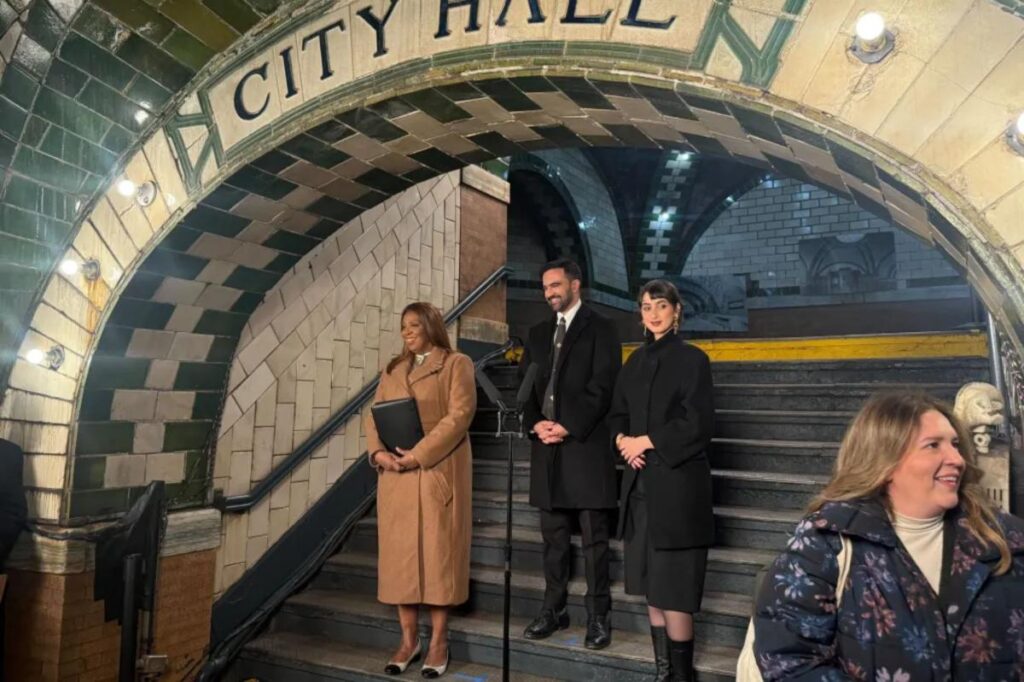
Image: from New York Post X@nypost
By Open Chronicle News Desk | January 1, 2026
NEW YORK CITY — On a historic Thursday afternoon at City Hall, the political landscape of America’s largest city underwent a seismic transformation. Zohran Mamdani was sworn in as the 112th Mayor of New York City, shattering a glass ceiling that had stood for nearly four centuries. At 34, Mamdani becomes the first Muslim, the first South Asian, and the first African-born person to lead the five boroughs.
👀 Zohran Mamdani sworn in as the 112th Mayor – first Muslim & South Asian – in a midnight ceremony at the abandoned City Hall subway station, oath on the Quran by AG Letitia James. A new era begins! #NYCMayor #ZohranMamdani pic.twitter.com/hlZ5CeiXMe
— VIRTUE.NEWS (@virtuemediacorp) January 1, 2026
The ceremony, thick with symbolism and progressive fervor, signaled a hard-left turn for a city that has long been a battleground between centrist pragmatism and radical reform.
While many inaugural addresses focus on moderate unity, Mamdani used his first moments in power to double down on the political identity that carried him to an upset victory in November.
“I was elected as a Democratic socialist, and I will govern as a Democratic socialist,” Mamdani told a cheering crowd. “I will not abandon my principles for fear of being deemed radical.”
Mamdani’s speech outlined a vision of New York where the city government takes a direct, interventionist role in the daily lives of its 8.3 million residents. His core pillars include:
-
Universal Childcare: A city-funded guarantee for all families.
-
Rent Control: Instituting immediate rent freezes to combat the city’s affordability crisis.
-
Public Services: Vowing that “no New Yorker is priced out” of the necessities of urban life.
The inauguration served as a victory lap for the American progressive movement. The oath of office was administered by Senator Bernie Sanders, who framed the election as a repudiation of the status quo. Sanders called the win the “biggest political upset in modern American history,” noting that Mamdani defeated not only the Democratic and Republican establishments but also the influence of real estate developers and the sitting president.
Congresswoman Alexandria Ocasio-Cortez, a pivotal ally in Mamdani’s rise, echoed these sentiments, declaring the start of a “new era” where the working class—rather than the donor class, sets the municipal agenda.
Bernie Sanders swears in Zohran Mamdani as NYC's 112th Mayor
First Muslim mayor in New York City history takes oath on his grandfather's Quran
40,000 New Yorkers 🅱️raved the cold to witness democratic socialist rise
From State Assembly to America's largest city in one year pic.twitter.com/ybS8JNRF2I
— Boi Agent One (@boiagentone) January 1, 2026
Mamdani’s personal trajectory is as unprecedented as his policy platform. Born in Kampala, Uganda, to Indian immigrant parents, he arrived in New York at age seven and only became a U.S. citizen in 2018. His rapid ascent from a New York State Assemblyman in 2020 to the mayoralty represents a generational shift in leadership.
The new mayor faces immediate scrutiny over the feasibility of his ambitious “City Hall Policy Agenda.” Opponents and fiscal hawks have expressed concern over the budgetary impact of his proposals, which seek to reshape the city’s economic foundation.
| Policy Goal | Description |
| Free Transit | Making the city’s bus network entirely fare-free to increase mobility. |
| Municipal Groceries | Establishing city-run grocery stores to combat “food deserts.” |
| $30 Minimum Wage | Raising the city’s minimum wage to $30 per hour by the year 2030. |
| Social Housing | A massive expansion of rent-stabilized and city-owned housing units. |
Mamdani’s administration begins at a time of deep polarization. While his supporters see him as a savior for the “disappeared” working class, his critics fear that his policies could trigger capital flight and budget deficits. In his closing remarks, Mamdani reached out to his detractors, stating, “If you are a New Yorker, I am your mayor,” pledging a commitment to all residents, even as he moves to fundamentally alter the city’s DNA.