
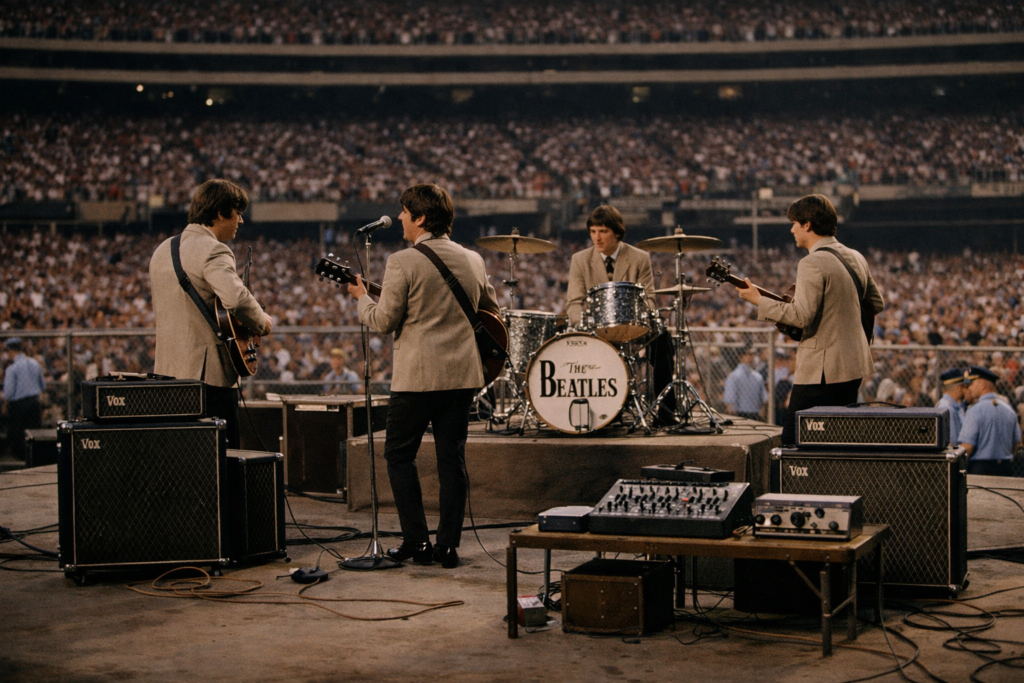
Image Credentials: Image Title: The Shea Stadium Paradox: Why the Beatles Weren’t Actually a “Loud” Band Source: (sora.openai) Date: January 2025. Attribution: This image was created using AI-generated imagery (sora.openai) and does not depict a real-world scene.
By Open Chronicle Music Desk | January 1, 2026
There is a persistent myth in rock history that The Beatles pioneered the “Wall of Sound” through sheer volume, that they were the first band to make decibels a primary instrument. But if you look at the technical data from their most iconic performance, the truth is far more staggering: by modern standards, the greatest rock band in history was practically playing in a library.
A common misconception is that the Beatles’ hearing survived only by some miracle of 1960s resilience. Many believe they were the first to treat volume as an essential tonal preference. However, the gear list for their 1965 Shea Stadium show, playing to a record-breaking crowd of over 55,000 people, tells a story of technical desperation rather than sonic intent.
-
The Backline: Three 100-watt Vox amps (AC100s) and one 50-watt Vox.
-
The Speakers: Paul had a pair of 15″ speakers for his bass; John and George had four 12″ speakers each.
-
The Drums: Ringo’s Ludwig kit was entirely unamplified.
To put this in perspective: a typical modern pub band playing to 50 people usually carries a minimum of 250 watts for their P.A. system alone. The Beatles were trying to fill a literal stadium with less power than a high-end home theater system today.
The most shocking part of the Shea Stadium setup was the Public Address (P.A.) system intended to carry the vocals. Instead of the massive line-array towers we see at festivals today, the “P.A.” consisted of EVLR4A speakers on sticks, thin white columns containing stacks of small elliptical drivers arranged in a square around the band’s riser.
The result? Noise cancellation and delay abounded. The sound was thin, directional, and frequently swallowed by the wind. The Beatles weren’t running their amps at “10” because they wanted a distorted, heavy tone; they ran them as loud as they could go simply to hear themselves over the 55,000 screaming fans.
If the Beatles seemed “loud” for their time, it wasn’t because they were a proto-metal band. It was because they were engaged in a losing battle with physics.
-
Stage Monitoring: It didn’t exist. There were no “wedges” pointing back at the band. Ringo famously had to watch the sway of his bandmates’ backs to keep time because he couldn’t hear the guitars.
-
Tonal Preference vs. Necessity: Modern bands use volume to achieve “crunch” or “saturated” tones. The Beatles’ Vox amps were struggling just to reach the front row.
-
The Audience Factor: The “sound” of a Beatles concert was actually the sound of the audience. The decibel level of the crowd (measured at roughly 130dB) far exceeded the output of the band’s 100-watt amplifiers.
| Feature | Shea Stadium (1965) | Modern Small Pub Gig |
| Audience Size | 55,617 | 50 |
| Total Amp Wattage | ~350 Watts | ~200 – 500 Watts |
| Vocal P.A. | Column speakers “on sticks” | Digital mixer / Subwoofers |
| Drum Mics | 0 | Minimum 4-8 |
Hardly the “Lords of Loud,” The Beatles were actually the victims of a technology gap. Their legendary status was built on performances where they could barely hear their own instruments. The “Beatle Sound” wasn’t defined by volume, but by the band’s ability to remain cohesive while playing through equipment that would be considered underpowered for a high school talent show today.
They weren’t the first band to play loud; they were the first band to realize that the world needed much bigger speakers.
References
-
Epstein, Brian. A Cellarful of Noise. London: Souvenir Press, 1964.
-
Lewisohn, Mark. The Complete Beatles Chronicle. New York: Harmony Books, 1992.
-
Miles, Barry. Many Years From Now. New York: Henry Holt and Company, 1997.
-
Babiuk, Andy. Beatles Gear: All the Fab Four’s Instruments from Stage to Studio. Milwaukee: Backbeat Books, 2001.
-
Vox Amplification. (1965). Vox Product Catalog: The British Sound. Dartford: Jennings Musical Industries.
-
Electro-Voice (EV). Engineering Data: The LR4A Line Radiator Column. Buchanan, MI: Electro-Voice Inc., 1962.
-
Eargle, John. The JBL Audio Engineering Handbook. Boston: Focal Press, 2003.
-
Millard, Andre. Beatlemania: Technology, Business, and Teenage Culture. Baltimore: Johns Hopkins University Press, 2012.
Institutional Resources
| Source | Data Provided |
| The Beatles’ Shea Stadium Film (1966) | Visual confirmation of the amplifier placement and P.A. column positioning. |
| Vox Showroom (Historical Archives) | Wiring diagrams for the AC100/4 amp head and speaker cabinets. |
| Audio Engineering Society (AES) | Historical papers on the development of “Line Array” vs. “Column” speakers. |
GuitarWorldX
Lessons, gear, techniques, artists, guitar legends and the stories shaping the world of guitar.
Return to GuitarWorldX ›