
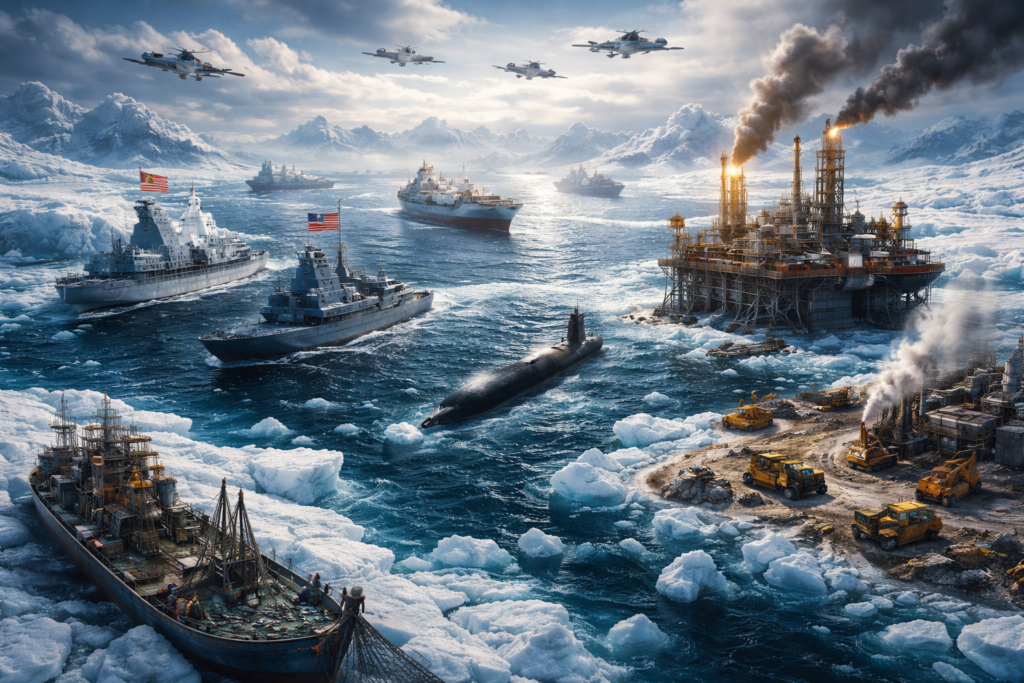
Image Credentials: Image Title: The Arctic Is No Longer a Peaceful Frontier, It Is the Next Global Flashpoint Source: (sora.openai) Date: December 2025. Attribution: This image was created using AI-generated imagery (sora.openai) and does not depict a real-world scene.
By José Carlos Palma*
For much of the modern era, the Arctic was seen as a rare exception in global politics. While wars raged elsewhere, the High North was governed by science, treaties, and cautious cooperation among the eight Arctic nations. That era is now over.
Melting ice has exposed something far more dangerous than new shipping lanes or mineral wealth. It has revealed how fragile the Arctic’s political calm really was.
Climate change has opened the door to economic opportunity on a scale that inevitably breeds rivalry. The Northern Sea Route promises to cut weeks off global shipping between Asia and Europe. Beneath the seabed lie vast reserves of oil, gas, and rare earth minerals that power everything from smartphones to electric cars. Fisheries, tourism, and mining are expanding into waters that were once permanently frozen. History tells us that where profit flows, power struggles follow.
Nowhere is this more visible than in Greenland. Its mineral wealth and strategic position in the North Atlantic have turned it into a prize that great powers openly covet. The United States views it as indispensable to its missile defense and control of the Greenland, Iceland, and UK gap, the maritime corridor that guards access to the Atlantic. China sees it as a source of rare earths and a gateway to its Polar Silk Road. Even the idea of American acquisition, once dismissed as absurd, reflects a hard truth, Greenland’s future is now a matter of global power politics.
Russia has responded to this new Arctic reality not with cooperation but with militarization. The Kola Peninsula already houses much of Moscow’s nuclear force, and its Northern Fleet is among the most powerful naval formations in the world. Russia has rebuilt or constructed dozens of Arctic bases, deployed icebreakers armed with cruise missiles, and expanded submarine operations deep into the North Atlantic. Its shadowy deep-sea unit GUGI now monitors and threatens the cables and pipelines that keep Europe’s economies alive.
At the same time, Moscow is openly preparing for confrontation. Russian leaders have repeatedly warned that NATO’s growing Arctic presence will be met with force. Military exercises now simulate amphibious landings and under-ice warfare. Russian intelligence operations, cyber attacks, and sabotage have become routine. From damaged undersea cables to unidentified drones over Nordic infrastructure, the signs of gray zone conflict are already visible.
China, meanwhile, is no longer content to remain an observer. Its investments in Arctic ports, mining projects, and Russian gas fields have given it a permanent stake in the region. Chinese icebreakers, warships, and bombers now operate alongside Russian forces. Beijing’s ambitions for a Polar Silk Road suggest it will not accept Russian control over Arctic sea lanes any more than it accepts restrictions in the South China Sea.
This uneasy partnership between Moscow and Beijing is likely to become more competitive as Arctic trade and resources increase in value. Their cooperation today masks long-term rivalry tomorrow.
Against this backdrop, NATO’s historic neglect of the Arctic looks increasingly dangerous. Britain, for example, has one aging ice patrol ship and is therefore limited in its ice surveillance capabilities. While Royal Marines retain elite cold-weather skills, the navy and air force struggle to sustain a constant Arctic presence. Yet this region now matters as much as the Baltic or the Black Sea.
Deterrence remains the only realistic path to stability. History shows that Russia exploits weakness and respects strength. The failure to respond forcefully to Crimea in 2014 emboldened Moscow and led directly to the war in Ukraine. A similar mistake in the Arctic would risk inviting Russian adventurism in places like Svalbard, Greenland, or the North Atlantic seabed.
Arctic rearmament is not a march toward war. It is an effort to prevent one. When all sides know that aggression will be detected and punished, the incentive to test limits disappears. As Frederick the Great warned centuries ago, diplomacy without arms is merely noise.
The Arctic will never again be a quiet scientific preserve. It is becoming a central theater of twenty-first-century geopolitics. The choice for the West is not whether to engage there, but whether to arrive prepared or be caught off guard.
The Grand Strategy Institute
Continue Exploring Strategic Analysis
Return to The Grand Strategy Institute for strategic assessments, long-form analysis and research examining geopolitics, military affairs, international security, emerging technologies and the changing international order.
← Back to The Grand Strategy Institute