
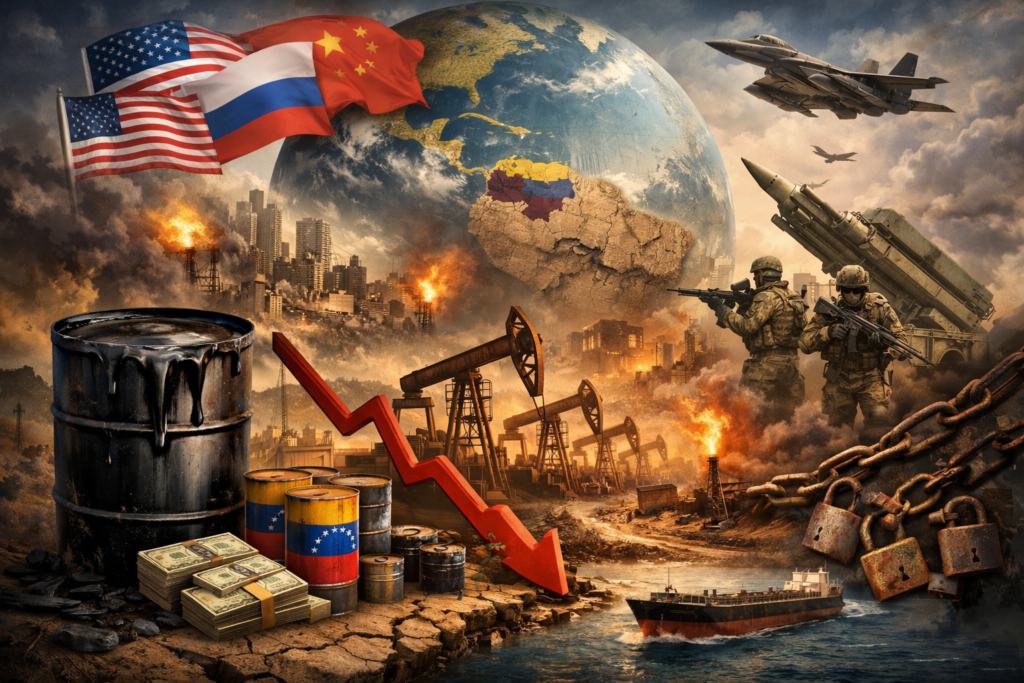
Image Credentials: Image Title: Venezuela’s Oil Industry and the New Geopolitics of Energy Power Source: (sora.openai) Date: January 2026. Attribution: This image was created using AI-generated imagery (sora.openai) and does not depict a real-world scene.
By José Carlos Palma*
Venezuela holds the largest proven oil reserves on Earth, an astonishing 303 billion barrels. Yet despite this geological wealth, the country produces barely one-third of what it pumped at the end of the twentieth century. Once exporting more than 3.2 million barrels per day, Venezuela now struggles to maintain output near one million. This collapse is not simply an energy story; it is a geopolitical one, shaping alliances, sanctions, and global power balances.
At the heart of Venezuela’s predicament lies the nature of its oil. Unlike the light and sweet crude that flows easily from shale fields in the United States or from the deserts of the Middle East, Venezuelan oil is overwhelmingly heavy and extra-heavy. Most of it comes from the Orinoco Belt, where the crude is so dense and sulphur-rich that it behaves more like sludge than liquid petroleum. This makes it expensive to extract, impossible to transport without blending, and costly to refine.
These geological facts alone place Venezuela at a disadvantage. But political decisions have turned that disadvantage into a strategic vulnerability.
Venezuela entered the twenty-first century with one of the most technically advanced national oil companies in the developing world. PDVSA was respected globally for its engineering expertise, heavy crude processing, and integrated export system. That institutional capital was shattered in 2003, when more than 18,000 skilled employees were fired after a national strike. Most were engineers, geologists, and refinery specialists. Many emigrated to Canada, Colombia, and the Middle East, where their skills were quickly absorbed.
What replaced them was not expertise but political loyalty. PDVSA was converted into a fiscal arm of the state, forced to finance social programmes instead of reinvesting in infrastructure. Maintenance was delayed, drilling was reduced, pipelines deteriorated, and research and development were hollowed out. By the time international sanctions were imposed in 2019, the industry was already in free fall.
Sanctions did not create Venezuela’s oil collapse, but they accelerated it dramatically. They cut off access to spare parts, financing, and crucially, the imported diluents needed to make Orinoco crude transportable. Production plunged to levels not seen since the 1940s.
In geopolitical debates, Venezuela is often portrayed as a potential oil prize for foreign powers. This comparison is misleading. Iraq sits atop vast reserves of medium and light crude that can be produced cheaply and refined almost anywhere. Venezuelan oil is the opposite. It requires blending, upgrading, and specialized refineries equipped with cokers and hydrocrackers. Only a limited number of facilities in the world can handle it efficiently.
This reality explains why China has become Venezuela’s dominant customer. Chinese independent refineries, particularly in Shandong, are configured to process discounted heavy crude and turn it into fuel oil and bitumen. Beijing also uses Venezuelan oil shipments to recover billions of dollars in loans it extended to Caracas during the Chávez era.
The United States, despite being the world’s largest oil producer, still needs heavy crude for its Gulf Coast refineries. These facilities were designed decades ago to process Venezuelan and Mexican grades. When sanctions briefly eased, American refiners rushed to secure Venezuelan barrels through Chevron’s joint ventures. The demand exists, but politics constrains supply.
Venezuela’s oil system today is not merely underfunded; it is structurally degraded. The four heavy oil upgraders at the Jose complex, once the backbone of Orinoco production, operate intermittently. Refineries run at a fraction of their capacity. Pipelines leak. Power failures shut down wells. Natural decline rates in conventional fields are among the highest in the world.
This means that even if sanctions were lifted tomorrow, Venezuela could not quickly flood the market with oil. A return to two million barrels per day might be possible within a few years under ideal conditions, but restoring the country’s former output would require tens of billions of dollars and at least a decade of sustained investment.
The most severe constraint is not capital but human expertise. The engineers who knew how to run this system are scattered across the globe. Rebuilding that institutional knowledge cannot be done quickly, regardless of how much money is available.
Venezuela now sits within a wider geopolitical alignment of sanctioned energy producers alongside Russia and Iran. Together, these states supply a large share of China’s crude imports. In return, China provides financing, markets, and diplomatic cover. This energy axis allows Beijing to secure discounted supplies while weakening Western leverage over global oil flows.
For Washington and its allies, Venezuela is not a looming oil windfall but a strategic outpost of rival powers in the Western Hemisphere. The country’s degraded oil industry still generates enough revenue to sustain this alignment, even at low production levels.
Venezuela’s vast reserves do not translate into immediate power. They represent potential energy, locked inside geology, broken infrastructure, and a fractured state. Any serious recovery would require political stability, sanctions relief, institutional rebuilding, and a generation of technical reconstruction.
In geopolitics, Venezuela is not a prize waiting to be seized. It is a long-term strategic challenge, one that illustrates how natural resources alone do not create power. Institutions, expertise, and political coherence matter just as much as what lies underground.
Until those elements are restored, Venezuela’s oil will remain what it has become today, the world’s largest stranded energy resource.
References
- Council on Foreign Relations. Venezuela’s Economic Crisis and Oil Sector Collapse. CFR Backgrounder, updated editions 2023 to 2025.
- EIA, U.S. Energy Information Administration. Venezuela Country Analysis Brief. Washington, DC, latest editions.
- OPEC. Monthly Oil Market Report and Annual Statistical Bulletin. Vienna, 2023 to 2025 editions.
- Wood Mackenzie. Venezuela Upstream Oil and Gas Outlook. Energy Industry Research Reports, 2024 to 2025.
- International Energy Agency. World Energy Outlook and Oil Market Report. Paris, recent editions.
- U.S. Congressional Research Service. Venezuela: Background and U.S. Relations. Washington, DC, updated reports 2024 to 2025.
- PDVSA. Annual Management and Financial Reports. Caracas, latest available filings.
- BP. Statistical Review of World Energy. London, latest edition.
- Reuters. Venezuela Energy Sector Coverage, 2019 to 2025 Investigative Reports.
- Financial Times. Global Energy and Latin America Coverage, 2022 to 2025.
The Grand Strategy Institute
Continue Exploring Strategic Analysis
Return to The Grand Strategy Institute for strategic assessments, long-form analysis and research examining geopolitics, military affairs, international security, emerging technologies and the changing international order.
← Back to The Grand Strategy Institute