
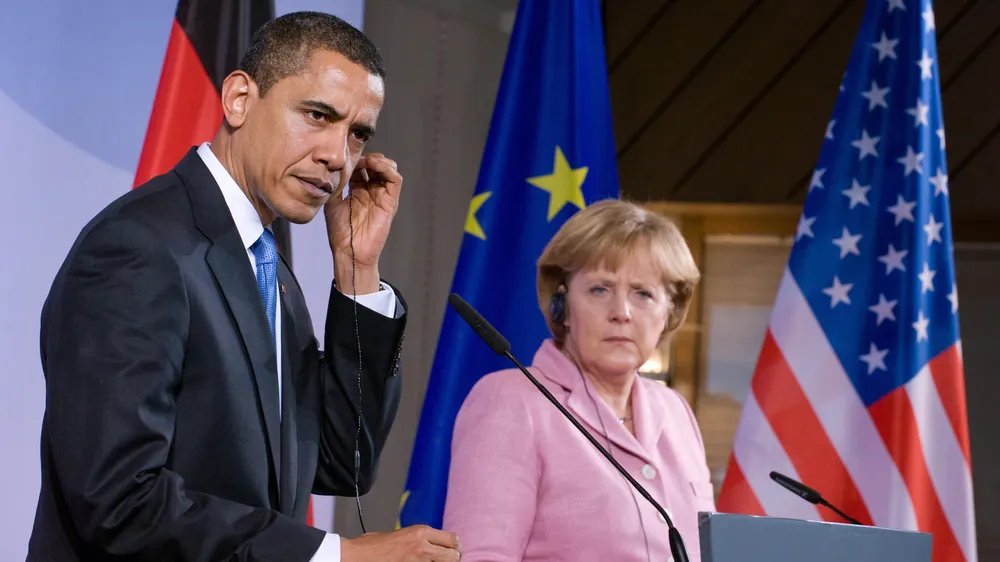
Image: from (((Tendar))) X@Tendar
By Open Chronicle Military Intelligence Desk
Berlin and Washington, long bound by one of the world’s most important intelligence partnerships, now find themselves linked by one of the most unsettling espionage stories of the post-Cold War era. Investigative reporting in Germany suggests that the Bundesnachrichtendienst, known as the BND, secretly monitored the communications of former United States President Barack Obama for much of his first term, quietly intercepting calls made from Air Force One between 2009 and 2014.
According to findings published by journalist Holger Stark of the newspaper Die Zeit, German intelligence technicians exploited weaknesses in the encrypted communications systems used aboard the presidential aircraft. American officials reportedly rotated through roughly a dozen transmission frequencies, yet the BND is said to have mapped them all, allowing it to selectively monitor presidential calls without maintaining a constant surveillance feed.
The operation was not part of Germany’s formal intelligence tasking. The United States was not listed as an approved surveillance target, a restriction that forced the BND to handle the intercepted material with extreme discretion. Transcripts of Obama’s calls were stored in a highly restricted internal file accessible only to the agency’s most senior leadership, including its president and vice president. Rather than being widely circulated, the intelligence was distilled into broader assessments of the United States’ political and strategic positions and forwarded to the office of Chancellor Angela Merkel. The original transcripts were then destroyed, a step apparently designed to reduce legal and political exposure.
The wiretapping allegedly came to an end in 2014, after Merkel’s office ordered a halt to spying on American political leaders. That decision followed revelations that German intelligence had also intercepted communications linked to Hillary Clinton, who at the time was serving as US Secretary of State. The episode was unfolding in parallel with the far more public scandal of US surveillance of German leaders, including Merkel herself, whose mobile phone was reportedly monitored by the National Security Agency for years. In a striking twist of intelligence symmetry, Obama was said to have been unaware of the NSA operation targeting his German counterpart.
For military and intelligence analysts, the implications are profound. Modern alliances are built not only on shared interests but also on trust in each other’s command and communications systems. The alleged ability of the BND to penetrate the secure channels of Air Force One exposes vulnerabilities in the most sensitive mobile command platform in the United States arsenal. It also highlights how even close allies treat one another as intelligence targets, particularly when strategic decisions, military deployments, and diplomatic negotiations are at stake.
The incident underscores a deeper reality of contemporary intelligence warfare. Encryption, frequency hopping, and airborne communications are designed to provide presidential-level security, yet no system is invulnerable when confronted by a technologically advanced partner with the incentive and capability to listen in. The fact that the intercepted material was reportedly used to shape Germany’s understanding of US policy positions suggests that Berlin was seeking strategic foresight, not scandal, even if the method crossed diplomatic red lines.
Neither the BND nor the office of Barack Obama has publicly confirmed or denied the allegations, and German officials have so far declined to provide comment. Yet even without official acknowledgment, the case fits a long pattern in which intelligence agencies gather information on both rivals and allies alike, driven by the same imperative, to know what comes next.
For NATO and the broader transatlantic alliance, the story serves as a reminder that behind every declaration of unity lies a constant, quiet struggle for informational advantage. In a world of hybrid conflict and digital surveillance, even the voice of the American president, carried through the skies aboard Air Force One, may not be beyond the reach of a friendly nation’s listening posts.