
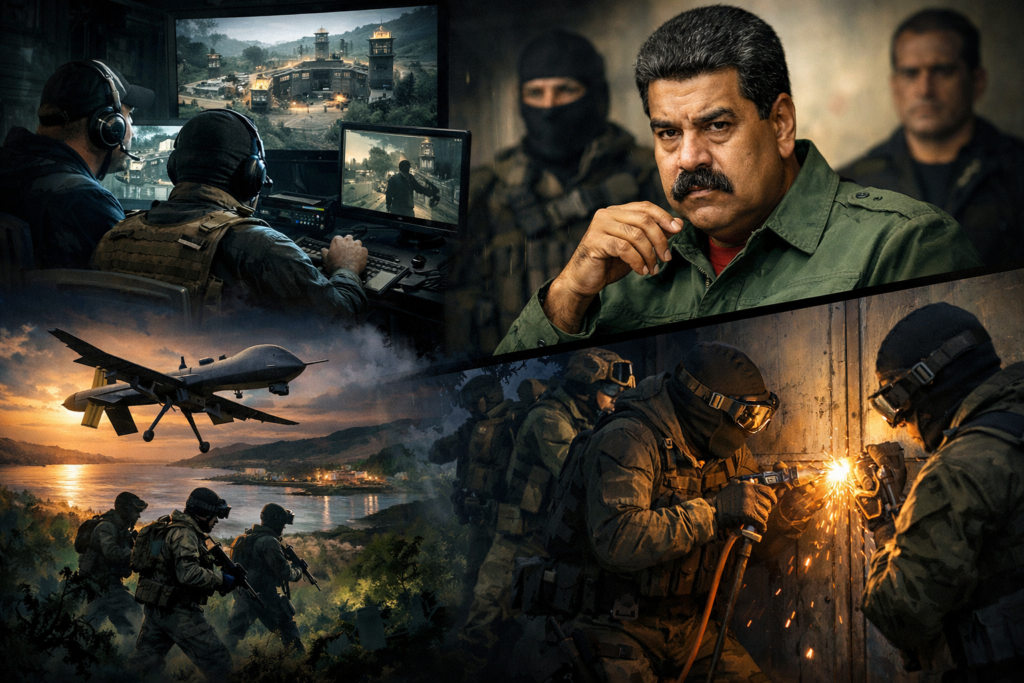
Image Credentials: Image Title: Spies, Drones and Blowtorches: Inside the US Operation That Captured Maduro Source: (sora.openai) Date: January 2026. Attribution: This image was created using AI-generated imagery (sora.openai) and does not depict a real-world scene.
By Open Chronicle Military Desk Staff | January 6, 2026
In the early hours of January 3, 2026, an unprecedented US military operation, dubbed Operation Absolute Resolve, culminated in the capture of Venezuelan President Nicolás Maduro and his wife, Cilia Flores. The mission marked one of the most complex and high-stakes interventions in Latin America since the Cold War.
Months of Intelligence and Planning
The operation was the result of months of meticulous intelligence gathering. US spies monitored Maduro’s routines, movements, and even personal habits, including his daily schedule and the care of his pets. One source within the Venezuelan government reportedly provided critical intelligence that allowed US forces to map Maduro’s Caracas safe house with precision.
US troops trained extensively for the mission, constructing a full-scale replica of the compound to rehearse entry points, breach procedures, and potential contingencies. The aim was to maximize the element of surprise while minimizing US casualties.
Launch and Execution
After a false start four days earlier due to weather concerns, President Donald Trump gave the final go-ahead at 22:46 EST on January 2. The mission, executed under the cover of darkness, involved a coordinated air, land, and sea assault. More than 150 aircraft—including bombers, fighter jets, and reconnaissance planes—supported the operation, targeting air defense systems and strategic points around Caracas.
Explosions and plumes of smoke were observed across the city at approximately 02:00 local time, with key sites such as La Carlota Air Base, Port La Guaira, and Generalissimo Francisco de Miranda Air Base reportedly struck. Witnesses described the city plunged into darkness, illuminated only by flashes from explosions and the hum of low-flying helicopters.
Special Operations and Breach
Elite US special operations forces, including members of Delta Force, executed the compound breach. Heavily armed and carrying blowtorches for metal doors, the troops encountered resistance but successfully secured the target. One helicopter was hit but remained operational.
Maduro reportedly attempted to reach a safe room within his residence, but the force breached the door in under a minute. The operation also included the apprehension of Cilia Flores. US officials emphasized the speed, precision, and coordination of the assault, which lasted approximately two hours and twenty minutes from initial air strikes to extraction.
Aftermath and Strategic Significance
Maduro and Flores were flown to the United States under the custody of the Department of Justice. They are scheduled to face criminal charges in New York, including narco-terrorism and cocaine importation conspiracy.
The operation drew immediate regional criticism, with Brazil’s President Lula da Silva warning of the precedent set by a foreign-led capture of a sitting head of state. In Washington, some members of Congress expressed concern over the lack of prior consultation, although US officials argued that secrecy was essential to the mission’s success.
From a military intelligence perspective, Operation Absolute Resolve showcased the integration of human intelligence (HUMINT), signals intelligence (SIGINT), and precision special operations. Analysts noted that such missions require months of planning, advanced reconnaissance, and the rapid execution of joint force capabilities to ensure operational success.
Lessons Learned
Experts highlight that the Venezuelan mission demonstrates the strategic advantage of combining high-grade intelligence with elite military capabilities. Persistent surveillance, precise targeting, and real-time command coordination were critical to minimizing US casualties while neutralizing a high-value target.
While the long-term geopolitical ramifications remain uncertain, the operation underscores the evolving capabilities of US military intelligence and special operations in executing high-risk, high-value missions abroad.