
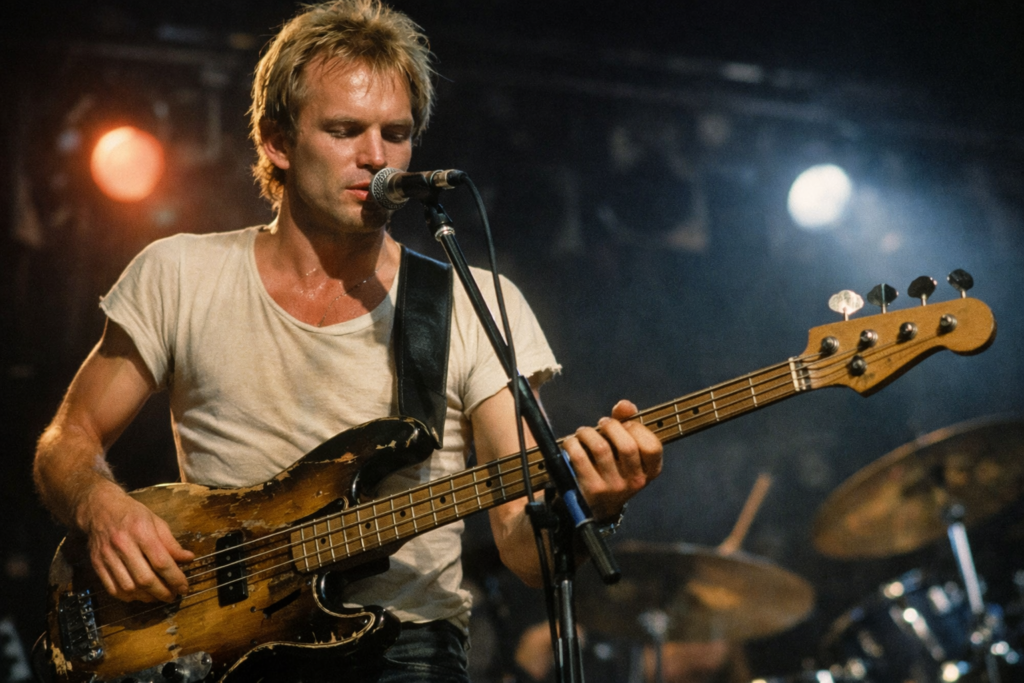
Image Credentials: Image Title: Sting, the Unseen Virtuoso of the Bass Source: (sora.openai) Date: January 2025. Attribution: This image was created using AI-generated imagery (sora.openai) and does not depict a real-world scene.
By Liam Scott | Open Chronicle Music Desk Staff Writer
In popular music, technical brilliance is often measured by speed, flash, and overt displays of virtuosity. Shredding solos, dazzling finger tapping, and hyperprecise fretwork tend to dominate conversations about what makes a musician exceptional. Sting does not fit comfortably into that frame, and that is precisely why his greatness is so often underestimated.
During his years with The Police, Sting never looked like a stereotypical bass hero. His instrument appeared worn rather than glamorous, his technique understated rather than flamboyant. Yet beneath that surface lies one of the most demanding and innovative approaches to bass playing in modern rock.
First and foremost, Sting is both singer and bassist, and he never sacrifices one role for the other. Many musicians excel at their instrument or at vocals, but very few maintain equal authority over both at the same time. In rock music, the bass provides harmonic grounding while also acting as the bridge between rhythm and melody. Sting occupies that role while simultaneously delivering complex vocal performances, a balancing act that only becomes fully appreciated when one attempts it personally.
Playing and singing simultaneously is notoriously difficult. Doing so while executing syncopated bass lines, often off the beat, elevates that challenge even further. Songs such as When the World Is Running Down, You Make the Best of What’s Still Around are built on insistent, repetitive bass figures that free Sting to deliver rapid, articulate vocal lines that verge on spoken rhythm. The repetition is not a limitation but a strength, creating a stable platform over which intricate melodies and lyrics can unfold.
The Police’s trio format made this approach essential. With only three instruments, space could easily become a weakness. Instead, the band turned it into a defining feature. Andy Summers’ guitar often served as the primary timekeeper, particularly with its reggae-influenced upstroke patterns. This freed Sting and drummer Stewart Copeland to play with rhythmic placement. In Roxanne, for example, the bass line leans into a tango-like feel, locking in with Copeland’s kick drum on unconventional beats while Summers anchors the groove. The result is a sense of motion that feels both loose and precise.
Another overlooked aspect of Sting’s playing is his use of ghost notes. These barely audible articulations add texture and momentum, creating a continuous, crackling undercurrent that keeps the music alive even in moments of restraint. In a trio, this technique is invaluable. The music never truly stops breathing, even when the arrangement pulls back.
Sting’s influence extends beyond technique into innovation. Long before it was fashionable, he brought the fretless bass into mainstream rock, later incorporating double bass as well. These choices were not about novelty but about expanding the expressive range of the instrument within popular music.
Ultimately, Sting’s bass playing is not defined by how many notes he plays, but by when he plays them. His mastery lies in timing, restraint, and musical intelligence. It is a form of virtuosity that resists easy categorization, subtle rather than showy, but no less demanding. In that sense, Sting is not merely a competent bassist who happens to sing. He is a musician who redefined what the bass could be in a modern rock band, quietly, consistently, and with remarkable authority.
GuitarWorldX
Lessons, gear, techniques, artists, guitar legends and the stories shaping the world of guitar.
Return to GuitarWorldX ›