
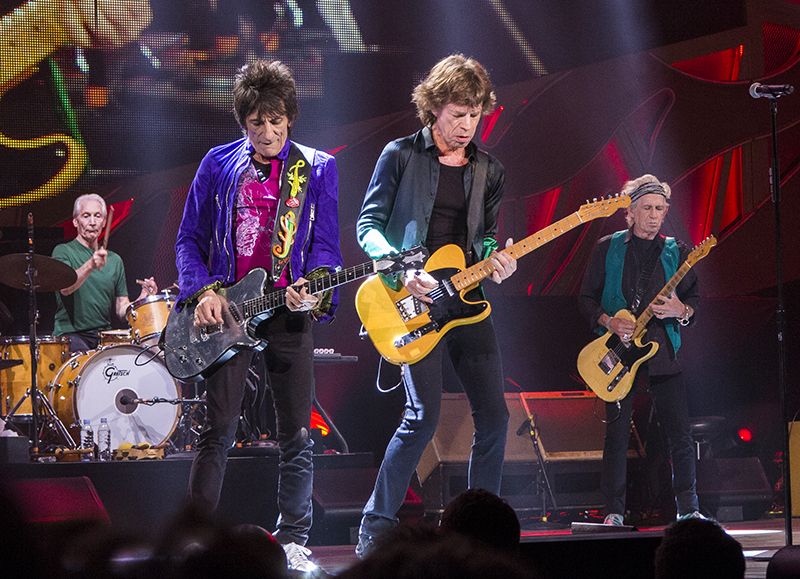
Image: Rolling Stones performing on stage in Milwaukee, Wisconsin. From left: Charlie Watts on a brown drum set, Ronnie Wood wearing a purple jacket with black jeans playing a silver coloured guitar, Mick Jagger wearing a black shirt and pants playing an orange/yellow guitar, Keith Richards with a green vest and black clothing playing an orange/yellow guitar (similar to Jagger’s) – By Jim Pietryga – https://www.iorr.org/tour15/, CC BY-SA 3.0, (Wikipedia)
By Open Chronicle Music Desk
When it comes to legendary rock bands, discussions about guitar riffs, vocal prowess, and stage presence often dominate the conversation. Yet the foundation of any great band is its rhythm section, the bassist and drummer whose interplay holds the music together. Among four iconic choices, The Rolling Stones, The Who, Led Zeppelin, and the original Eagles, the verdict on the “best rhythm section” might surprise some.
Critics often overlook the understated brilliance of The Rolling Stones’ Bill Wyman and Charlie Watts. Wyman’s steady, melodic bass lines provided a perfect counterpoint to the band’s more flamboyant members, while Watts’ impeccable timing and jazz-influenced drumming kept the Stones grounded without drawing attention away from the songs themselves. Together, they epitomized the concept of a rhythm section: unflashy, reliable, and perfectly in sync.
By contrast, The Who’s John Entwistle and Keith Moon were anything but traditional. While both were undoubtedly brilliant, Entwistle, a virtuoso bassist, and Moon, a chaotic powerhouse on drums, their style was more explosive and unconventional, often dominating the sonic space rather than underpinning it. Led Zeppelin’s John Paul Jones and John Bonham were technical marvels, combining power and creativity, yet their larger-than-life approach sometimes overshadowed the rhythm’s supportive role.
As for the original Eagles, their rhythm section, particularly Don Henley on drums, fails to impress in the context of purely technical and musical contribution. Henley’s dual role as singer and drummer limits the complexity of his drumming, making it competent but not extraordinary when compared to Wyman and Watts’ seamless cohesion.
Ultimately, Wyman and Watts exemplify what a rhythm section should be, understated, perfectly synchronized, and dedicated to supporting the band’s overall sound. Their work across decades of Stones records shows that mastery is not always about flamboyance but about serving the music with precision and consistency. For anyone forming a band or analyzing classic rock, this duo remains the gold standard of rhythm section excellence.
References
-
Unterberger, Richie. The Rolling Stones: A Musical Biography. Hal Leonard, 2002.
-
Watts, Charlie, and James Henke. Charlie Watts: A Life in Music. HarperCollins, 2018.
-
Wyman, Bill, and Richard Havers. Stone Alone: The Story of a Rock ‘n’ Roll Band. Viking, 1990.
-
Gulla, Bob. Icons of Rock: An Encyclopedia of the Legends Who Changed Music Forever. Greenwood Press, 2009.
-
Lewis, Dave. Led Zeppelin: The Complete Guide to Their Music. Omnibus Press, 2003.
-
Atkins, John. The Who on Record: A Critical History, 1963–1998. McFarland, 2000.
-
Erlewine, Stephen Thomas. “The Rolling Stones Biography.” AllMusic, https://www.allmusic.com/artist/the-rolling-stones-mn0000894465/biography.
-
Davis, Stephen. Hammer of the Gods: The Led Zeppelin Saga. William Morrow, 1985.
GuitarWorldX
Lessons, gear, techniques, artists, guitar legends and the stories shaping the world of guitar.
Return to GuitarWorldX ›