
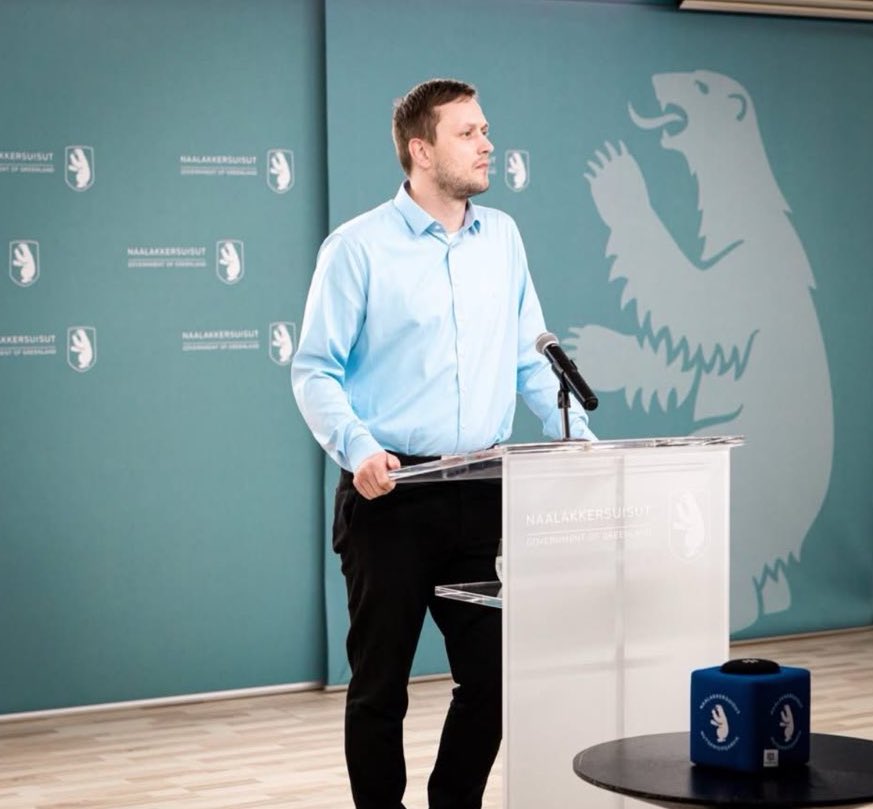
Image: from Sajsha Prince X@sajshaprince
By Open Chronicle News Desk with Agencies | January 11, 2026
Greenland’s political leadership has delivered its clearest rejection yet of President Donald Trump’s push for the United States to take control of the Arctic island, turning a long-simmering geopolitical dispute into a defining test of sovereignty, alliance politics, and self-determination in the High North.
In a joint statement issued late Friday in Nuuk, Prime Minister Jens Frederik Nielsen and four other party leaders drew a firm line against Washington’s ambitions. “We do not want to be Americans, we do not want to be Danes, we want to be Greenlanders,” the leaders said, underlining that the future of the semiautonomous territory must be decided only by its own people. The statement was signed by Nielsen, Pele Broberg, Múte B. Egede, Aleqa Hammond, and Aqqalu C. Jerimiassen, representing a broad spectrum of Greenlandic politics.
Message from Jens-Frederik Nielsen, the Prime Minister of Greenland. Translated from Danish 🇬🇱 This is strong and real diplomacy. pic.twitter.com/UhffHCElc6
— Sergio Escobar (@sergioes11) January 5, 2026
The rebuke came hours after President Trump again floated the idea of acquiring Greenland, this time with unusually stark language. He told reporters that he would prefer to secure the island “the easy way,” but warned that if that did not happen, “we’re going to do it the hard way,” without explaining what such an approach would involve. The White House later confirmed it was considering a range of options, including the use of military force, to pursue U.S. control of the strategically located territory.
According to Reuters, Trump team actively discussing range of options including purchase or force acquisition of Greenland
White House confirms US military "always an option"
European leaders issue joint statement defending Denmark's sovereignty
🅱️REAKING https://t.co/BDPoRJpP77
— 🅱️🅱️🅱️ (@badboibakademia) January 6, 2026
Trump has repeatedly argued that Greenland’s location and resources make it too important to remain outside direct American control. He has claimed that if the United States does not own the island, Russia or China could move in, a scenario he portrays as an unacceptable security risk for North America. Greenland, perched between the Atlantic and Arctic Oceans, sits astride emerging shipping routes and near the flight paths of intercontinental missiles, making it a critical node in modern defense planning.
Greenlandic leaders, however, framed the issue not as one of great power rivalry but of basic democratic rights. Their statement emphasized that Greenland’s political future must be shaped through dialogue with its own population and in accordance with international law. “No other country can interfere in this,” they said. “We must decide the future of our country ourselves, without pressure for quick decision, delay, or interference from other countries.”
The standoff is unfolding against the backdrop of delicate diplomacy. Officials from Denmark, Greenland, and the United States met in Washington on Thursday and are scheduled to meet again next week, as Washington presses its case and Copenhagen and Nuuk seek to defend the existing arrangement. Greenland is a self-governing territory within the Kingdom of Denmark, which remains responsible for its defense and foreign affairs. While Greenland manages most domestic issues, Denmark’s military provides the island’s security, a role that would be tested if U.S. pressure escalated.
Danish Prime Minister Mette Frederiksen has warned that any American takeover of Greenland would strike at the heart of the Western alliance system. She has said such a move would effectively mark the end of NATO, a stark assessment that reflects how deeply the issue cuts into alliance norms about sovereignty and mutual respect. An attack or coercive takeover of a NATO-associated territory by the United States would pose unprecedented legal and political questions for the rest of the alliance.
The imbalance of power is obvious. Greenland, with a population of about 57,000 and no standing military, depends on Denmark for its defense, and Denmark’s armed forces are far smaller than those of the United States. That reality makes Trump’s threats especially unsettling in Nuuk, where leaders fear being forced into decisions by pressure rather than consent.
Yet the unified tone of Greenland’s party leaders suggests that, at least politically, the island is determined to stand its ground. By rejecting both American and Danish identities and asserting a distinct Greenlandic one, they are making a broader statement about their long-term goal of self-determination, a goal that many in Greenland see as incompatible with becoming a strategic prize in a new era of great power rivalry.
As talks continue in Washington and the rhetoric from the White House remains sharp, Greenland has become more than just a remote Arctic territory. It is now a symbol of whether small nations and autonomous peoples can defend their right to choose their own future in a world where strategic geography once again attracts the attention of empires.