
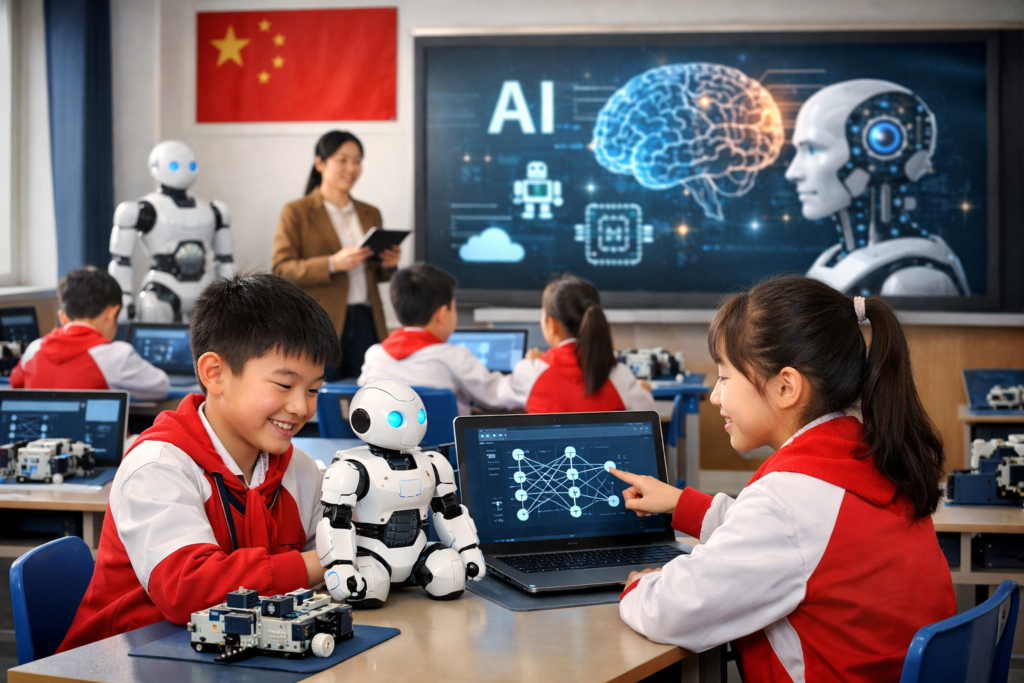
Image Credentials: Image Title: China Implements Nationwide AI Curriculum: “No Longer Optional” for Students Source: (sora.openai) Date: January 2026. Attribution: This image was created using AI-generated imagery (sora.openai) and does not depict a real-world scene.
By Open Chronicle News Desk
BEIJING — While educators in the West continue to debate the risks of generative AI in the classroom, China has taken a definitive stance by making artificial intelligence a mandatory part of its national primary and secondary school curriculum. According to a report from NPR on Tuesday, January 27, 2026, the transition has transformed AI from a niche interest into a fundamental pillar of basic education.
At schools like the Beijing University of Posts and Telecommunications Affiliated Primary School, the change is already visible. Students as young as 11 are programming robots and using AI image software, such as Wukong, to assist in graphic design competitions.
The National Tiered Framework
The Chinese Ministry of Education (MOE) has implemented a “tiered” system designed to align with students’ cognitive development:
-
Primary School (Focus: Literacy & Experience): Students are introduced to basic concepts like voice recognition and image classification through hands-on play and “smart device” interaction.
-
Junior High (Focus: Technical Logic): The curriculum shifts to machine learning workflows and the critical evaluation of AI outputs, specifically teaching students how to identify misinformation.
-
Senior High (Focus: Applied Innovation): High schoolers move toward algorithm construction and cross-disciplinary projects, integrating AI into robotics, drones, and materials science.
The “AI+ Initiative”
The mandate is part of a broader government strategy known as the “AI+ Initiative.” Starting in the fall of 2025, Beijing municipal rules began requiring at least eight hours of dedicated AI instruction per academic year.
“It must decide on its own,” said Li Zichen, a fifth-grader demonstrating a self-navigating robot. “I think AI is very important for the nation’s deep space exploration.” This sentiment reflects a core goal of the curriculum: fostering a sense of “national technology strategy” among the youth.
Ethics and Restrictions
Despite the rapid integration, the MOE has established clear boundaries. While students are encouraged to use AI as a “diagnostic tool” or a “tethered experience,” the government strictly prohibits students from submitting AI-generated content as their own academic work or for examination responses.
Teachers are being trained to act as “ethical guides,” helping students navigate the “dual-nature” of the technology, balancing its innovative power against risks to privacy and the potential for over-dependence.
Global Competition
Policy analysts suggest that China’s top-down, standardized approach aims to create a “T-shaped” workforce, graduates who possess deep specialized knowledge but are also fluent in AI applications across medicine, agriculture, and engineering. This stands in contrast to the United States, where AI education remains largely fragmented and dependent on individual school district policies.