
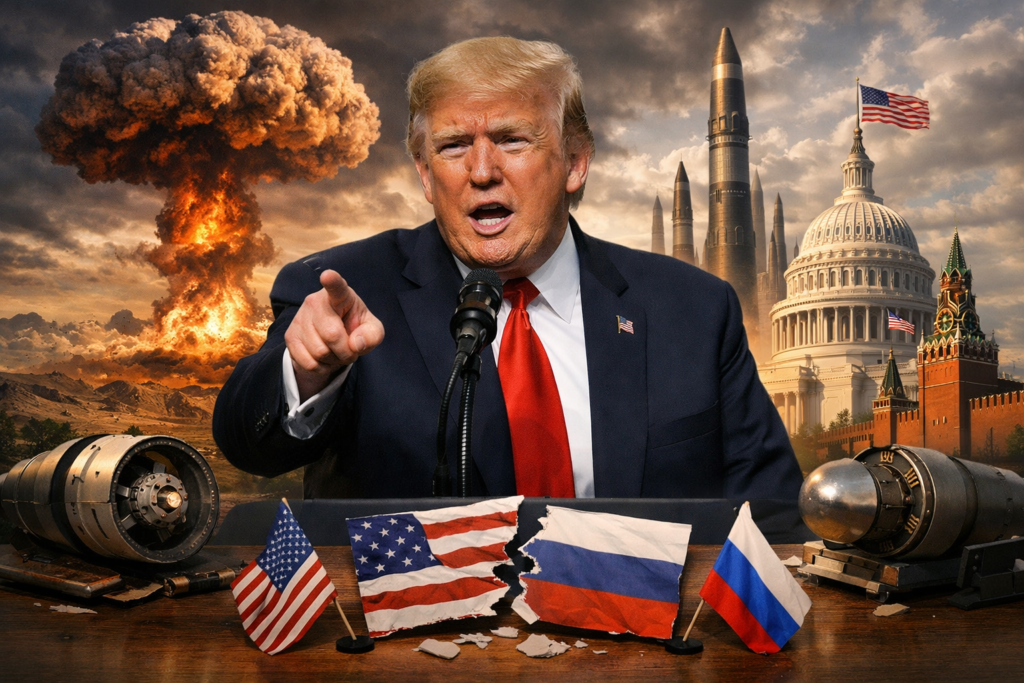
Image Credentials: Image Title: Strategic Vacuum: New START Expires as Trump Calls for ‘Modernized’ Nuclear Pact Source: (sora.openai) Date: February 2026. Attribution: This image was created using AI-generated imagery (sora.openai) and does not depict a real-world scene.
By Open Chronicle Staff | Thursday, February 6, 2026
WASHINGTON — For the first time in over five decades, the world’s two largest nuclear powers are without a legally binding arms control agreement. The New START (Strategic Arms Reduction Treaty) between the United States and Russia officially lapsed on Thursday, marking the end of the last major pillar of the international nuclear safety architecture.
In a statement following the expiration, U.S. President Donald Trump rejected an extension of the existing framework, labeling it a “badly negotiated” deal. Instead, the President called for the development of a “new, improved, and modernized” treaty that addresses modern strategic realities and alleged Russian violations.
🚨BREAKING: New START just expired at midnight.
Obama-Medvedev’s 2010 Prague deal—gone.
No more caps on U.S. & Russia nukes.
50+ years of arms limits—ended.
Welcome to an unchecked nuclear arms race. 💥🇺🇸🇷🇺 pic.twitter.com/JTIoLjrLaT— Eric Trump Commentary (@erictrumpfan1) February 5, 2026
The End of an Era
Signed in 2010 and entering force in 2011, the New START treaty capped the number of deployed strategic nuclear warheads and provided a rigorous system of mutual inspections and data exchanges. Its expiration effectively removes the “ceilings” on the arsenals of both nations, raising concerns among global security experts about a potential renewed arms race.
“Rather than extend ‘NEW START’… we should have our Nuclear Experts work on a new… Treaty that can last long into the future,” Trump posted on social media, signaling a preference for a ground-up renegotiation over the preservation of the Obama-era pact.
Russia-US NUKE reduction treaty expires TOMORROW
Rubio: 'I don’t have any announcement New START right now, Prez will pine in on it later'
'To have true arms control, impossible to do something that doesn’t include China' pic.twitter.com/UjTk0vEiCi
— Victor vicktop55 commentary (@vick55top) February 4, 2026
Conflicting Narratives
The Russian Foreign Ministry offered a different account of the treaty’s final days. Moscow claimed that President Vladimir Putin had proposed maintaining existing caps for at least one year to allow for further talks. According to Russian officials, no formal response was received from Washington via bilateral channels before the deadline.
With the treaty now void, Russia announced that it no longer considers itself bound by its obligations, including the crucial verification regimes that allowed each nation to monitor the other’s nuclear capabilities.
Global Implications
The lapse of New START introduces a period of profound strategic uncertainty. Without the transparency provided by the treaty’s inspection protocols, military planners on both sides may be forced to rely on “worst-case scenario” assumptions, potentially leading to increased defense spending and the deployment of new weapons systems.
International observers have noted that while the Trump administration seeks a broader deal, potentially one that includes China, the diplomatic path forward remains fraught with difficulty. Beijing has consistently resisted joining trilateral arms control talks, arguing that its arsenal is significantly smaller than those of the U.S. and Russia.
As the nuclear “guardrails” disappear, the global community now looks toward the next phase of high-stakes diplomacy between Washington and Moscow to prevent an unchecked escalation of strategic forces.