
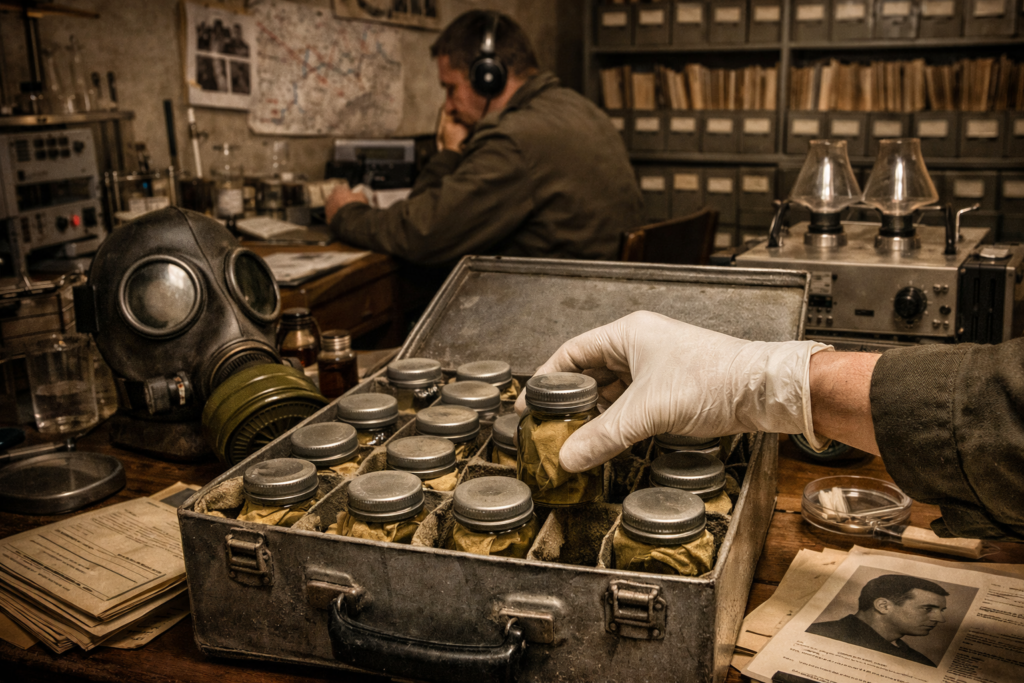
Image Credentials: Image Title: When the State Collected Smell: The Stasi’s Obsession with Total Surveillance Source: (sora.openai) Date: January 2026. Attribution: This image was created using AI-generated imagery (sora.openai) and does not depict a real-world scene.
By Open Chronicle Staff | Friday, February 6, 2026
Among the many unsettling practices of the East German Ministry for State Security, better known as the Stasi, few capture the extremity of its surveillance culture as vividly as its systematic collection of citizens’ scents. In a state already defined by files, informants, and psychological intimidation, even something as intimate and invisible as human smell became an object of control.
The German Democratic Republic built one of the most intrusive security apparatuses in modern history. By the 1980s, the Stasi employed tens of thousands of full-time officers and relied on a vast network of unofficial collaborators. Its mission was not merely to stop crimes, but to detect disloyalty, dissent, and deviation before they could become politically dangerous. In that logic, no detail was too small to record.
Smell as evidence
The Stasi believed that every individual carried a unique scent signature that could be preserved and later identified. This idea was rooted partly in police dog training methods, which rely on scent discrimination, and partly in a broader faith in technocratic control. If smell could be archived, then even anonymous acts might one day be traced back to a body.
In practice, officers collected scents in several ways. In some cases, they secretly entered a suspect’s home and exposed absorbent materials to the air, hoping to capture residual body odor from clothing, furniture, or bedding. In other cases, the process was more direct. A person under interrogation might be asked to sit on a chair that contains odor-absorbing fabric. Afterward, the fabric would be discreetly removed, sealed in a glass jar, labeled, and stored.
These jars, sometimes called “Geruchsproben,” were cataloged like fingerprints. The assumption was that if a crime or act of sabotage occurred later, trained dogs could match the scent at the scene to one of the archived samples.
Surveillance beyond crime
What makes the practice especially disturbing is that it was not limited to criminal suspects in the conventional sense. Many people whose scents were collected had committed no crime at all. They were writers, church members, activists, or simply individuals whose attitudes or associations raised suspicion.
The goal was preventive repression. By gathering material that could be used in future investigations, the Stasi extended its reach forward in time. Citizens were not only watched for what they had done, but prepared to be implicated in things they had not yet done.
Effectiveness versus symbolism
There is little evidence that scent jars ever played a decisive role in solving crimes. The reliability of long-stored odor samples is scientifically questionable, and even today, scent-based identification remains controversial. For the Stasi, however, effectiveness may have been secondary.
The practice reflected an ideology of total knowledge. The state sought to know its citizens completely, down to their physical presence, habits, and biological traces. Smell collection symbolized a system that refused to accept any private sphere, even the air surrounding a body.
Psychological control
More than a forensic tool, scent collection functioned as part of the Stasi’s broader strategy of intimidation and psychological pressure. The knowledge that the state might possess something so intimate contributed to a climate of fear and self-censorship. Surveillance worked best when it did not need to be used, only believed.
After the fall of the Berlin Wall, the discovery of scent jars in Stasi archives shocked the public and became a powerful symbol of authoritarian excess. They illustrated how far the regime had gone in its effort to monitor and manage human behavior.
In the end, the jars were less about catching criminals than about asserting dominance. They represented a state that believed even something as fleeting as smell could, and should, belong to power.
References
- Bruce, Gary. The Firm: The Inside Story of the Stasi. Oxford University Press, 2010
- Gieseke, Jens. The History of the Stasi: East Germany’s Secret Police, 1945–1990. Berghahn Books, 2014
- Macrakis, Kristie. Seduced by Secrets: Inside the Stasi’s Spy-Tech World. Cambridge University Press, 2008
- Fulbrook, Mary. The People’s State: East German Society from Hitler to Honecker. Yale University Press, 2005
- Dennis, Mike. The Stasi: Myth and Reality. Routledge, 2003
- Stasi Records Agency (BStU). Geruchsproben und Überwachungspraxis der Staatssicherheit. Archival materials and public exhibitions, Berlin