
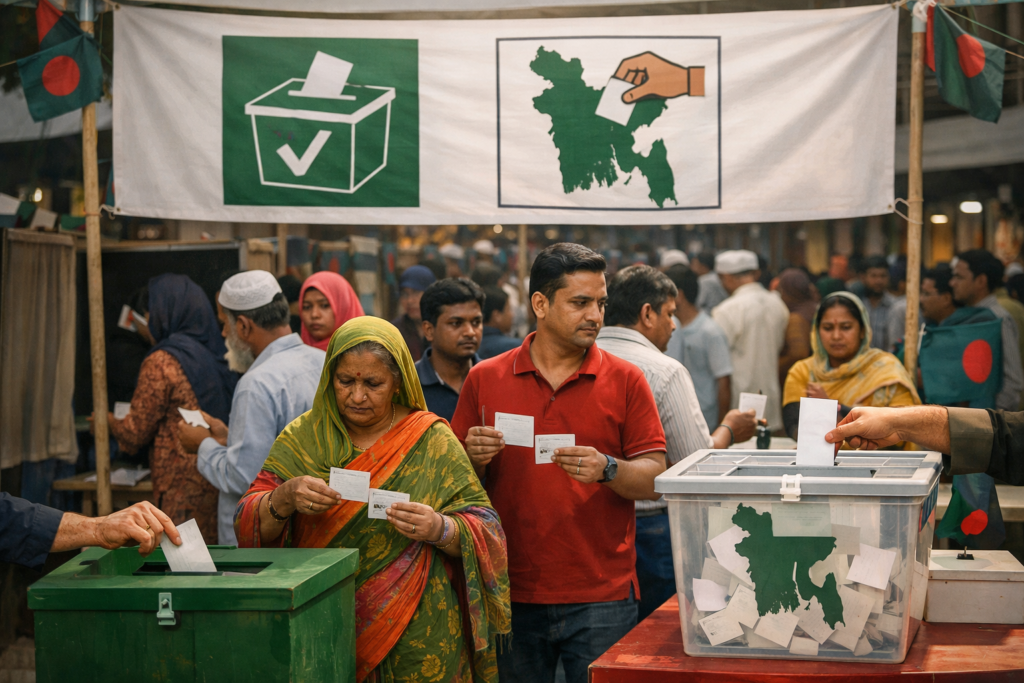
Image Credentials: Image Title: A Nation at the Crossroads: Why Bangladesh is Holding a Referendum Alongside its General Election. Source: (sora.openai) Date: February 2026. Attribution: This image was created using AI-generated imagery (sora.openai) and does not depict a real-world scene.
OPEN CHRONICLE | Serving the Truth, Shaping the Future
By Open Chronicle Staff
DHAKA – As millions of Bangladeshis head to the polling stations this Thursday, they are carrying more than just the responsibility of electing a new parliament. For the first time in the nation’s history, a general election is being held concurrently with a national constitutional referendum, a move designed to dismantle the vestiges of authoritarianism and redefine the country’s democratic soul.
The decision to pair the 13th general election with a referendum on the “July National Charter” comes after a period of intense upheaval. Following the ouster of former Prime Minister Sheikh Hasina in August 2024, the interim government, led by Nobel Laureate Muhammad Yunus, has sought a mandate not just for new leadership but for a fundamental restructuring of the state.
A Government Elected Without Power?
Bangladesh’s Referendum TrapBangladesh is heading into an election on February 12.
But the real question isn’t who will win.It’s who will actually hold power after the vote.
This election is being sold as democratic.
But there’s a catch.… pic.twitter.com/Sd4LLwLt76— Bangladesh Awami League (@albd1971) February 6, 2026
The “July Charter”: A Blueprint for Reform
The referendum asks a singular, pivotal question: Do citizens approve of the constitutional amendments outlined in the July National Charter?
If passed, the referendum will trigger a series of sweeping changes that the interim government argues are essential to prevent the return of “one-person rule.” Key provisions include:
-
Restoration of the Caretaker System: Reinstating the neutral interim administration model to oversee future elections, a system abolished by the previous government in 2011.
-
A Bicameral Legislature: The creation of a 100-member “Upper House” to provide a system of checks and balances against the traditional 350-seat parliament.
-
Executive Term Limits: Implementing limits on the Prime Minister’s tenure to ensure a rotation of power.
-
Judicial and Parliamentary Independence: Enhancing the powers of the President and ensuring the Deputy Speaker and parliamentary committee chairs are drawn from the opposition.
Why Now?
The synchronization of the two votes is both a logistical and a symbolic choice. Logistically, it addresses the urgent demand for a return to elected governance while ensuring the new parliament operates under a reformed constitutional framework. Symbolically, it offers the electorate a “double mandate”—choosing their representatives and the rules by which those representatives must govern.
“Our goal is to transition to an accountable and effective democratic system,” Chief Adviser Muhammad Yunus stated in a national address. “The referendum is the people’s voice on the very structure of our democracy.”
A Divided Political Landscape
While the Bangladesh Nationalist Party (BNP) and various student-led reform movements have signaled support for the “Yes” vote, the path has not been without friction. The Jatiya Party has called for a “No” vote, labeling the process as unconstitutional, while other factions remain wary of the rapid pace of reform.
As over 127 million registered voters cast their ballots at 42,000 polling stations today, the stakes could not be higher. The results will determine if Bangladesh enters a new era of “checks and balances” or remains mired in the political volatility that has defined its recent past.