
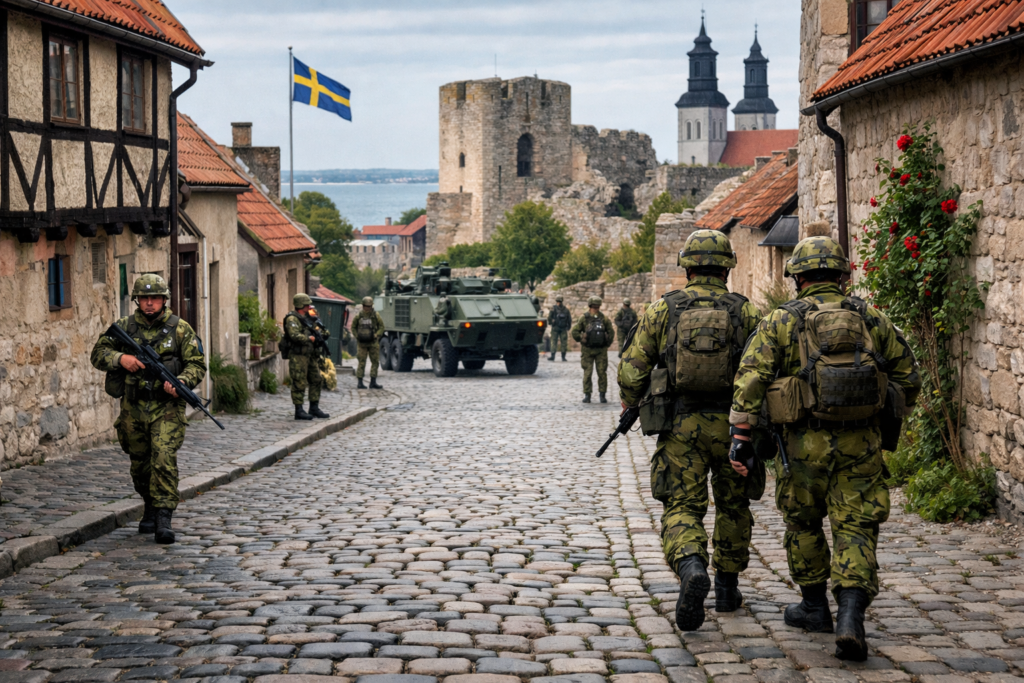
Image Credentials: Image Title: Strategic Stronghold: Sweden Fortifies Gotland as NATO’s ‘Frontier’ Against Russian Ambition. Source: (sora.openai) Date: February 2026. Attribution: This image was created using AI-generated imagery (sora.openai) and does not depict a real-world scene.
OPEN CHRONICLE | Serving the Truth, Shaping the Future
By Open Chronicle Staff
VISBY, SWEDEN — The cobblestone streets of Visby, a UNESCO World Heritage site known for its medieval charm and Viking history, are increasingly echoing with the sound of military boots. As geopolitical tensions reach a fever pitch, Sweden has accelerated the remilitarization of Gotland, its largest island, fearing it could become the “number one target” in a potential conflict between NATO and Russia.
Strategically positioned in the heart of the Baltic Sea, Gotland has long been a favorite for tourists, drawing over a million visitors annually. However, its idyllic landscapes now host fresh missile installations, newly constructed barracks, and high-tech surveillance facilities.
The ‘Unsinkable Aircraft Carrier’
Military experts often refer to Gotland as an “unsinkable aircraft carrier.” Located just 300km from the Russian enclave of Kaliningrad, the island holds the key to the Baltic.
“If you can control Gotland and place surface-to-air and anti-ship missiles, you have control over the entire northern Baltic Sea region,” says Niklas Granholm of Sweden’s Defence Research Agency.
Former US Army Officer Ben Hodges has echoed these concerns, warning that a Russian seizure of the island would “significantly change the balance of power” in Europe, potentially cutting off the Baltic states from their NATO allies.
From Demilitarization to Defense
The island’s history reflects the shifting tides of European security:
-
2005: Following the end of the Cold War, Gotland was fully demilitarized.
-
2015: Re-armed following Russia’s annexation of Crimea.
-
2024: Sweden formally joins NATO, integrating Gotland into the alliance’s defensive architecture.
-
2027 Target: The Swedish Armed Forces aim to have at least 4,000 soldiers permanently stationed on the island.
Deterrence and Detection
Stockholm’s military expansion serves a dual purpose: discouraging a direct Russian assault and monitoring sabotage operations in a region increasingly plagued by “shadow fleet” activity and underwater infrastructure threats. While the beaches remain open for now, the presence of heavy weaponry serves as a stark reminder that even the most picturesque corners of Europe are being pulled back into the realities of high-stakes defense.