
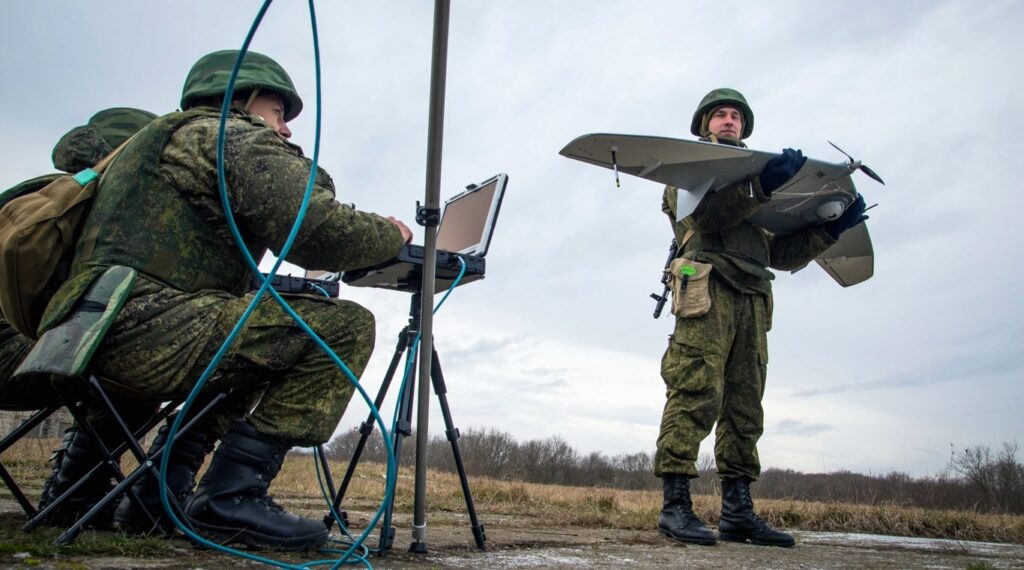
Image: from MilitaryNewsUA X @front_ukrainian
The Open Chronicle | Independent. Incisive. Global.
By Chronicle Staff February 17, 2026
KYIV — Long shrouded in the secrecy typical of the Kremlin’s high-tech military assets, the specialized Russian unit known as “Rubikon” has finally been thrust into the spotlight. Following recent high-profile defections and intelligence leaks, new details have emerged regarding the structure, leadership, and strategic role of this elite unmanned aerial vehicle (UAV) center, which serves as the “brain” of Moscow’s precision strike capabilities.
The Architecture of Modern Warfare
Established to consolidate Russia’s most advanced drone technology, the Rubikon unit, formally the Center for Advanced Unmanned Technologies, is not a standard reconnaissance wing. Unlike the frontline tactical units that fly short-range FPV drones, Rubikon operates at the strategic level.
Under the direct oversight of the Russian Ministry of Defense, the unit integrates artificial intelligence with long-range strike capabilities. It is designed to act as a “strike-reconnaissance loop,” where data from sophisticated sensors is processed in real-time to guide heavy munitions and loitering missiles toward high-value Ukrainian targets.
The Men Behind the Joysticks
Intelligence reports indicate that Rubikon is led by high-ranking officers with backgrounds in electronic warfare and aerospace engineering. The unit’s personnel are recruited from the top tiers of Russian technical universities and specialized military academies, creating a “technocratic elite” within the armed forces.
“Rubikon is where Russia tests its most experimental algorithms,” says a defense analyst specializing in Eastern European security. “They are responsible for the coordination of complex swarm attacks and the integration of Iranian-designed Shahed drones with domestic Russian navigation systems.”
A Strategy of Attrition
The strategic objective of Rubikon is clear: to maintain a constant state of technological pressure on Ukrainian air defenses. By utilizing “maskirovka” (deception) in the digital realm, Rubikon operators attempt to spoof radar signatures and find “blind spots” in Western-supplied defense systems like the Patriot and IRIS-T.
However, the recent defection of a senior operator has revealed that this elite status comes with a high price. Internal reports suggest a culture of extreme surveillance and psychological pressure, where operators are treated as “disposable assets” despite their high level of training.
The Intelligence Goldmine
With the structure of Rubikon now partially exposed, Ukrainian and NATO intelligence agencies are racing to decode the unit’s operational blueprints. The revelation of its command hierarchy and specific basing locations marks a significant setback for a Russian military that has increasingly relied on technological superiority to compensate for mounting losses on the ground.
As the war enters its next technological phase, the exposure of Rubikon proves that even the most sophisticated digital shields are vulnerable to the human element of dissent.