
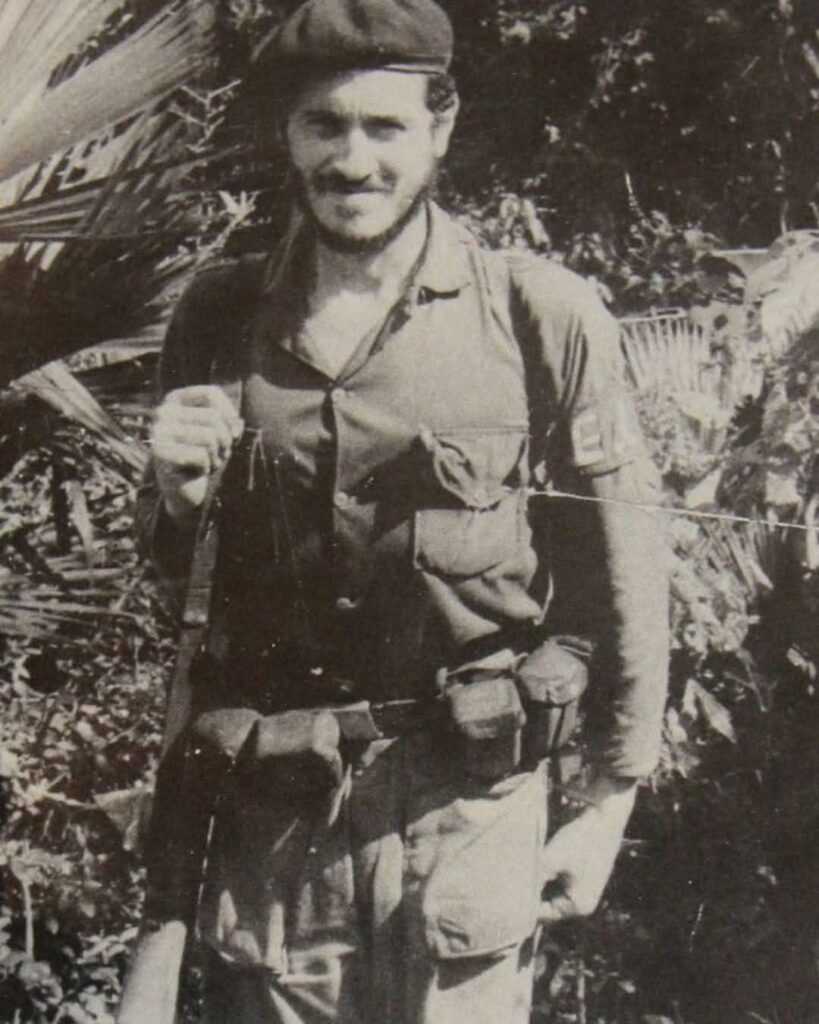
Image: from M-19 X @HistoriaM19
By Chronicle Staff February 17, 2026
BOGOTÁ — In a moment of profound historical reckoning for Colombia, forensic experts have confirmed the identification of the remains of Camilo Torres Restrepo, the “guerrilla priest” whose disappearance in 1966 became one of the most enduring mysteries of the nation’s internal conflict.
The announcement, made this week by the Search Unit for Missing Persons (UBPD), comes exactly six decades after Torres was killed in his first combat engagement. The discovery marks the end of a sixty-year search for a man who remains a towering figure in Latin American liberation theology and a polarizing symbol of revolutionary struggle.
The Search for the “Martyr of the Poor”
Camilo Torres, a sociologist and Catholic priest born into Bogotá’s aristocracy, shocked the continent in 1965 when he traded his cassock for a rifle to join the National Liberation Army (ELN). He was killed months later, on February 15, 1966, during an ambush in the mountains of Santander.
Fearing his grave would become a shrine for insurgents, the Colombian military buried him in a secret, unmarked location. For decades, his family, the ELN, and social movements campaigned for the return of his body, which General Alvaro Valencia Tovar, the man who led the troops that killed him, later admitted had been moved several times to prevent it from being found.
Forensic Breakthrough
The breakthrough came after years of meticulous investigation by the UBPD, a state entity born from the 2016 Peace Agreement. Investigators eventually located a site in a military pantheon within the Municipal Cemetery of Bucaramanga.
Despite the remains being degraded by decades of exposure to chemicals like formaldehyde, forensic teams successfully isolated genetic material from a tibia and ulna. Working with international labs, including experts in the United States, the UBPD achieved a “triple confirmation” of the identity through DNA and anthropometric testing.
A Tense Homecoming
¡Al fin! A 60 años de su muerte, en la noche de este 15 de febrero, la Unidad de Búsqueda de Personas Desaparecidas UBPD, hizo entrega de los restos del sacerdote revolucionario Camilo Torres Restrepo. Se hizo a puerta cerrada y no en la homilía celebrada en la Capilla de la… pic.twitter.com/xPL6htcjbl
— Antonio Sanguino (@AntonioSanguino) February 16, 2026
On Sunday, February 15, 2026, the 60th anniversary of his death, the remains were returned to his family and the academic community in a ceremony at the National University of Colombia. The atmosphere was a mix of somber reflection and political tension; while many celebrated the return of the university’s co-founder of the Sociology Faculty, others criticized the ELN for continuing to use his image to justify ongoing violence.
President Gustavo Petro, who has often invoked Torres as a figure of “social Christianity,” hailed the identification as a step toward national reconciliation. “Camilo will be deposited with honors as a founder of Sociology and as a pioneer of Liberation Theology,” Petro stated, emphasizing the need to move beyond the era of disappearances.
The Final Resting Place
Torres’s remains are slated to be interred in the Christ the Master chapel at the National University. For many Colombians, the identification of “Camilo” is more than a forensic success; it is a symbolic closure for a country that has seen over 120,000 people disappear during its half-century of war.
As the “guerrilla priest” is finally laid to rest, his legacy continues to challenge the nation, a reminder of a time when the pulpit and the frontline were, for one man, the same.