
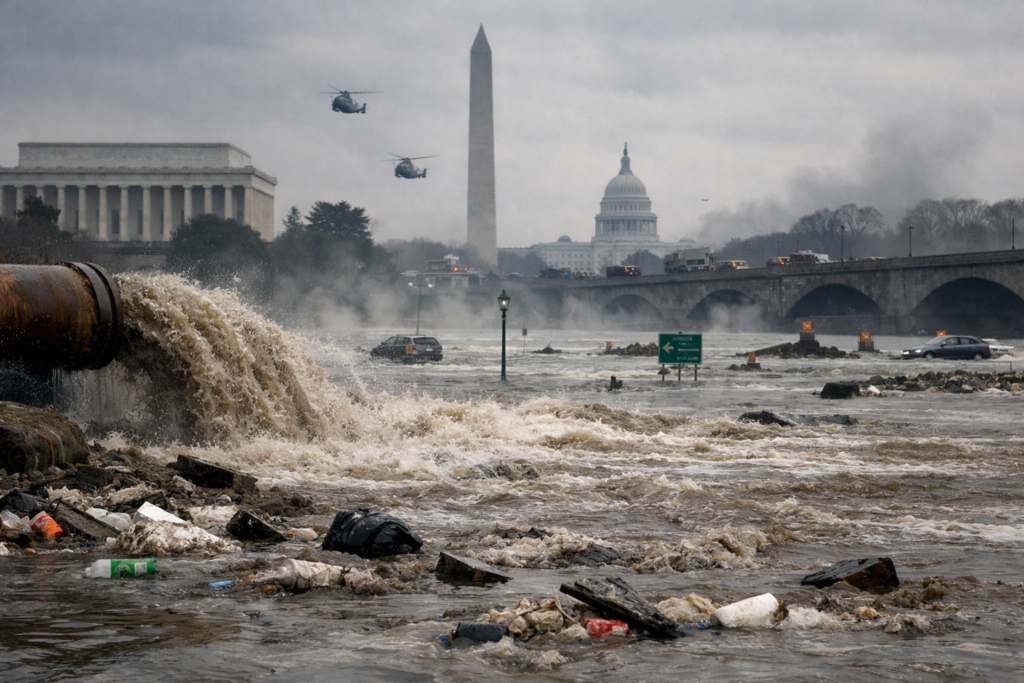
Image Credentials: Image Title: POTOMAC UNDER SIEGE: Federal Emergency Declared as Massive Sewage Crisis Grips Capital Source: (sora.openai) Date: Feb 2026. Attribution: This image was created using AI-generated imagery (sora.openai) and does not depict a real-world scene.
By Open Chronicle Staff February 22, 2026
WASHINGTON — In a move underscoring the severity of what experts are calling an unprecedented ecological disaster, President Donald Trump has approved a federal emergency disaster declaration for the District of Columbia. The move follows weeks of escalating tension and environmental degradation after a catastrophic infrastructure failure sent hundreds of millions of gallons of raw sewage into the Potomac River.
The federal intervention, which mobilizes the Federal Emergency Management Agency (FEMA) and the Environmental Protection Agency (EPA), comes days after D.C. Mayor Muriel Bowser declared a local public emergency. The disaster was triggered on January 19, when a 72-inch section of the “Potomac Interceptor”, a critical 60-year-old sewer line, collapsed in Montgomery County near the D.C. Maryland border.
Since the collapse, an estimated 240 million gallons of untreated wastewater have surged into the river, marking one of the largest spills in U.S. history.
A Regional Crisis Has Occurred. While drinking water remains safe for the metropolitan area, as contamination has not yet reached the primary intake points; however, the environmental and recreational impact has been devastating. Bacteria levels, specifically E. coli, were found to be 10,000 times over the legal limit in some areas.
Health advisories now stretch over 70 miles of the river, from the American Legion Memorial Bridge down to the Gov. Harry W. Nice Memorial Bridge in King George County. Local businesses, from Georgetown kayak rentals to southern Maryland shellfish harvesters, have reported a “doom loop” of economic losses as the spring season approaches.
Political and Financial Fallout: The crisis has quickly morphed into a political flashpoint. The Trump administration has been vocal in its criticism of local leadership, with the President urging regional governors and the Mayor to “act immediately” while blaming years of deferred maintenance. Conversely, local officials have pointed to the aging nature of the federally designed interceptor and the sheer scale of the $600 million long-term repair bill as reasons for federal assistance.
“Protecting the health of the Potomac is about protecting our environment and our local economy,” said one regional official. “This isn’t a talking point; it’s a disaster that requires leadership, not finger-pointing.”
The Path to Recovery: DC Water crews have successfully implemented a temporary bypass system, reporting no new overflows since February 8. However, the work is far from over. Specialized teams are currently battling a “rock dam” discovered inside the collapsed pipe, a complication that has slowed the stabilization process.
FEMA’s mobilization will now enable the reimbursement of substantial repair costs and facilitate the coordination of a multi-agency cleanup. While emergency repairs are expected to take another four to six weeks, engineers warn that permanent restoration of the Potomac Interceptor could take several years and hundreds of millions of dollars to complete.
For now, the capital’s iconic waterway remains a restricted zone, a silent, murky reminder of the fragility of the nation’s aging infrastructure.