
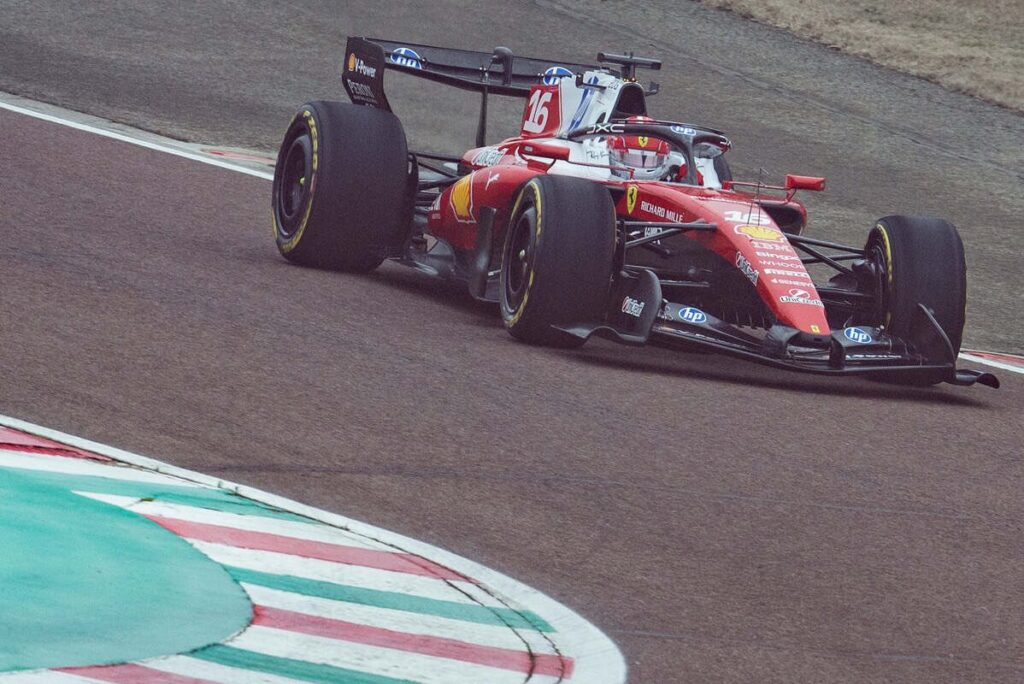
Image: from CL16 inside X @Cl16__FanpageFr
By Open Chronicle Staff March 4, 2026
LONDON — After years of ballooning weights in the hybrid era, Formula 1 is finally reversing the scales. The 2026 technical regulations have established a new minimum weight of 768 kilograms, a significant 30kg reduction from the previous generation, marking the first major weight drop in the sport’s modern history.
The move to 768kg (measured with the driver but without fuel) is a response to long-standing complaints from drivers and engineers that the heavy 2022–2025 cars hampered racing quality and accelerated tire degradation. Achieving this “slimmer” profile required radical design trade-offs across the car’s architecture.
The new Williams FW48 weighs in at just 0.4kg more than the Mercedes W17 and 2.4kg more than the Ferrari SF-26 according to the 2026 F1 car specification sheets from each team 👀
The legal minimum car weight for 2026 is currently 768kg. pic.twitter.com/YzTTQLoZ3W
— Motor Sport magazine (@Motor_Sport) February 3, 2026
Where the 30kg Was Found
-30kg, -10cm width, -20cm wheel base, the 2026 Formula 1 car will be lighter, smaller and more nimble than its predecessor! 🏎️
Go more in depth into the 2026 FIA Formula 1 Technical Regulation on FIA YouTube channel ➡️ https://t.co/v8lwl0CRwN#FIA @F1 pic.twitter.com/QsoVappCAp
— FIA (@fia) June 6, 2024
The reduction wasn’t found in a single place but through a combination of structural and mechanical changes:
-
Power Unit Simplification: The removal of the MGU-H (Motor Generator Unit–Heat) eliminated a complex and heavy component, along with its associated wiring and cooling systems.
-
Smaller Dimensions: The 2026 cars are physically smaller. The wheelbase has been shortened to 3,400mm, and the width narrowed to 1,900mm. Shorter chassis tubs and narrower wings naturally require less carbon fiber, contributing to the weight savings.
-
Thermal Management: With a lower fuel flow limit, the internal combustion engine requires smaller cooling provisions, further trimming the fat from the car’s internal packaging.
Taking a look at how the F1 car minimum weight limit has changed since the early 1990s 👀⚖️
The new 2026 Formula 1 cars will weight 30kg less than in 2025 thanks to the removal of the MGU-H and a slightly reduced car size.
Should the series lower the minimum weight even further… pic.twitter.com/LF9U5viGFk
— Motor Sport magazine (@Motor_Sport) February 3, 2026
The “Hidden” Weight Save
While the minimum weight is down by 30kg, the cars will feel even lighter at the start of a Grand Prix. The maximum fuel allowance has been slashed from 110kg to 70kg. This means a 2026 car will begin a race approximately 70kg lighter than its predecessor, a change expected to drastically improve cornering speeds and reduce the thermal load on Pirelli’s tires in the opening laps.
The Engineering Challenge
Despite the new limit, staying under 768kg is proving difficult for some. Reports from early-season scrutineering suggest teams like Mercedes are hovering slightly above the limit at 772kg. In F1, every gram counts; teams that successfully hit the minimum weight gain the advantage of using “ballast”, moveable weights used to perfect the car’s balance and handling.
As the 2026 season gets underway, the battle to stay light may be just as competitive as the battle on the track, as teams strive to master these new, more agile “monsters” of the tarmac.