
Image: from Sprinter Press X @SprinterPress
MOSCOW – In a rare display of functional diplomacy between the world’s two largest nuclear powers, Russian Deputy Foreign Minister Sergey Ryabkov confirmed on Thursday that Washington provided advance notice of its latest “Minuteman III” intercontinental ballistic missile (ICBM) test.
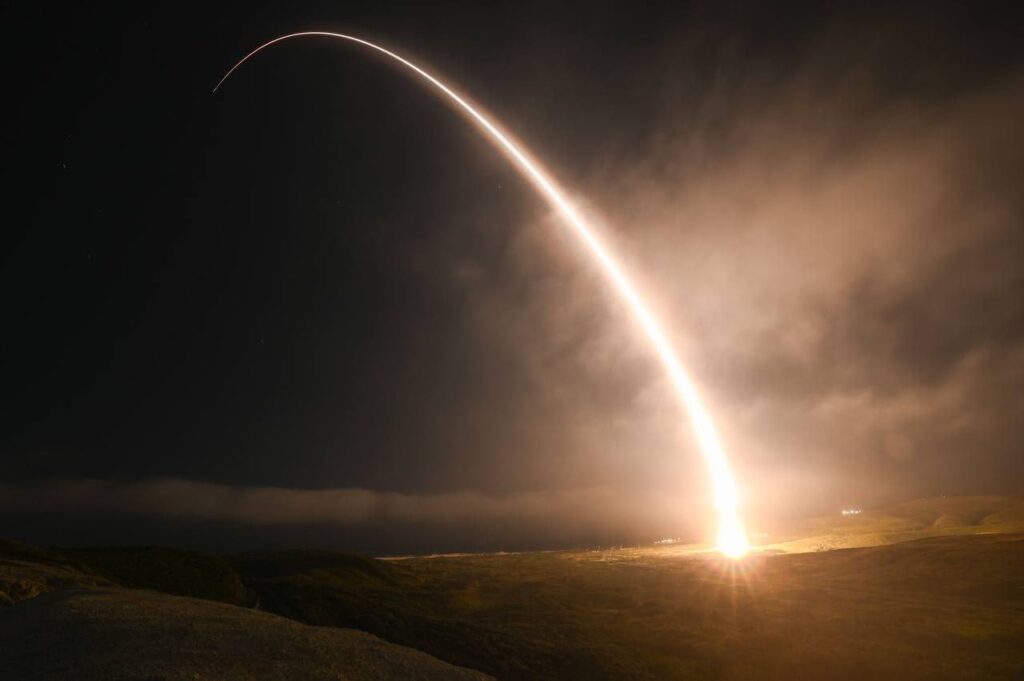
The remarks follow the successful Wednesday launch of the unarmed missile—often referred to in strategic circles as the “Doomsday Missile”—from Vandenberg Space Force Base in California. Despite the heightened global tensions surrounding conflicts in the Middle East and Eastern Europe, the exchange of data suggests that the “red lines” of nuclear protocol remain intact.
The 1988 Accord: A Stabilizing Relic
Ryabkov’s confirmation highlights the enduring relevance of the 1988 Ballistic Missile Launch Notification Agreement. Under this Cold War-era treaty, both the U.S. and Russia are required to notify each other at least 24 hours in advance of any strategic missile launches.
🚨 U.S. TESTS NUCLEAR-CAPABLE MINUTEMAN III MISSILE OFF CALIFORNIA
The United States has conducted a test launch of a Minuteman III intercontinental ballistic missile (ICBM) from the California coast.
The missile was fired from Vandenberg Space Force Base as part of a routine… pic.twitter.com/i0AIF6s22n
— Jim Ferguson (@JimFergusonUK) March 5, 2026
“The 1988 agreement on mutual notification of missile launches is working,” Ryabkov stated in response to press inquiries. “We hope it will continue to play a stabilizing role, adding predictability in this area.”
For a relationship currently defined by suspension of treaties and aggressive rhetoric, the continued adherence to this specific notification system is seen by analysts as a vital “safety valve” to prevent catastrophic miscalculation.
Routine Test, Global Message
The U.S. Air Force Global Strike Command emphasized that the launch was a “planned and routine” activity intended to demonstrate that the United States’ nuclear deterrent is safe, secure, and effective. The Minuteman III was unarmed but equipped with two test reentry vehicles, which traveled approximately 4,200 miles to the Reagan Test Site in the Marshall Islands.
Military officials were quick to distance the exercise from current geopolitical flashpoints. “This test is not the result of current world events,” the Command stated, asserting that such launches occur periodically to ensure the aging fleet—first deployed in the 1970s—remains mission-ready.
The Contrast of “Doomsday” Rhetoric
The term “Doomsday Missile” has seen a resurgence in headlines this week, applied both to the American Minuteman III and the Russian RS-28 Sarmat. While the American test appears to have followed established transparency protocols, the parallel developments in Russian missile testing continue to keep global markets and defense ministries on edge.
As the sunset of the New START treaty looms in 2026, the success of the 1988 notification agreement provides a slim but significant pillar of stability. For now, even as the rhetoric heats up, the technical channels designed to prevent accidental nuclear war appear to be holding.