
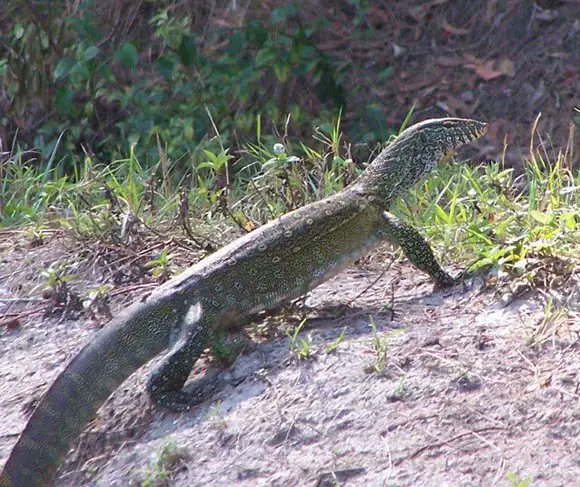
Image: from Mike Buresh X @MikeFirstAlert
INVASIVE ALERT
By Open Chronicle Staff with Agencies | March 11, 2026
WEST PALM BEACH, FL — A six-foot shadow is stretching across Florida’s waterways. The Nile monitor (Varanus niloticus), a semi-aquatic predator with razor-sharp claws and a notoriously aggressive temperament, has officially transitioned from a “pet trade fluke” to a high-priority ecological threat.
As of March 2026, wildlife officials report that sightings have reached into the thousands across the region. Despite intensive trapping efforts, these “crazy” reptiles—as described by University of Florida experts—continue to expand their territory, thriving in the state’s humid canals and mangrove forests.
A BIOLOGICAL “SWISS ARMY KNIFE”
The Nile monitor is uniquely equipped to dominate the Florida landscape. Unlike the herbivorous green iguana, the monitor is a generalist carnivore that eats virtually anything it can overpower.
KEY CHARACTERISTICS & THREATS
| Feature | Impact on the Florida Ecosystem |
| Size & Power | Can grow to 6–7 feet; powerful enough to kill small mammals and pets. |
| Diet | Consumes fish, frogs, snakes, birds, and—critically—the eggs of American crocodiles and sea turtles. |
| Mobility | Equally at home in trees, underground burrows, and both fresh and saltwater. |
| Reproduction | High fecundity: a single female can lay up to 60 eggs in a clutch. |
THE “BURROWING OWL” CRISIS
Biologists are particularly alarmed by the overlap between Nile monitor populations and the state’s largest colonies of burrowing owls. Because monitors are expert diggers, they can easily enter owl burrows to consume both the adults and their offspring, potentially wiping out entire local populations in Lee and Palm Beach counties.
LEGAL STATUS: NO LONGER “JUST A PET”
Since April 2021, the Nile monitor has been on Florida’s Prohibited Nonnative Species List. This status means:
-
Possession is Illegal: Breeding, selling, or transporting them as pets is strictly prohibited.
-
No Permit Required for Removal: On private property, residents can humanely kill Nile monitors with the landowner’s permission.
-
Open Season on Public Lands: They can be captured and killed year-round on 32 FWC-managed lands without a license.
“You cannot wait until an invasive species has demonstrated its impact upon the ecosystem. Because if you do, then it’s too late.”
— Frank Mazzotti, Professor of Wildlife Ecology, University of Florida.
HOW TO IDENTIFY THEM
-
Color: Olive green to black with yellow-ish V-shaped stripes on the neck and head.
-
Tail: Muscular and rudder-like, often 1.5 times the body length.
-
Behavior: Extremely active during the day; will hiss, bite, or whip their tails if cornered. Do not attempt to capture them yourself.
Tags: Nile Monitor, Invasive Species, Florida Wildlife, FWC, Environmental Crisis, South Florida Canals, Predator Alert