
Image: from NΞMICO X @NemicoNetwork
By Open Chronicle Staff Wednesday, March 18, 2026
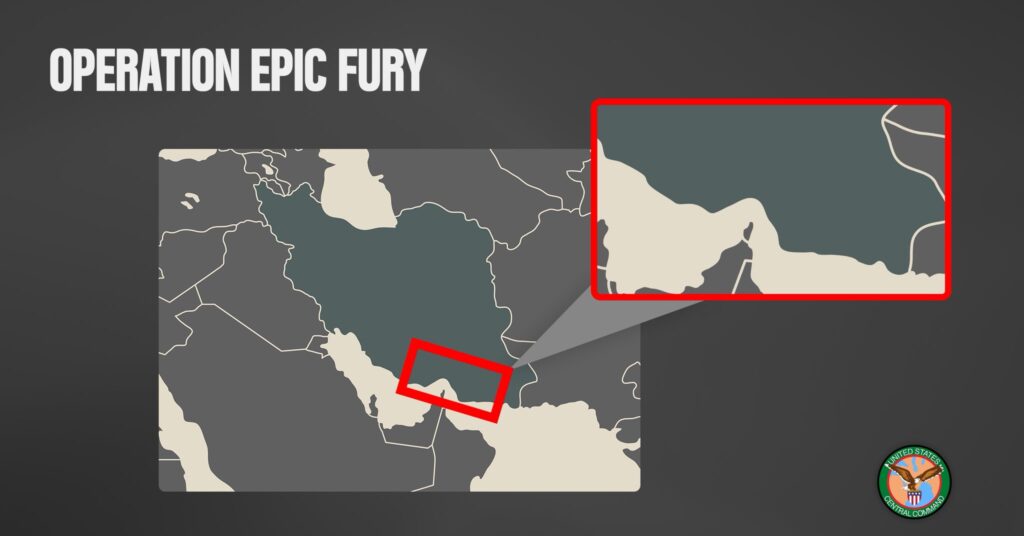
WASHINGTON — In a major escalation of the ongoing conflict in the Middle East, the United States military launched a series of precision airstrikes on Tuesday, deploying massive “bunker buster” bombs against fortified Iranian missile installations near the Strait of Hormuz.
U.S. Central Command (CENTCOM) confirmed the operation in a statement, revealing that American forces employed multiple 5,000-pound GBU-72 deep-penetrator munitions. The strikes targeted hardened underground sites along Iran’s southern coastline that reportedly housed advanced anti-ship cruise missiles.
“The Iranian anti-ship cruise missiles in these sites posed a direct and imminent risk to international shipping in the strait,” CENTCOM stated. “Our forces successfully neutralized these threats to ensure the continued attempt to restore maritime security in the region.”
The Strait of Hormuz, a narrow waterway through which approximately 20 percent of the world’s oil supply flows, has been effectively shuttered since the first week of March. The closure followed the outbreak of hostilities between Iran and a joint U.S.-Israeli front on February 28. The disruption has sent global energy prices soaring and caused chaos in international shipping lanes.
The use of the 5,000-pound munitions, designed to drill through layers of reinforced concrete and earth before detonating, underscores the difficulty of the mission. While these “bunker busters” are significantly more powerful than standard ordnance, military analysts note they are smaller than the 30,000-pound GBU-57 Massive Ordnance Penetrators used by the U.S. against Iranian nuclear facilities last year.
U.S. drops 5,000-pound bunker busters on underground Iranian missile sites along the Hormuz coastline
CENTCOM confirms GBU-72 Advanced Penetrator bombs were used to destroy hardened Iranian anti-ship cruise missile sites threatening commercial shipping in the Strait.
Five… pic.twitter.com/b5Z5hMp4Ar
— Imtiaz Mahmood (@ImtiazMadmood) March 18, 2026
The timing of the strikes follows a period of mounting frustration in Washington. President Donald Trump recently signaled that the U.S. would act unilaterally to reopen the strait after several NATO allies, including France and Germany, expressed reluctance to join a proposed naval escort mission.
“Everyone agrees with us, but they don’t want to help,” the President told reporters earlier this week, calling the allies’ hesitation a “foolish mistake.”
The regional fallout from the strikes was immediate. As U.S. jets hammered the coastline, air defense sirens were heard across the Persian Gulf. The United Arab Emirates reported intercepting several retaliatory drones and ballistic missiles launched from Iranian territory, while in Israel, emergency responders reported two fatalities from a missile strike in central Ramat Gan.
As of Wednesday morning, Iranian officials have not released a detailed assessment of the damage, but Mohammad Bagher Ghalibaf, Iran’s parliament speaker, warned on social media that the status of the Strait of Hormuz “won’t return to its pre-war status.”
The operation, part of the broader “Operation Epic Fury,” signals a determined effort by the U.S. to dismantle Iran’s “chokehold” on the global economy, even as the risk of a wider regional war continues to intensify.