
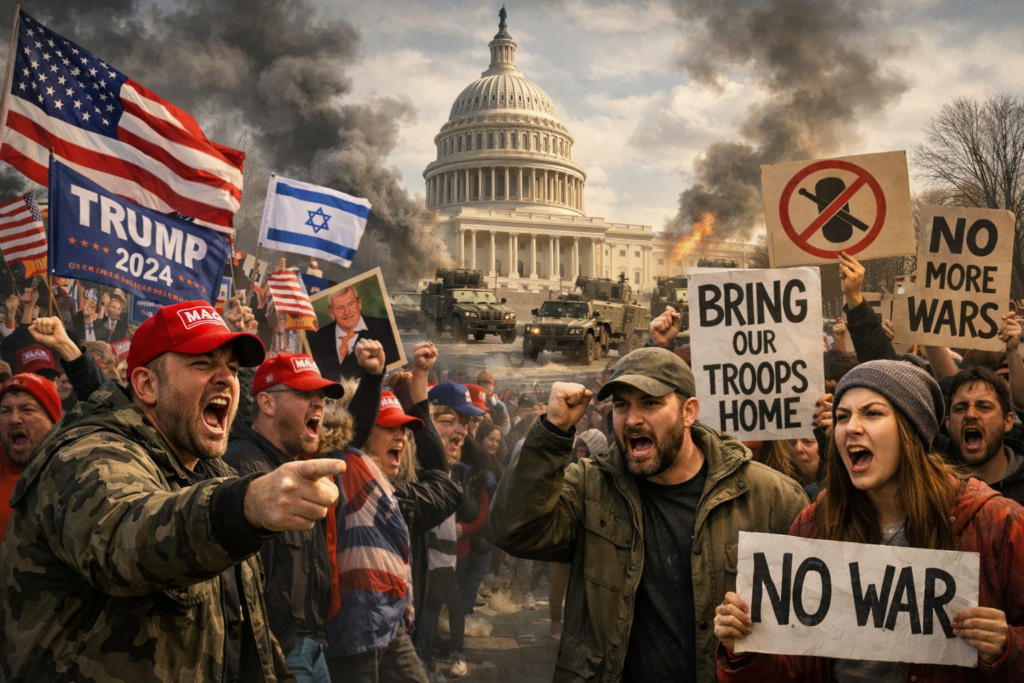
Image Credentials: Image Title: MAGA Divided: Rising Isolationist Backlash Over Trump’s Iran Campaign Source: (sora.openai) Date: March 2026. Attribution: This image was created using AI-generated imagery (sora.openai) and does not depict a real-world scene.
By The Open Chronicle Editorial Staff
WASHINGTON, D.C. — President Donald Trump’s “Operation Epic Fury” is facing a burgeoning rebellion from within his own political base, as new polling and vocal opposition from influential conservative figures suggest a deepening fissure in the MAGA movement over the war in Iran.
While the White House has framed the conflict as a necessary strike to neutralize a global threat, the “America First” coalition that propelled Trump to power is increasingly at odds with the administration’s hawkish trajectory. Recent polls indicate that more than half of Americans now oppose U.S. military action in Iran, a sentiment that is gaining significant traction among the President’s most loyal supporters.
The ‘America First’ Dilemma
The pushback was highlighted in a recent discussion between journalist Liz Landers and Curt Mills, Executive Director of The American Conservative. Mills, a prominent voice in the isolationist wing of the right, has become a leading critic of the administration’s involvement in the Persian Gulf.
“The core promise of the Trump movement was to end ‘forever wars,’ not start the largest one of the century,” Mills suggested during the exchange. He argued that the current campaign risks alienating a base that favors domestic revitalization over Middle Eastern intervention.
Key points of contention within the movement include:
-
Economic Blowback: With gas prices surging following strikes on energy infrastructure, the “pocketbook” voters of the MAGA movement are feeling the immediate sting of a war they didn’t ask for.
-
Mission Creep: What was initially framed as targeted strikes to protect shipping has evolved into a campaign for regime change, a concept many MAGA supporters associate with the “failed neo-con policies” of the past.
-
Resource Allocation: Isolationist critics argue that billions spent on Tomahawk missiles and carrier deployments should instead be directed toward U.S. border security and infrastructure.
A Movement at a Crossroads
The internal friction presents a unique political challenge for the President. While traditional GOP hawks and Israeli allies have lauded the escalation, the vocal dissent from outlets like The American Conservative suggests that Trump is losing the “anti-interventionist” flank of his coalition.
“You can’t be the candidate of ‘America First’ while being the President of ‘Middle East First,'” one GOP strategist noted, speaking on condition of anonymity.
The administration has attempted to counter this narrative by emphasizing the threat to U.S. sailors and the global economy, but as the conflict enters its second month with no clear exit strategy, the “cracks” in the MAGA foundation appear to be widening.
As the 2026 midterms approach, the President may soon find himself forced to choose between the tactical demands of his military advisers and the foundational isolationist instincts of his voters.