
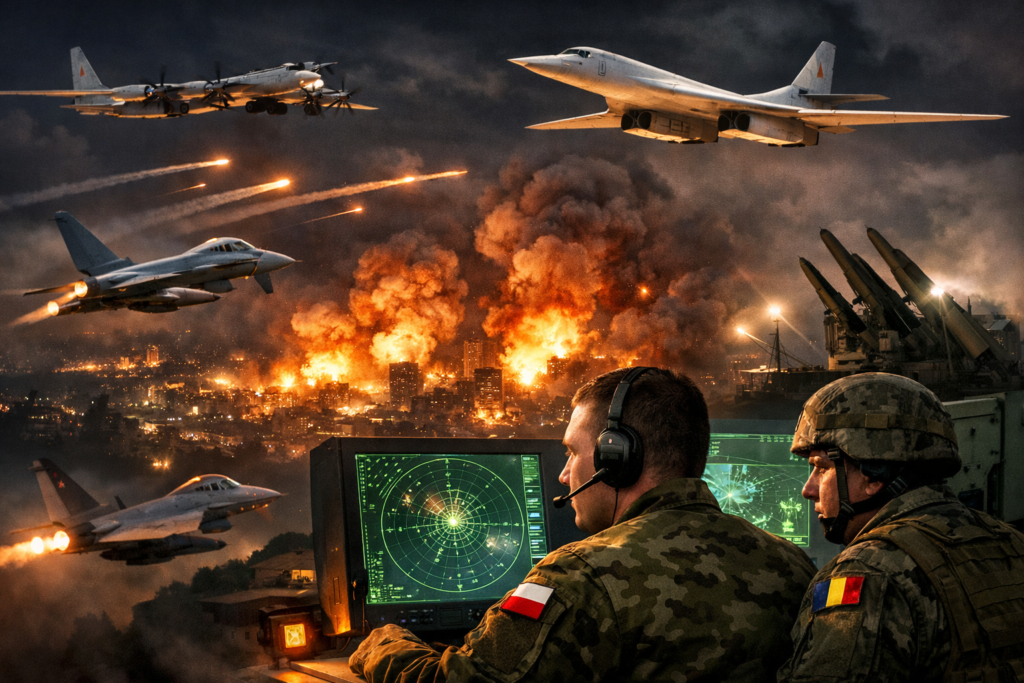
Image Credentials: Image Title: NATO Scrambles Jets as Russia Launches Massive Missile Barrage Source: (sora.openai) Date: March 2026. Attribution: This image was created using AI-generated imagery (sora.openai) and does not depict a real-world scene.
By Harrison Vane with Agencies | Open Chronicle Defense Correspondent
WARSAW — Tensions between the Kremlin and the West reached a fever pitch Tuesday as NATO scrambled fighter jets from multiple allied nations in response to one of Russia’s most aggressive aerial bombardments of the war. The “massive and lethal” overnight strike, which utilized strategic Tu-95MS and Tu-160MS bombers, targeted several Ukrainian cities and prompted Poland and Romania to place their air defenses on the “highest state of readiness.”
The escalation comes as Russia issued a chilling warning to London, threatening “dire consequences” for the UK’s continued support of Ukrainian long-range strikes.
A Shield Over the Frontier
In Warsaw, the Operational Command of the Armed Forces confirmed that both Polish and allied aircraft were launched to secure the nation’s airspace as Russian missiles flew dangerously close to the NATO border. “Due to the activity of long-range Russian air forces conducting strikes on Ukrainian territory, Polish and allied air forces have begun operating in our airspace,” the command stated.
The maneuver involved a mix of multi-role fighters and early-warning AWACS aircraft. Simultaneously, Romania scrambled two F-16 fighters after Russian suicide drones targeted Ukrainian port infrastructure along the Danube River, just meters from the Romanian border.
The Primorsk Setback
The timing of the Russian barrage appears to be a retaliatory strike following a devastating Ukrainian attack 24 hours earlier. Russia’s largest Baltic port, Primorsk, reportedly continues to burn today after a precise strike on its energy export infrastructure.
The incapacitation of Primorsk is a significant strategic blow to the Kremlin’s “shadow fleet,” particularly as global oil markets are already reeling from the ongoing war between the United States, Israel, and Iran. With US oil sanctions being relaxed to stabilize prices during the Middle East crisis, the loss of Primorsk further complicates Russia’s economic survival.
Threats to the UK
Adding to the volatility, Russia’s ambassador to London, Andrey Kelin, targeted the British government for its role in supplying Storm Shadow missiles. Kelin claimed that the use of these precision systems would be “impossible” without British participation and suggested that London was “flexing its muscles” against the backdrop of the American-Israeli strikes in Iran.
“The British have decided to remind everyone of both Ukraine and themselves,” Kelin remarked, warning that the Kremlin views this involvement as a direct provocation that will not go unanswered.
Carnage in the Cities
While NATO jets patrolled the periphery, the situation on the ground in Ukraine remained catastrophic. At least 34 missiles and over 400 drones were reported in the latest wave. Targets included residential buildings in Zaporizhzhia and a hotel in Poltava.
In the western region of Ivano-Frankivsk, close to the Romanian border, early morning explosions rocked the area as Russian cruise missiles targeted energy facilities. Despite Ukrainian air defenses claiming a high intercept rate, the sheer volume of the “saturation attack” has left hundreds of thousands without power as sub-freezing temperatures grip the region.
As the smoke clears over Primorsk and the sirens fall silent in Warsaw, the international community remains on edge. With peace talks in Geneva showing little progress and the war in the Middle East threatening to merge with the European front, the “sensory overload” of 2026 continues to push the world toward an unpredictable precipice.