
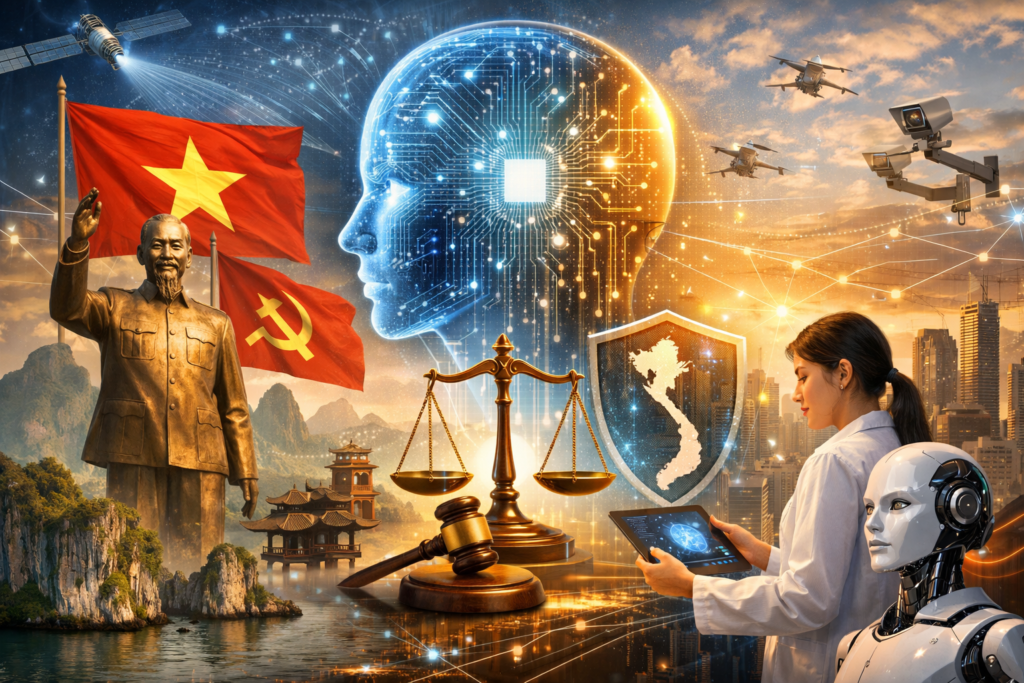
Image Credentials: Image Title: Vietnam Enacts Landmark AI Law to Harness Growth and Enforce Sovereignty Source: (sora.openai) Date: March 2026. Attribution: This image was created using AI-generated imagery (sora.openai) and does not depict a real-world scene.
By Harrison Vane | Open Chronicle Policy Correspondent
HANOI — In a move that positions it as a regional pioneer, Vietnam has officially implemented its first standalone Law on Artificial Intelligence (AI). Effective March 1, 2026, the legislation represents a high-stakes balancing act: an aggressive push to turn AI into “national intellectual infrastructure” while maintaining the Communist Party’s tight grip on digital sovereignty and public order.
The law, comprising 35 articles, arrives as Prime Minister Pham Minh Chinh steers the country toward the “era of national rise”, a strategic vision to transform Vietnam into a high-income developed nation by 2045.
1. The Principle of “Human-in-Command.”
At the heart of the new law is a philosophical anchor: AI must serve as a support tool, not a replacement for human authority. Minister of Science and Technology Nguyen Manh Hung emphasized that final decisions in matters critical to society—such as justice, healthcare, and finance—must remain with humans.
“We cannot let AI freely develop outside of a legal framework,” Hung told the National Assembly. Unlike some Western models that focus on liability for harm, Vietnam’s law establishes a “fault-based” system, where a human decision-maker remains legally accountable for the outcomes of the AI systems they deploy.
2. The Three-Tier Risk Model
Mirroring elements of the EU AI Act, Vietnam has adopted a risk-based classification system. AI products are now categorized into three levels:
-
High-Risk: Systems in sensitive sectors like healthcare, finance, education, and transport. These require mandatory third-party certification, routine audits, and registration in a National AI Database.
-
Medium-Risk: Applications that could “confuse, influence, or manipulate” users (such as most consumer chatbots). These must ensure transparency and provide explanations of their operations upon request.
-
Low-Risk: Most other AI applications are subject to minimal oversight unless violations are detected.
3. Cracking Down on the “Deepfake Dilemma.”
To combat the proliferation of misinformation, the law mandates that all AI-generated audio, video, and images be clearly labeled with machine-readable markers. The “deliberate and systematic” use of deepfakes to simulate real people for deception is strictly prohibited. Under the updated Cybersecurity Law (taking effect in July 2026), users who generate “toxic content” using AI will bear individual responsibility, rather than the platform providers, provided the content was correctly labeled.
4. Sovereignty and Incentives
Vietnam is not just regulating AI; it is funding it. The law establishes a National AI Development Fund and “AI Vouchers” to help startups access high-performance computing and GPU power. The government plans to build a national AI computing center and a controlled open-data system to reduce market entry barriers.
Crucially, the law asserts digital sovereignty by requiring foreign AI providers, like OpenAI, Google, and Meta, to establish a local presence or authorized representative in Vietnam if their systems impact Vietnamese users.
5. Industry Concerns and Grace Periods
While the government hails the law as a “predictable regulatory framework” to boost investor confidence, tech giants and local startups have expressed concern. The Computer and Communications Industry Association (CCIA) warned that stringent registration requirements could “deter market entry.”
To ease the transition, the government has granted grace periods. Most existing systems have until March 2027 to comply, while those in high-stakes sectors like finance and healthcare have an extended window until September 2027.
As Hanoi moves to finalize the “nitty-gritty” of risk criteria and technical standards, the world is watching. Vietnam’s experiment will determine if a nation can truly “manage for development”, fueling a technological revolution while keeping the “brakes” of state control firmly engaged.