
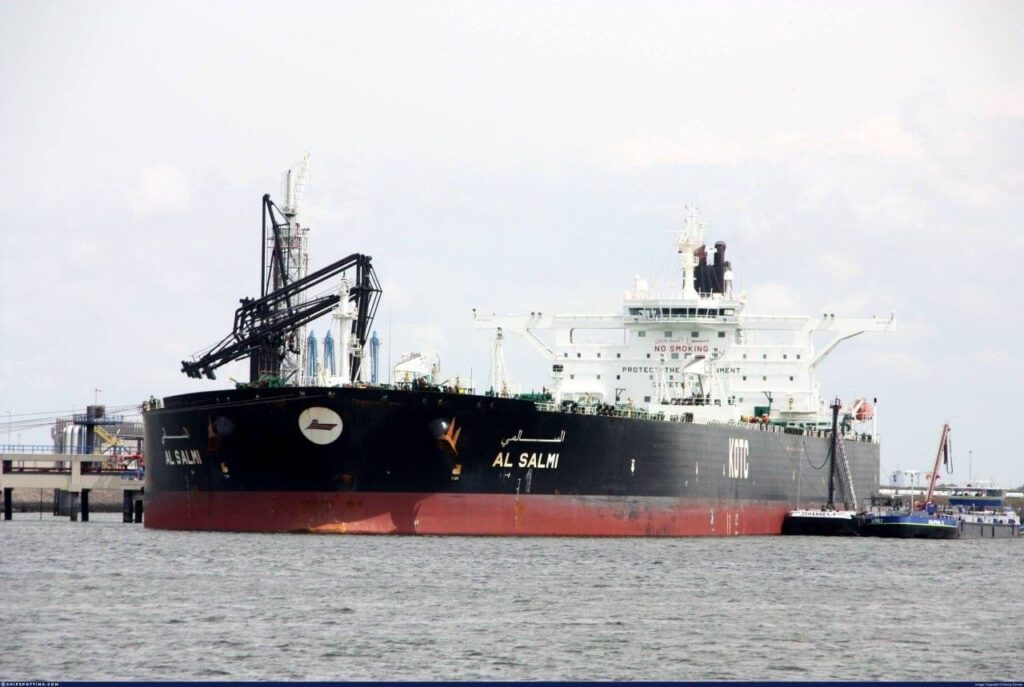
Image: from Strategic Axis: Iran & Israel X @StrategicAxis0
By Open Chronicle Staff with Agencies
DUBAI, United Arab Emirates — A Kuwaiti oil tanker carrying two million barrels of crude erupted in flames early Tuesday after being struck by an apparent drone attack while anchored off the coast of Dubai. The incident marks a dangerous escalation in the five-week-old regional conflict and comes less than 24 hours after U.S. President Donald Trump warned Tehran that he would order the “obliteration” of Iranian civilian and energy infrastructure if a deal to reopen the Strait of Hormuz is not reached.
The Kuwait Petroleum Corporation identified the vessel as the Al-Salmi. Officials confirmed the tanker’s hull sustained significant damage, raising fears of a major oil spill in the Persian Gulf. According to maritime intelligence firm Tanker Trackers, the ship was laden with approximately 1.2 million barrels of Saudi Arabian crude and 800,000 barrels of Kuwaiti crude.
A “Nervous Day” for Global Markets
Dubai’s government media office reported that maritime firefighting teams successfully extinguished the blaze and that all 24 crew members were unharmed. While Iran has not officially responded to the accusations, Kuwaiti authorities explicitly blamed Tehran for the strike, characterizing it as a direct provocation following Washington’s latest ultimatum.
The attack sent shockwaves through energy markets. The price of Brent crude, the global benchmark, spiked to $116 a barrel on Monday following President Trump’s initial threats, then saw renewed volatility on Tuesday morning.
Trump Signals Potential Escalation
The maritime strike follows a series of aggressive social media posts by President Trump. Despite unverified claims of “great progress” in diplomatic talks, the President warned that a failure to reach an agreement would lead to the bombardment of Iranian power plants, oil production facilities, and desalination plants.
“If the negotiations fail… I will order the bombardment of Iranian targets,” the President stated, a move that legal experts and international observers warn could be categorized as a war crime if it targets essential civilian water and power supplies.
Regional Conflict Widens
As the war enters its second month, the scale of destruction continues to climb across multiple fronts:
-
Lebanon: The Israeli military confirmed the destruction of over 100 high-rise buildings in Beirut, alleging they served as Hezbollah command centers. Meanwhile, two UN peacekeepers were killed in southern Lebanon on Monday by an explosion of undetermined origin.
-
Turkey: NATO air defenses intercepted a ballistic missile in Turkish airspace, the fourth such incident since the conflict began.
-
Diplomatic Warfare: In Tehran, a parliamentary committee approved a controversial plan to impose tolls on ships crossing the Strait of Hormuz and officially ban all American and Israeli transit—a move U.S. Secretary of State Marco Rubio dismissed as “illegal” under international maritime law.
The Human Toll
The humanitarian cost of the “Operation Epic Fury” era remains staggering. According to the Human Rights Activists News Agency, at least 1,574 civilians, including 236 children, have been killed in Iran. In Lebanon, the death toll has surpassed 1,230, while 13 American service members have been killed since the start of the campaign.
With thousands more U.S. Marines and Special Operations Forces currently deploying to the Middle East, the prospect of a diplomatic breakthrough remains overshadowed by the smoke rising from the Al-Salmi off the coast of the Emirates.